
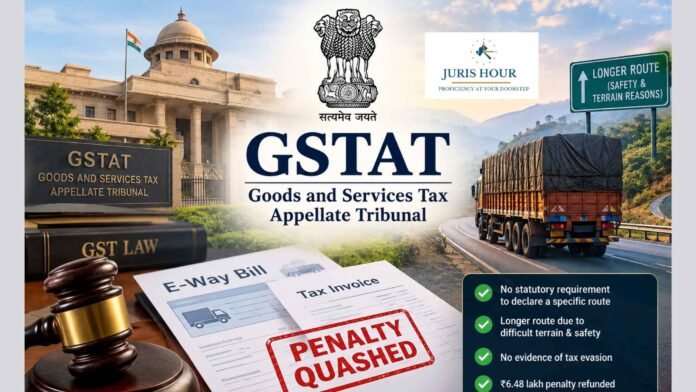
The Goods and Services Tax Appellate Tribunal (GSTAT), Varanasi has held that merely opting for a longer route, particularly for genuine logistical and safety reasons, could not by itself establish an intention to evade tax when the goods were accompanied by valid documents.
The Bench of Narendra Bahadur Yadav (Judicial Member) and Ananjai Kumar Rai, (Technical Member) has noted the distinction between the earlier VAT regime and the present GST framework. Under certain previous State VAT laws, dealers were required to declare the specific transit route. According to the Tribunal’s discussion of the Allahabad High Court ruling, the Central and State GST laws do not impose a corresponding requirement to declare or rigidly follow a designated route.
BUY NOW: E-Way Bill Judgements From 2020–2026 [Includes Orders of GSTAT]
The case arose from the interception of vehicle on 9 June 2025 by the Mobile Squad Unit-I, Naubatpur, Chandauli, at Saiyyadraja in District Chandauli, Uttar Pradesh.
The vehicle was carrying 29 metric tonnes, comprising 145 drums, of Tailor Made Cold Binder. The authorities issued a detention notice in MOV-07, citing an alleged discrepancy of around 150 km from the destination and the vehicle’s entry into Uttar Pradesh.
According to the department, the unusual route created a suspicion that the taxable goods might have been diverted for delivery to some other recipient within Uttar Pradesh.
The assessee explained before the adjudicating authority that the longer route had been deliberately chosen because the shorter route passed through a hilly and difficult terrain, creating difficulties in operating a heavily loaded commercial vehicle.
The company also cited safety considerations as the reason for avoiding the shorter route. The Tribunal noted that this explanation had not been effectively rebutted by the authorities.
However, the Proper Officer rejected the explanation and, by order dated 16 June 2025, imposed a penalty of ₹6,48,366 under IGST. The appellant deposited the amount under protest so that the vehicle and goods could be released for safe delivery to the consignee.
The company subsequently challenged the order before the first appellate authority. The Additional Commissioner, Grade-II (Appeal-I), State Tax, Varanasi, dismissed the appeal on 31 December 2025, leading to the proceedings before GSTAT.
The Tribunal identified the central issue as whether transportation of the goods through Uttar Pradesh by taking a route substantially longer than the shorter available route could be treated as transportation undertaken with an intention to evade tax.
The shorter route was stated to be approximately 70 km, whereas the vehicle travelled more than 200 km in excess. The department relied upon the route deviation to raise suspicion regarding possible tax evasion.
The Tribunal, however, noted that the department had not identified any destination in Uttar Pradesh where the appellant allegedly intended to consign the goods.
A significant observation made by GSTAT was that the GST Act and Rules do not contain a provision requiring a taxpayer to declare a specific route for transportation of goods.
The appellant had argued that the documents, including the E-Way Bill, contained the relevant place of supply and delivery details but did not prescribe a mandatory route map. The Tribunal accepted the legal significance of this distinction.
It observed that where the statute itself does not require declaration of a particular transportation route, merely taking a longer route cannot automatically be treated as a violation of GST provisions.
The Tribunal further observed that opting for a longer route to avoid difficult terrain, particularly when transporting heavily loaded commercial vehicles, could constitute a genuine logistical and safety consideration.
The appellant had contended that the authorities had invoked Section 129 of the GST Act merely on the basis of suspicion and conjecture, without material demonstrating an intention to evade tax.
The Tribunal agreed with the substance of this contention. It found that the goods were being transported with valid documents and that the department had failed to bring material on record establishing that the taxpayer actually intended to evade tax.
The Tribunal specifically recorded that the explanation regarding the difficult terrain on the shorter route remained unrebutted. It therefore found the explanation for taking the longer route to be plausible and reasonable.
The Tribunal emphasized that the vehicle was accompanied by valid documents, and no statutory requirement relating to the route had been violated.
It found that the diversion from the shorter route occurred because of the difficult terrain and that there was nothing on record establishing that the taxpayer actually intended to evade tax.
The Tribunal concluded that transportation of the goods with valid documents, coupled with the absence of evidence establishing mala fide intention, could not justify the penalty merely because a longer route had been adopted.
GSTAT allowed the appeal and quashed both the original adjudication order dated 16 June 2025 and the first appellate order dated 31 December 2025.
The Tribunal further directed that the ₹6,48,366 deposited under protest as penalty be refunded to Bitchem Asphalt Technologies Limited, in accordance with law and rules.
Membership Required to Access Case Details & Order Copy
To view the complete Case Details and Download Order Copy, you must have an active membership. Please subscribe to continue.

