
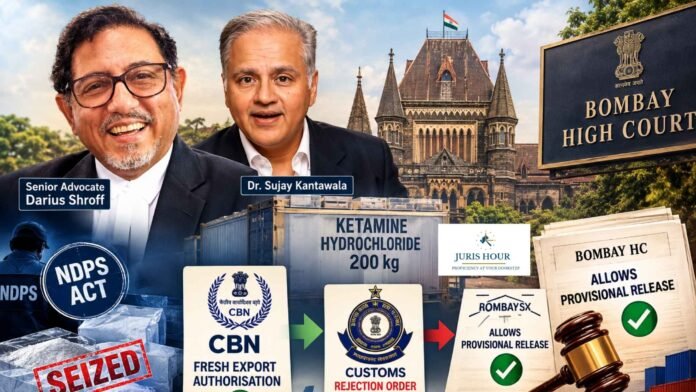
The Bombay High Court has directed the provisional release of 200 kg of Ketamine Hydrochloride seized by Customs authorities after the exporter’s original Export Authorisation had expired, holding that the subsequent issuance of a fresh authorisation by the Central Bureau of Narcotics (CBN) could not be disregarded in the peculiar facts of the case.
The bench of Justice M. S. Karnik and Justice Sandesh D. Patil quashed the Assistant Commissioner of Customs (Export), ACC, Mumbai-III’s order dated August 10, 2026, which had rejected the exporter’s request for provisional release.
Buy Now: 100+ Judgements On Customs Classification
The bench permitted release subject to the petitioner depositing Rs. 72 lakh with Customs within one week.
The petitioner challenged the rejection of provisional release of its consignment of Ketamine Hydrochloride. The principal controversy before the Court was whether a fresh Export Authorisation issued by the CBN after seizure of the goods could be taken into consideration for permitting provisional release, particularly when the Customs authorities had seized the goods under the Narcotic Drugs and Psychotropic Substances Act, 1985 (NDPS Act).
The case arose from an export transaction involving 200 kg of Ketamine Hydrochloride. According to the judgment, an overseas buyer had placed a purchase order with the petitioner on January 8, 2026. The petitioner subsequently received an import certificate issued by the Ministry of Food and Drug Safety, Republic of Korea, valid until May 31, 2026.
The petitioner applied to the Central Bureau of Narcotics on April 2, 2026 for a No Objection Certificate for export of the goods to Korea. The CBN thereafter issued an Export Authorisation on April 16, 2026, which was also valid until May 31, 2026.
The petitioner submitted pre-shipment documents to the overseas buyer on May 20 and May 22. On May 28, the Customs Broker filed the checklist for the shipping bill on the E-Sanchit portal.
However, the overseas buyer subsequently raised a query concerning the shipment batch. The petitioner arranged a fresh batch and submitted revised pre-shipment documents on June 1, 2026, which were approved on the same day. By that time, however, the original Import Certificate and Export Authorisation had expired on May 31, 2026.
The petitioner maintained that the shipping bill was filed on June 2 due to a bonafide and inadvertent human oversight following the change in shipment batch and the buyer’s approval of the revised documents on June 1.
The goods were dispatched to the Air Cargo Complex, Sahar, on June 4, 2026. On June 5, Customs raised a query on the ICEGATE portal concerning the expired Export Authorisation and called upon the petitioner to submit a fresh authorisation. The petitioner explained the circumstances and requested that the consignment be returned or retained securely pending procurement of fresh authorisations.
The matter subsequently escalated when Customs placed the consignment on hold for examination scheduled for July 2, 2026.
On the same day, the overseas buyer furnished a fresh Import Certificate valid until November 30, 2026. The petitioner also applied to the CBN for cancellation of the earlier Export Authorisation and issuance of a fresh authorisation.
During the examination on July 2, the petitioner’s General Manager (Sales & Marketing) and Customs Broker were issued summons under Section 67 of the NDPS Act. Their statements were recorded and they were subsequently arrested on the allegation of attempting to export Ketamine Hydrochloride without a valid Export Authorisation.
The petitioner later received a fresh Export Authorisation from the CBN on July 10, 2026, permitting export of the goods until October 9, 2026. The petitioner thereafter requested Customs authorities to release the consignment in view of the fresh authorisation.
When no release was granted, the petitioner approached the Bombay High Court.
During the earlier proceedings, the respondents placed before the High Court a clarification dated July 30, 2026 issued by the CBN.
The CBN stated that the earlier Export Authorisation, which was valid until May 31, 2026, had been cancelled and that a fresh Export Authorisation dated July 9, 2026 had been issued against a fresh Import Certificate for the same purchase order. The CBN stated that the fresh authorisation was valid and suggested that Customs authorities could take an appropriate view in relation to it.
Despite this, the Assistant Commissioner of Customs rejected the request for provisional release on August 10, 2026.
The rejection order proceeded on the basis that the goods had been seized under Section 42 of the NDPS Act and could not be provisionally released under Section 110A of the Customs Act on the basis of an Export Authorisation issued subsequently.
Senior Advocate Darius Shroff along with Dr. Sujay Kantawala, on behalf of the Petitioner contended that so far as the criminal proceedings under the NDPS Act is concerned, the petitioner will resort to appropriate remedies available in law. It is further submitted that the value of the goods is Rs.72 lakhs and the petitioner is willing to deposit the amount of Rs.72 lakhs with the Customs Department subject to further orders that may be passed as a result of the outcome of the adjudication proceedings, to show their bonafides.
Before the High Court, the Customs authorities argued that the writ petition was an attempt to circumvent the statutory mechanism under the NDPS Act and the Bharatiya Nagarik Suraksha Sanhita, 2023.
The respondents contended that the seizure had been effected under statutory powers under the NDPS Act after detection of an alleged attempted export of Ketamine Hydrochloride, which is a notified psychotropic substance, on the basis of an Export Authorisation that had already expired before the shipping bill was filed.
The respondents further argued that questions concerning the legality of the seizure, applicability of penal provisions and criminal liability were already under investigation and proceedings before the competent Special NDPS Court/Magistrate.
They also contended that the case involved disputed questions of fact, including the petitioner’s knowledge regarding expiry of the authorisation, the circumstances in which the shipping bill was filed and the role of various persons involved in the export transaction. According to the respondents, such issues required appreciation of evidence and could not appropriately be decided in proceedings under Article 226 of the Constitution.
The Division Bench noted that, ordinarily, it would have been reluctant to entertain a civil writ petition concerning goods seized under Section 42 of the NDPS Act.
The Court observed that, at first blush, the respondents’ contention that the petitioner should pursue remedies before the appropriate criminal forum appeared persuasive, particularly because the seizure itself had been made under the NDPS Act.
However, the Bench found that the peculiar facts of the case warranted interference.
The Court considered the chronology of the authorisations, the buyer’s request for a change in the shipment batch, the subsequent filing of the shipping bill, the seizure and, importantly, the issuance of a fresh Export Authorisation by the competent authority.
The High Court placed considerable emphasis on the factual circumstances surrounding the expiry of the original authorisation.
The Court noted that the petitioner had earlier been authorised to export the goods and had been exporting such goods with valid authorisations. The original batch had to be replaced because of the overseas buyer’s query, and revised documents were submitted on June 1, 2026.
By the time the fresh batch was submitted for export, the earlier authorisation had expired. Subsequently, however, the CBN granted a fresh Export Authorisation upon an application made by the petitioner.
The Bench observed that the goods had not actually been exported during the intervening period because they remained in Customs custody.
Significantly, the Court held that, on the facts before it, this was not a case where the petitioner’s intention was to export the prohibited goods without authorisation. The Court noted the petitioner’s previous valid authorisation, the change in shipment batch and the subsequent grant of fresh authorisation by the CBN.
The Court therefore concluded that the seizure should not, in the peculiar circumstances, deprive the petitioner of the benefit of the Export Authorisation subsequently issued by the competent authority.
One of the significant aspects of the judgment was the High Court’s reliance on the principle that different departments of the Union Government cannot take contradictory positions concerning the same transaction.
The Court referred to the Supreme Court’s decision in Central Warehousing Corporation v. Adani Ports and Special Economic Zone Ltd., where the Supreme Court had emphasised that the Union of India should not speak in two contradictory voices and that conflicting positions adopted by different departments should be resolved at the governmental level.
Applying that principle to the present case, the Bombay High Court found the approach of the Assistant Commissioner of Customs erroneous.
The Court noted that the CBN had issued the fresh Export Authorisation for the very goods that had been seized. According to the Bench, the delay in obtaining the fresh authorisation, in the peculiar facts, had to be regarded as technical.
The Court consequently held that provisional release could be permitted subject to appropriate conditions.
The High Court quashed and set aside the August 10, 2026 rejection order.
The Court allowed the petitioner’s application for provisional release on the condition that it deposit Rs.72 lakh with the Assistant Commissioner of Customs, Export, ACC, Mumbai-III, within one week from the date of the order.
The Court, however, made it clear that the order did not bring the adjudication or criminal proceedings to an end.
The respondents were expressly permitted to continue with adjudication and criminal proceedings in accordance with law, subject to the petitioner pursuing appropriate remedies and orders passed therein. The concerned officer was also left free to follow the procedure under Section 52A of the NDPS Act.
The Bench also considered the petitioner’s substantial export history involving Ketamine Hydrochloride.
According to the submissions recorded in the judgment, between July 1, 2025 and September 6, 2025, the petitioner had exported approximately 67,000 kg of the goods under 39 invoices. The petitioner stated that its annual Ketamine shipments were approximately 300 invoices per year and that its annual foreign exchange earnings from Ketamine Hydrochloride were around Rs.400 crore. It projected foreign exchange earnings of approximately Rs.2,000 crore over the following five years.
The Court’s order thus provides provisional relief to the exporter while preserving the authorities’ power to continue the underlying adjudicatory and criminal proceedings.
Membership Required to Access Case Details & Order Copy
To view the complete Case Details and Download Order Copy, you must have an active membership. Please subscribe to continue.
Read More: JURISHOUR | TAX LAW DAILY BULLETIN : 22 SEPTEMBER, 2026

