
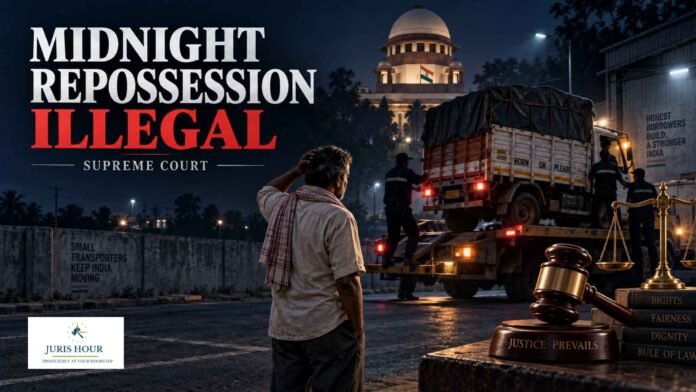
The Supreme Court has strongly deprecated the forcible repossession of a borrower’s truck by recovery agents in the middle of the night without prior notice, holding that a financier’s contractual right to recover a secured debt cannot be exercised through force, stealth or arbitrary means.
The bench of Justice Pamidighantam Sri Narasimha and Justice Alok Aradhe held that the repossession and subsequent sale of the truck by Cholamandalam Investment and Finance Company Limited violated the borrower’s fundamental rights under Articles 14 and 21 of the Constitution.
Buy Now: E-Magzine On Landmark Supreme Court Judgements Under Limitation Act Till 2025 : PART-1
The Bench awarded ₹10 lakh as compensation to the borrower for mental agony and loss of livelihood. It also directed the finance company to refund the truck’s ₹4.50 lakh sale price with 6% annual interest and close both loan accounts.
The appeal arose from an April 4, 2025 order of the Allahabad High Court dismissing Sharma’s writ petition. The High Court had noted that the truck was already sold in August 2023 and held that the borrower had approached the court belatedly.
Setting aside that order, the Supreme Court held that the High Court failed to examine whether the financier had followed the mandatory contractual and regulatory safeguards before repossessing the vehicle.
The Court observed that the case concerned the balance between a lender’s right to recover a secured debt and the borrower’s right to have such recovery undertaken within the bounds of law.
“A loan may create a debt, and a debt may confer upon the financier a right to recover what is due; but the manner in which that right is exercised is not without significance,” the Court remarked.
Sharma obtained a commercial vehicle loan from the finance company on March 25, 2019, for purchasing a Tata SFC 407 truck bearing registration number UP-16-GT-0449.
Out of the sanctioned loan amount of approximately ₹10.40 lakh, ₹9.36 lakh was disbursed. The amount was repayable in 75 monthly instalments and was secured through hypothecation of the truck. A supplementary loan of approximately ₹1.04 lakh was extended on June 12, 2021.
The borrower subsequently defaulted on the repayment obligations. A recall-cum-demand notice was issued on January 17, 2022.
The company earlier repossessed the vehicle and issued a pre-sale letter on June 13, 2022. After the borrower paid ₹86,726 and assured the company that he would regularise the account, the vehicle was released.
Further defaults allegedly resulted in notices being issued on July 7 and December 22, 2022, asking the borrower to clear the dues or surrender the hypothecated vehicle.
According to the borrower, the truck was parked at a consignor’s godown in Ayodhya after completing the delivery of goods. At approximately 1 am on April 9, 2023, four unidentified persons allegedly broke the truck’s steering lock and drove it away.
The borrower maintained that the vehicle was taken without any prior notice and that the incident was captured under CCTV surveillance. He lodged a lost article report and an electronic FIR on the same day.
On September 30, 2023, he received a legal notice from the company disclosing that it had repossessed the vehicle and sold it on August 31, 2023.
The company stated that ₹5.71 lakh was outstanding as of the date of sale and that ₹4.50 lakh had been recovered from the sale of the truck. It consequently demanded an additional ₹1.25 lakh from the borrower.
The Supreme Court acknowledged that where a financing agreement confers the right to repossess a vehicle, there is ordinarily no legal impediment to exercising that contractual right unless the agreement is unconscionable or opposed to public policy.
Such self-help repossession clauses, the Court explained, enable financial institutions to provide credit against the asset being financed, including to small transporters who may not possess conventional collateral.
However, because this remedy operates outside the supervision of courts and tribunals at the initial stage, the power must be construed and exercised with “great circumspection”.
The Court cautioned that an unchecked repossession clause could become an “unbridled licence” to seize property by stealth, force or in the dead of night, converting a mechanism intended to promote financial inclusion into an “instrument of oppression” against the very borrowers it was meant to serve.
The Bench referred to the RBI’s Fair Practices Code and the Supreme Court’s earlier ruling in ICICI Bank Ltd. v. Prakash Kaur, which held that recovery of loans and seizure of vehicles must be conducted through lawful means.
It reiterated that banks and financial institutions cannot employ “goondas” or recovery agents to take possession of vehicles by force.
The Court summarised the safeguards governing loan recovery and repossession, observing that:
- Lenders cannot harass borrowers by repeatedly contacting them at odd hours or using muscle power.
- A vehicle can be seized only through lawful means.
- Banks and financial institutions must conduct due diligence before engaging recovery agents.
- Repossession clauses must comply with the Indian Contract Act, 1872.
- Recovery agents must strictly follow the applicable RBI guidelines.
- A repossession clause must clearly prescribe the notice period, circumstances for waiver of notice, repossession procedure, opportunity to repay, restoration procedure and method of sale or auction.
- Recovery should ordinarily occur at a centrally designated place, with visits to a borrower’s residence or workplace permitted only in prescribed circumstances.
Article 11 of the loan agreement allowed the company to repossess the asset upon default. It provided for a seven-day notice before repossession and another seven-day notice after repossession, giving the borrower a final opportunity to clear the dues.
However, the agreement also permitted the company to waive the notices at its discretion if it believed that issuing them could jeopardise the asset or the company’s interest.
The Supreme Court found that Article 11 placed the borrower entirely at the mercy of the financier’s unilateral discretion regarding whether notice would be given and how and when the vehicle would be sold.
The Court held that the clause was inconsistent with both the RBI guidelines and the Indian Contract Act.
It identified several deficiencies in the clause. The stipulation that the borrower’s rights over the asset would automatically terminate without notice upon default directly conflicted with the requirement of prior notice. Similarly, the authority given to recovery agents to enter “any place or places” in search of the vehicle offended the requirement of a fair and lawful repossession procedure.
The agreement also failed to provide a definite procedure for repossession or sale and left these matters completely to the company’s discretion.
According to the Court, a contractual term allowing one party to unilaterally dispense with safeguards intended to protect the other party cannot satisfy the standards of fairness required of a legally valid repossession clause.
Turning to the facts, the Supreme Court found that no seven-day notice had been issued before the vehicle was repossessed.
Since the company’s right to repossess the truck was conditional upon issuing such notice, the Bench held that the right never accrued to the company in the first place.
The borrower’s specific assertion that the vehicle was taken at 1 am after the steering lock was broken remained unrebutted. The Court said this was not a peaceful mode of repossession and bore every mark of the “goondaism” previously condemned by the Supreme Court and the RBI.
The possession memorandum also did not contain the borrower’s signature, reinforcing the conclusion that the recovery agents had taken the truck without following due process.
The Supreme Court also rejected the High Court’s conclusion that the writ petition should be dismissed because of delay.
It noted that the borrower lodged an FIR on the very day the truck was taken and subsequently filed an application under Section 156(3) of the Code of Criminal Procedure in the bona fide belief that his vehicle had been stolen.
Significantly, the borrower continued to receive traffic challans in January 2024, November 2024 and February 2025, even though the finance company claimed to have sold the truck in August 2023.
The Court said this circumstance required an explanation and should have been considered by the High Court. The petition could not have been dismissed solely on the ground of delay without examining the merits, particularly when the company had not demonstrated any resulting prejudice.
The Court observed that the borrower was a person of modest means and depended entirely on the truck for his livelihood through the transportation business.
By repossessing and selling the truck through an arbitrary and unfair process, the company deprived him of his livelihood. The action, therefore, violated the guarantees of equality and protection of life and livelihood under Articles 14 and 21.
The Bench observed that when a financier breaks open a lock in the dead of night, repossesses a vehicle without notice or a signed memorandum and later treats the borrower merely as a source of residual liability, it forfeits the protection otherwise available under the contract and the law.
Although the Court disapproved of both the repossession and the subsequent sale, it declined to set aside the sale because the vehicle had already been sold in August 2023.
The Court expressed concern that the RBI’s guidelines, master circulars and clarifications governing recovery practices had remained only “on paper”.
It directed the RBI to take effective steps to secure genuine compliance by NBFCs and scheduled commercial banks so that incidents involving dispossession of citizens’ livelihood without notice and due process do not recur.
The Supreme Court Registry was directed to forward a copy of the judgment to the RBI.
Membership Required to Access Case Details & Order Copy
To view the complete Case Details and Download Order Copy, you must have an active membership. Please subscribe to continue.
Read More: AO Can’t Reopen Income-Tax Settlement Commission’s Final Order Through Reassessment: Supreme Court

