
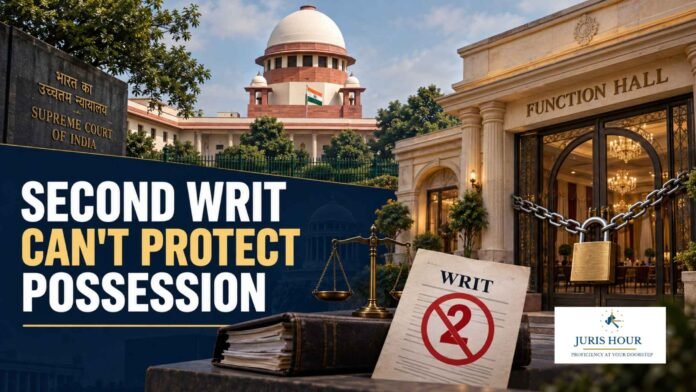
The Supreme Court has ruled that lessees claiming possession through a property owner cannot institute a fresh writ petition to secure protection when the owner’s earlier challenge against the State’s action has already been withdrawn with liberty to approach the civil court.
The Bench of Justice Prashant Kumar Mishra and Justice Shree Chandrashekhar set aside orders of the Telangana High Court that had protected the lessees of a Hyderabad property from dispossession and directed the revenue authorities to unlock the premises.
The Court observed that the lessees appeared to have approached the High Court to obtain interim protection that the property-owning trust could otherwise have sought only from the competent civil court.
“It appears, since the Trust could not have filed a writ petition, the lessees came forward for preferring a fresh set of writ petition only to secure an interim order which otherwise could have been considered only by the civil court,” the Supreme Court said.
The dispute concerned land measuring 4,678 square metres situated in T.S. No. 19, Ward No. 54, Block-L of Gaganmahal Village in Hyderabad.
M/s Kishan Chand Foundation Trust claimed ownership of the land on the basis of a registered sale deed executed in its favour in 1968.
In June 1997, the Mandal Revenue Officer, Himayathnagar, issued a notice to the Trust under Section 7 of the Andhra Pradesh Land Encroachment Act, 1905. The Trust was called upon to explain why it should not be evicted from the land.
The State authorities maintained that the property was government land, while the Trust asserted private ownership.
The Trust instituted a civil suit in 1997. However, the suit was dismissed in July 2001 on the ground of pecuniary jurisdiction. An appeal filed against that decision was subsequently dismissed for non-prosecution in August 2002.
Thereafter, the authorities initiated proceedings under Section 6 of the 1905 Act and directed the Trust to hand over possession of the property.
The Trust challenged the proceedings before the High Court. In April 2005, a Single Judge allowed the writ petition and quashed both the notice issued under Section 7 and the order prepared under Section 6 of the Land Encroachment Act.
The State challenged this decision before a Division Bench.
In September 2022, the Division Bench allowed the State’s writ appeal and set aside the Single Judge’s order. It held that a court exercising jurisdiction under Article 226 of the Constitution was not the appropriate forum to declare possession or title where serious factual disputes existed.
The Division Bench also noted that the legislation provided a statutory appeal against an order passed under Section 6 and a further remedy of revision.
The Trust approached the Supreme Court against the Division Bench’s September 2022 judgment.
Initially, the Supreme Court directed the parties to maintain the status quo regarding the property. However, on September 9, 2025, the Trust was permitted to withdraw its special leave petition with liberty to institute a fresh civil suit.
Significantly, the Supreme Court did not extend any interim protection in favour of the Trust while permitting the withdrawal.
Soon afterward, M.A. Garden Function Hall, represented by Mohammed Omer and others claiming to be lessees of the Trust, approached the Telangana High Court. They challenged the State authorities’ action of taking possession of the premises.
On September 12, 2025, a Single Judge disposed of the lessees’ writ petitions and granted the Trust ten days to institute a fresh civil suit in accordance with the liberty granted by the Supreme Court.
During that period, the State authorities were directed not to dispossess the petitioners. The Mandal Revenue Officer was also directed to unlock the M.A. Garden Function Hall.
The Single Judge allowed the Trust to approach the civil court and seek appropriate interim relief. If the Trust failed to secure an order within the stipulated period, the authorities were permitted to take action in accordance with law.
The State challenged this order, but a Division Bench dismissed its writ appeals on December 30, 2025, thereby affirming the protection granted by the Single Judge.
The State of Telangana then approached the Supreme Court.
Allowing the State’s appeals, the Supreme Court held that once the Trust had withdrawn its challenge against the earlier Division Bench judgment, it was not open to the lessees to initiate another round of writ proceedings.
The Court emphasised that the lessees were claiming possession only through the Trust. They could not acquire a better right to invoke writ jurisdiction than the Trust from which their claim arose.
The earlier Division Bench had already held that questions regarding possession and title could not be decided in proceedings under Article 226 because they involved serious factual disputes.
The Supreme Court said that the Single Judge and the subsequent Division Bench could not have exercised writ jurisdiction contrary to the earlier orders passed by the High Court and the Supreme Court.
“Once the High Court has already recorded a finding in Writ Appeal No.1243 of 2005 that it was not open for the writ court to record finding of possession, a second writ petition filed by the lessees only for protection of possession ought not to have been entertained,” the Bench observed.
The Court also took note of the sequence of events. The Trust’s special leave petition was withdrawn on September 9, 2025, and the fresh writ petitions were instituted by the lessees on or after September 11, 2025.
According to the Supreme Court, this indicated that the lessees had approached the High Court to obtain an interim order that was required to be considered by the civil court.
The Supreme Court was informed that a fresh civil suit had been instituted on September 16, 2025. However, the trial court did not grant any interim order within the ten-day period specified by the High Court.
The Bench consequently observed that the liberty granted by the Single Judge had not been effectively availed of within the prescribed period.
The Supreme Court set aside the Single Judge’s order dated September 12, 2025, as well as the Division Bench’s judgment dated December 30, 2025.
The Court expressly declined to interfere with the State authorities’ action of locking the premises.
At the same time, it clarified that the civil suit filed in relation to the property was already pending before the trial court and must be decided independently on its own merits.
Membership Required to Access Case Details & Order Copy
To view the complete Case Details and Download Order Copy, you must have an active membership. Please subscribe to continue.

