
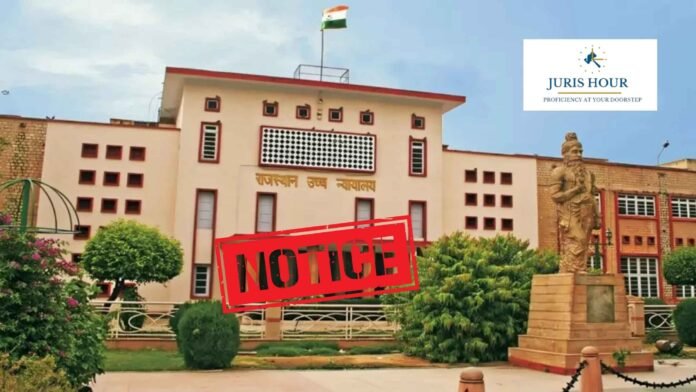
The Rajasthan High Court has quashed a GST show-cause notice, adjudication order and consequential recovery proceedings involving a demand of approximately ₹11.77 crore, holding that statutory documents bearing neither a physical nor digital signature have no legal existence.
The Bench of Justice Arun Monga and Justice Bhuwan Goyal ruled that merely uploading a document on the GST portal does not satisfy the mandatory authentication requirement prescribed under Rule 26(3) of the Central Goods and Services Tax Rules, 2017.
Buy Now: E-Magazine: 1000+ Landmark GST Judgments (2017–2026)
The Court observed that logging into the departmental portal using a digital signature authenticates the officer’s access to the system, but it does not authenticate the contents of the notice or adjudication order.
“A login authenticates access. A signature authenticates content,” the Bench remarked while rejecting the Revenue’s argument that uploading the documents through the Back Office Web GST Portal was sufficient to establish their authenticity.
The petitioner/assessee is engaged in the development and construction of commercial, residential, township and retail real estate projects.
The dispute originated from scrutiny proceedings initiated through Form GST ASMT-10 dated November 29, 2022. The petitioner submitted its response in Form GST ASMT-11 on April 25, 2023.
Thereafter, the department issued a show-cause notice under Section 73 of the CGST Act on September 23, 2023. An Order-in-Original was subsequently passed on December 19, 2023.
The show-cause notice, Form GST DRC-01, Order-in-Original and Form GST DRC-07 were uploaded on the GST portal. However, according to the petitioner, none of these documents contained either a physical signature or a digital signature.
A demand of ₹11,76,97,600 was reflected on the GST portal based on the adjudication order.
The department subsequently initiated recovery proceedings and issued a notice under Section 79 in Form GST DRC-13 on March 27, 2024 to the petitioner’s bank. The bank received the notice on April 8, 2024, following which the petitioner’s bank account was frozen and its banking transactions were disrupted.
The petitioner claimed that it became aware of the demand and adjudication proceedings only after discovering that its bank account had been attached.
The petitioner argued that the entire demand rested on documents that were non-est in the eyes of law.
It was contended that an unsigned show-cause notice could not form the basis of valid adjudication proceedings. Similarly, an adjudication order lacking a physical or digital signature could not support recovery action or attachment of a bank account.
The petitioner maintained that the absence of authentication deprived the documents of legal existence. Consequently, the proceedings were void from their inception and could neither impose a liability nor authorise coercive recovery.
The petition had initially challenged certain notifications issued under Section 168A of the CGST Act and corresponding State Government circulars. That challenge was subsequently withdrawn, and the controversy before the High Court was confined to the legal effect of unsigned statutory documents.
The department opposed the petition on the ground that the adjudication order was appealable under Section 107 of the GST enactment. It argued that the petitioner should have availed the statutory appellate remedy instead of directly approaching the High Court.
On the question of signatures, the department contended that documents could not be processed through the Back Office Web GST Portal and reflected on the GSTN portal unless the officer concerned had used a valid digital signature.
According to the department, the fact that an Application Reference Number and reference number were generated demonstrated that the documents had been authenticated. It maintained that a digital signature might not appear on the printout downloaded from the GST portal, even though it had been used while uploading the document.
The High Court examined Rule 26(3) of the CGST Rules, which provides that all notices, certificates and orders under the relevant chapter must be issued electronically through a digital signature certificate, E-signature under the Information Technology Act, 2000, or any other mode of signature or verification notified by the Board.
The Bench held that the provision is framed in mandatory terms and admits of no exception. A statutory notice or order must not only be issued electronically but must also be properly authenticated.
The Court found that the disputed show-cause notice and adjudication order carried only reference numbers generated at the time of their creation. Neither document contained a digital signature certificate or a physical signature.
It explained that electronic generation and authentication are separate legal requirements. Uploading a document on the portal may satisfy the requirement of electronic issuance, but it does not by itself fulfil the separate requirement of authentication.
The High Court held that accepting portal login as sufficient authentication would amount to introducing the concept of a “deemed digital signature” into Rule 26(3), even though the provision contains no such concept.
The Rule requires authentication of the actual document, not merely authentication of the officer’s session on the departmental portal, the Court stated.
According to the Bench, substituting portal access for a signature would leave the contents of an order unattributable to an identified officer. It would dilute accountability, undermine transparency and potentially lead to arbitrariness.
The Court further observed that, in the absence of a signature, the possibility of a document being altered subsequently could not be entirely ruled out. It clarified that this observation was made as a matter of caution and did not suggest that any alteration had occurred in the present case.
The High Court observed that an unsigned document is essentially an anonymous document and that anonymity cannot coexist with the exercise of quasi-judicial authority.
A signature assures a taxpayer that the document has emanated from the competent officer. It also identifies the officer responsible for the notice or decision and operates as a safeguard against arbitrary action by demonstrating the application of mind by a designated authority.
The Court distinguished the Gujarat High Court’s decision in Vishwa Enterprise v. State of Gujarat. In that case, the documents actually contained digital signatures, but the software displayed an unverified status marker.
The Rajasthan High Court explained that a display defect affecting an existing digital signature was fundamentally different from the complete absence of a signature. While the former may be curable, the latter is not.
The Bench followed its earlier decision in M/s Mayur Timber v. State of Rajasthan, in which it had held that a notice or adjudication order without a physical or digital signature is no notice or order in the eyes of law.
The absence of a signature was not a procedural irregularity capable of being cured or protected under Section 160 of the CGST Act. Instead, it was a jurisdictional defect that struck at the very authority to proceed.
Since the show-cause notice and the Order-in-Original had no legal existence, all consequential proceedings based on those documents were also liable to be set aside.
The High Court also rejected the department’s objection that the petitioner had an alternative remedy of appeal under Section 107.
It held that an appeal under Section 107 presupposes the existence of a legally valid order. Where the very existence of the purported order was under challenge and the document was found to be non-est, the rule against entertaining a writ petition due to an alternative remedy would not apply.
“A writ court is not powerless merely because a statutory appeal is provided against something that does not exist in law,” the Bench observed.
Accordingly, the High Court declared the show-cause notice dated September 23, 2023 and the Order-in-Original dated December 19, 2023 to be non-est in law.
It quashed the show-cause notice and adjudication order, along with the recovery notice dated March 27, 2024 issued under Section 79 in Form GST DRC-13. The consequent attachment of the petitioner’s bank account was also set aside.
However, the Court granted liberty to the competent authority to initiate fresh proceedings and pass fresh orders in accordance with law. It directed that any fresh notice or order must bear a physical or digital signature as required under Rule 26(3), and must be duly served upon the petitioner.
Membership Required to Access Case Details & Order Copy
To view the complete Case Details and Download Order Copy, you must have an active membership. Please subscribe to continue.

