
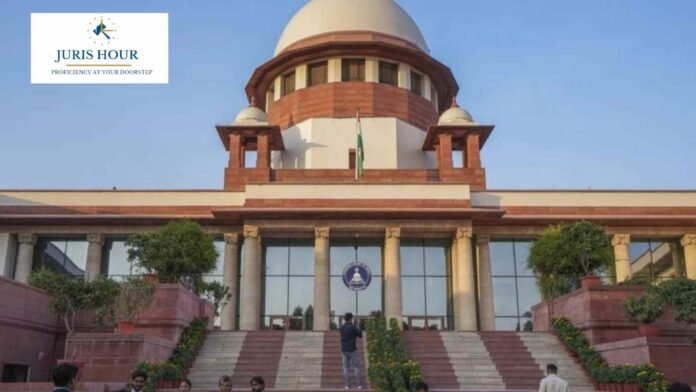
The Supreme Court has acquitted five persons convicted in a Bihar murder case, holding that a court cannot presume the guilt of an accused merely because the investigation was defective or allegations of collusion were raised against the investigating officer.
The Bench of Justice J.B. Pardiwala and Justice K. Vinod Chandran observed that although a faulty investigation cannot automatically benefit an accused, a conviction cannot be sustained when the prosecution has failed to produce reliable evidence establishing guilt beyond a reasonable doubt.
“The case is not of a faulty investigation but of no investigation having been carried out,” the Bench remarked while setting aside the conviction of the appellants.
Buy Now: Supreme Court Judgments E-Compilation – August 2026
The case concerned a murder allegedly committed in broad daylight on an election day. According to the prosecution, the deceased was proceeding towards his agricultural fields along with his son, an employee, a nephew and another villager when a group of accused persons ambushed them.
The prosecution alleged that the accused opened indiscriminate fire after exhorting one another to kill all the members of the group. The deceased was allegedly shot in the back, while those accompanying him began running away.
A patrolling vehicle carrying a Magistrate reportedly arrived at the scene, prompting the assailants to flee. The injured man was taken to a hospital, where he was declared dead.
Six accused were convicted under Sections 302 and 307 read with Section 149 of the Indian Penal Code, relating to murder, attempt to murder and offences committed by members of an unlawful assembly in furtherance of a common object.
Some of the accused were also convicted under Section 148 of the IPC and Section 27 of the Arms Act, while others were convicted under Section 147 of the IPC. Five of the accused approached the Supreme Court, while one had already completed his sentence and was released following remission.
The prosecution primarily relied upon the evidence of three alleged eyewitnesses: an employee of the deceased, a relative and the deceased’s son. The independent villager who was allegedly accompanying the group was not examined before the court.
The eyewitnesses generally supported the allegation of an ambush but differed on material aspects of the incident, including which accused fired at the deceased.
Two witnesses stated that one accused had ordered the firing and another had shot the deceased from behind. The deceased’s son, however, attributed the fatal shot to a different accused.
The Supreme Court acknowledged that some inconsistency in eyewitness accounts may be understandable when an incident involves a sudden ambush, indiscriminate firing and people running in panic. Witnesses in such a situation cannot necessarily be expected to reproduce the precise chronology or every detail of the occurrence.
However, the Court found that the prosecution case suffered from several other serious deficiencies which, when considered together, rendered the alleged eyewitness accounts unsafe to rely upon.
Despite the allegation that the accused had opened indiscriminate fire, the investigating agency did not recover a single spent cartridge from the alleged place of occurrence.
The bullet that passed through the deceased’s body was also not recovered. No attempt was shown to have been made to recover the firearms allegedly used by the accused.
The State argued that cartridges could not be recovered because the deceased and his companions were walking on an uneven ridge surrounded by fields containing crops and spiked grass. The investigating officer’s testimony, however, contradicted that argument.
The officer described the place of occurrence as a lane leading from the Madanpur Distributary Canal towards Arara. It was stated to be a clear pedestrian pathway, with recently ploughed fields on both sides.
The Court further noted that the investigating officer did not testify that any meaningful search had been conducted for cartridges. Considering the prosecution’s allegation of indiscriminate firing, the absence of cartridges and any effort to locate them assumed significance.
Bloodstained earth was reportedly collected from the alleged scene of the crime, but it was never sent for forensic or chemical examination. Consequently, there was no scientific evidence connecting the alleged place of occurrence with the murder.
The investigating agency also failed to seize the clothes of the deceased or those of the witnesses who claimed to have carried the injured man to the hospital in the patrol vehicle.
The Supreme Court observed that if the witnesses had actually carried the bleeding victim, their clothes could reasonably have contained bloodstains. Seizure and examination of those clothes could have provided independent support for their presence at the scene and their version of events.
The absence of such evidence, coupled with the failure to examine independent witnesses, placed the prosecution’s account under a serious cloud.
The post-mortem examination established that the deceased had died from a gunshot injury. The bullet entered and exited the body, while abrasions on the face were consistent with the body falling to the ground.
Significantly, the doctor stated that the shape and trajectory of the gunshot wound indicated that the deceased was likely sitting when he was shot from behind. The blackening and tattooing around the wound suggested that the shot had been fired from a distance of approximately three to four feet.
This medical opinion did not support the prosecution’s claim that the deceased was walking at the front of a group in a straight line when the accused emerged from behind and opened fire.
The Supreme Court found the prosecution version particularly unlikely because the alleged assailants were said to have approached and fired from behind while the deceased was walking at the front of the group.
The medical evidence suggesting that he was sitting and had been shot from close range persuaded the Court to disbelieve the eyewitness description of the incident.
The Court noted that all the examined eyewitnesses were closely connected with the deceased. One was his employee, another was his son and the third was a relative.
The Bench clarified that a related witness cannot always be categorised as an interested witness merely because of the relationship. In the present case, however, the witnesses’ relationship with the deceased had to be considered alongside the doubtful investigation, lack of corroborative evidence, local rivalry and omissions in their earlier statements.
One witness had not named the accused in his statement recorded under Section 161 of the Code of Criminal Procedure. He had also not stated that the accused had surrounded and ambushed the group or that all of them were carrying weapons.
The Court further noted that although the prosecution alleged indiscriminate firing directed at the entire group, none of the surviving eyewitnesses suffered any injury.
These circumstances, along with the failure to examine the independent villager allegedly present with the group, made the presence and testimony of the prosecution witnesses doubtful.
The prosecution attributed the crime partly to a dispute arising from the alleged kidnapping of a girl from the accused persons’ village by a boy belonging to the deceased’s village.
It was alleged that the former village Mukhiya, who was the father of one of the accused, had approached the deceased and requested his assistance in tracing the girl and the boy. The deceased’s refusal to assist allegedly angered the former Mukhiya.
The prosecution also referred to a supposed political rivalry because the deceased’s nephew had contested an election against the former Mukhiya.
The Supreme Court found no evidence proving either the alleged kidnapping or the claimed political rivalry. It also noted that no connection had been established between the deceased and the boy who had allegedly kidnapped the girl.
Further, although the motive was primarily attributed to the father of one of the accused, he had not been arrayed as an accused. The Court consequently held that the alleged motive did not inspire confidence and could not support the murder conviction.
Another significant circumstance was the investigating officer’s admission that the inquest was conducted before the First Information Statement was obtained.
According to the Supreme Court, this sequence made the subsequent narration of events suspect and indicated that the case presented by the prosecution may have been premeditated.
The High Court had relied upon a complaint accusing the investigating officer of conducting a collusive investigation. It treated the alleged collusion as an explanation for the failure to examine independent witnesses, send bloodstained earth for chemical examination and seize bloodstained clothes.
The Supreme Court disapproved of that approach. It noted that the complaint against the investigating officer had not been produced during the trial and had not been put to or elicited from the eyewitnesses.
The High Court could not rely upon such a complaint to describe the prosecution evidence as clinching and uphold the guilt of the accused, the Supreme Court held.
The Bench reiterated that investigative defects do not invariably entitle an accused to acquittal. Where credible and reliable evidence establishes the commission of an offence, the accused cannot escape punishment merely because the investigating officer was negligent or conducted a defective investigation.
However, the Court stressed that the position is different when reliable evidence is altogether absent.
“A faulty investigation cannot inure to the benefit of the accused, but when there is no reliable evidence, merely because the I.O. was recalcitrant or a complaint of collusion was raised against him, the Court cannot presume the guilt of the accused,” the judgment stated.
The Supreme Court concluded that the prosecution had failed to prove the culpability of the appellants beyond a reasonable doubt. The eyewitness testimonies did not inspire confidence, the medical evidence contradicted their account, no weapons or cartridges were recovered, material forensic examinations were not conducted and independent witnesses were withheld.
Finding a “complete lack of evidence” capable of sustaining the convictions, the Court allowed the appeals and acquitted all five appellants.
The Court directed that any appellant still in custody be released immediately, unless required in another case. If any appellant had already been released on bail, the corresponding bail bonds were ordered to stand cancelled.
Membership Required to Access Case Details & Order Copy
To view the complete Case Details and Download Order Copy, you must have an active membership. Please subscribe to continue.

