
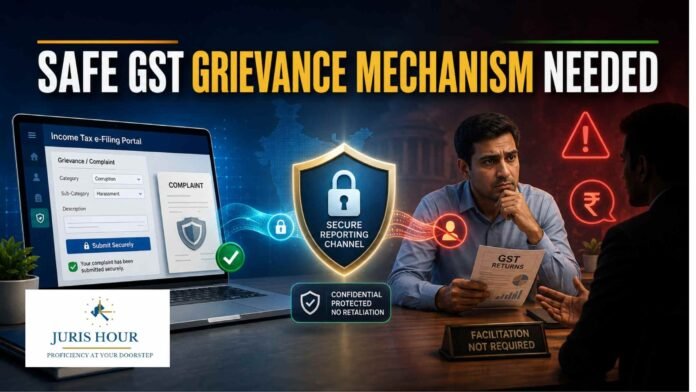
The introduction of a dedicated facility on the Income Tax e-Filing Portal for reporting corruption, misbehaviour and harassment has prompted tax professionals to call for a similar grievance-redressal mechanism on the Goods and Services Tax Portal.
The newly visible option in the Income Tax Portal’s grievance module allows taxpayers to lodge complaints concerning corruption and inappropriate conduct by departmental officials. The available categories reportedly cover corruption, misbehaviour, harassment and sexual harassment. Complainants are also required to furnish details such as the name and designation of the officer concerned, along with a description of the incident.
The development has been widely welcomed as an important taxpayer-centric measure that offers individuals and businesses a readily accessible channel to report serious misconduct. Until now, taxpayers facing such situations may have been uncertain about the appropriate authority to approach or reluctant to initiate a complaint due to apprehensions about possible repercussions.
Buy Now: GSTAT E-Compilation For August 2026
However, tax professionals have pointed out a practical difficulty in the present design of the Income Tax grievance form. Since a substantial part of the Department’s assessment and appellate processes now operates through faceless systems, taxpayers may not always know the identity or designation of the officer handling their case.
Consequently, making the officer’s name and designation mandatory could prevent a taxpayer from submitting a genuine complaint in cases where the identity of the official is unavailable. It has therefore been suggested that the portal should permit complaints based on other identifying information, including the notice or communication number, Document Identification Number, assessment year, date of interaction, proceeding reference and details of the relevant jurisdictional unit.
Demand for Similar Facility on GST Portal
Following the Income Tax Department’s initiative, stakeholders have urged Union Finance Minister Nirmala Sitharaman, the GST Council and the concerned tax authorities to introduce a corresponding facility on the GST Portal.
The proposed mechanism would allow taxpayers to report alleged corruption, harassment, intimidation or misconduct arising during GST registration, scrutiny, audit, investigation, search, refund and adjudication proceedings.
The demand assumes significance because GST proceedings frequently involve direct interaction with officers, particularly during summons, inspections, searches, audits and personal hearings. A taxpayer alleging improper conduct may presently have to approach a departmental vigilance wing, the Central Vigilance Commission, the Central Bureau of Investigation, a state Anti-Corruption Bureau or another authority, depending upon whether the official concerned belongs to the Central or State tax administration.
A unified reporting window on the GST Portal could simplify this process by receiving the complaint and electronically forwarding it to the competent and independent authority.
Recent Bribery Cases Renew Concerns
The call for such a mechanism has gained momentum against the backdrop of recent cases involving allegations of bribery connected with GST proceedings.
In one Maharashtra case, a Sales Tax Department officer was booked and taken into custody by the Navi Mumbai Anti-Corruption Bureau for allegedly demanding ₹15 lakh from a trader to close a GST-related inquiry. According to the reported case details, the alleged demand was subsequently reduced to ₹8 lakh following negotiations. The proceedings arose from a complaint concerning scrutiny of the taxpayer’s GST account and a notice relating to input tax credit. The allegations remain subject to investigation and adjudication.
In another case, the Central Bureau of Investigation arrested an Additional Commissioner of CGST, a CGST Superintendent and a private individual in Raigad, Maharashtra. The agency alleged that an initial demand of ₹1.50 crore was made in connection with a GST and royalty-related matter and was later reduced to ₹40 lakh.
The CBI stated that the public servants allegedly arranged for the amount to be collected through a private individual. A trap was laid, following which the private person was allegedly caught while accepting ₹40 lakh. The acceptance of the amount was subsequently alleged to have been acknowledged by the two CGST officers. These are allegations under investigation, and the accused remain entitled to the presumption of innocence unless convicted by a competent court.
These cases have strengthened demands for a mechanism through which taxpayers can securely report an alleged demand at the earliest stage—before payment is made or evidence is lost.
Suggested Details for the GST Complaint Form
Tax professionals have suggested that a specialised GST grievance form should capture information beyond the basic identity of the officer. The form could seek details regarding:
- The GST proceeding in which the alleged incident occurred;
- The date, time and place of the personal hearing or interaction;
- Whether the interaction was physical, virtual or conducted through an intermediary;
- What allegedly occurred during the personal hearing;
- The nature and amount of any alleged demand;
- Whether the original amount was subsequently negotiated or reduced;
- The amount for which the matter was allegedly proposed to be “settled”;
- Details of any intermediary or private person involved;
- Relevant notices, summons, orders and communication references;
- Telephone numbers, messages, recordings or other supporting material; and
- Whether the taxpayer fears retaliatory action from the officers concerned.
The portal could also allow taxpayers to file a preliminary confidential complaint even where the officer’s exact identity is unknown. The system may identify the concerned officer internally from the proceeding number, DIN, GSTIN, jurisdiction and date of hearing.
Confidentiality and Protection Against Victimisation Essential
Stakeholders have emphasised that creating an online form alone will not be sufficient. Its effectiveness will depend upon the safeguards governing the complaint after it is filed.
Taxpayers may hesitate to report misconduct if the complaint is immediately forwarded to the same formation or supervisory hierarchy against which the grievance has been raised. There may also be apprehension that filing a complaint could result in repeated summons, intensified scrutiny, delayed refunds or other adverse administrative action.
The proposed mechanism must, therefore, provide confidentiality, controlled access to the complainant’s identity and protection against victimisation. Complaints involving corruption should preferably be examined by an independent vigilance or anti-corruption unit rather than by officers belonging to the same field formation.
The system could also generate an acknowledgement number, permit confidential submission of evidence and allow the complainant to monitor the status without repeatedly contacting departmental officials. Where immediate intervention is necessary, the portal should facilitate secure escalation to the appropriate vigilance agency.
Safeguards would simultaneously be required to discourage frivolous or malicious complaints. A preliminary verification process could distinguish complaints supported by identifiable proceedings and material particulars from unsupported allegations, without denying genuine complainants a fair opportunity to be heard.
Taxpayer-Friendly Reform Sought
The Income Tax Portal’s decision to provide specific grievance categories for corruption and harassment represents a significant step towards improving institutional accountability. The remaining concern about mandatory officer identification can be addressed by permitting alternative proceeding-based information in faceless cases.
Stakeholders now expect the GST administration to adopt and expand upon this model. A centralised, safe and independent complaint mechanism—supported by confidentiality, evidence-upload facilities, status tracking and safeguards against retaliation—could offer taxpayers a meaningful avenue to report serious misconduct.
The demand is not merely for another grievance form, but for a credible institutional framework under which taxpayers can raise allegations without fear and authorities can act promptly, impartially and transparently.

