
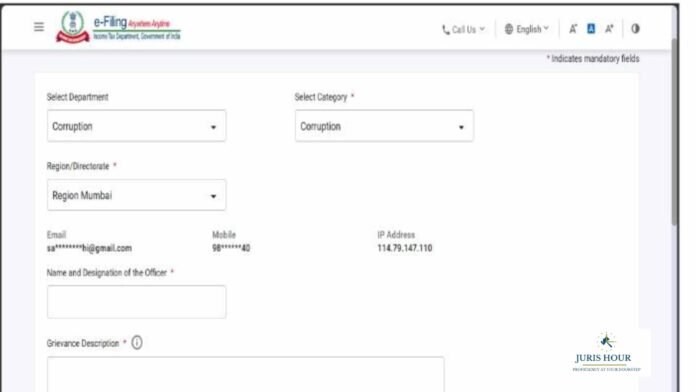
The Income Tax e-Filing Portal has introduced a dedicated mechanism for raising grievances involving corruption and alleged misconduct by departmental officials. The facility allows complainants to identify the officer concerned by name and designation and provide a detailed description of the incident.
The grievance categories available on the portal reportedly cover not only corruption but also misbehaviour, harassment and sexual harassment. By bringing these sensitive complaints within the online grievance system, the initiative provides taxpayers with a more accessible and identifiable channel for reporting inappropriate conduct.
Earlier, taxpayers encountering corruption or harassment could face uncertainty about where and how to submit a complaint. Some may also have been reluctant to approach the authorities due to fear of possible repercussions or victimisation. A dedicated option on the e-Filing Portal could reduce this uncertainty by enabling complaints through a familiar digital platform.
Buy Now: Income tax E-Compilation – August 2026
Complainants Can Identify Officer Involved
Under the new facility, a complainant can provide particulars such as the name and designation of the officer against whom the grievance is being raised. The person can also describe the alleged incident and submit relevant information supporting the complaint.
The ability to identify the official concerned may help route the grievance to the appropriate authority and facilitate a more focused inquiry. The inclusion of specific categories such as corruption, misbehaviour, harassment and sexual harassment also means that such complaints need not be submitted under a vague or general grievance heading.
Supporting documents can be uploaded where available, although the Income Tax Department’s general grievance manual states that uploading documents is not mandatory. The grievance description must contain at least 100 characters. Once the complaint is submitted, the portal generates an acknowledgement number that can be used to monitor its status.
How to Raise a Grievance on the Portal
A registered taxpayer can log in to the Income Tax e-Filing Portal and navigate to Grievances → Submit Grievance. The complainant must then select the relevant department, category and subcategory, enter the required information, describe the issue and submit the grievance.
The official grievance guide also provides a pre-login facility for persons who do not have a PAN or TAN. Such complainants can enter their name, email address and mobile number, complete OTP verification and proceed to raise the grievance. Status can subsequently be checked through the acknowledgement number and registered mobile number.
According to the portal’s help material, grievances may generally be raised in relation to the e-Filing system, the Assessing Officer, CPC-ITR and CPC-TDS. No electronic verification is required merely for filing a grievance. The status of a complaint can be monitored in both pre-login and post-login modes. Income Tax Department grievance manual
Important Step Towards Greater Accountability
The introduction of clearly identified categories for corruption and misconduct could strengthen accountability within the tax administration. It formally recognises that taxpayers’ grievances may extend beyond return processing, refunds, outstanding demands and technical difficulties to the conduct of officials with whom they interact.
A visible complaint mechanism may also improve awareness among taxpayers who otherwise might not know the appropriate forum for reporting such incidents. Centralising the process on the e-Filing Portal can provide a digital record of the complaint, an acknowledgement number and a means of tracking its progress.
The real effectiveness of the initiative, however, will depend on how complaints are processed after submission. Timely acknowledgement, confidential handling, impartial examination and communication of the outcome will be essential for building confidence in the mechanism.
Protection Against Victimisation Remains Crucial
One of the principal concerns for a taxpayer reporting an official is the possibility of retaliation or adverse treatment. A person may hesitate to complain if the officer named in the grievance continues to exercise authority over an assessment, investigation, refund or other proceeding involving that taxpayer.
It is therefore important that genuine complainants are protected against victimisation and that sensitive complaints are handled by an authority independent of the official or office against whom the allegations have been made. Confidentiality safeguards, clear escalation procedures and appropriate supervisory monitoring could encourage taxpayers to use the facility without fear.
At the same time, allegations involving corruption, harassment or sexual harassment require careful and fair examination. A transparent procedure should protect genuine complainants while also ensuring that complaints are verified in accordance with law and principles of natural justice.
Calls for Similar Facility on GST Portal
The development may also prompt demands for a comparable mechanism on the GST Portal. GST taxpayers frequently interact with officers in connection with registration, scrutiny, audits, inspections, investigations, refunds and recovery proceedings. A clearly visible digital facility for reporting corruption, harassment or misconduct could provide similar accessibility and accountability within the indirect-tax system.
Although general government grievance and vigilance channels already exist, integrating a dedicated complaint option into the portal used by taxpayers can make the reporting process considerably easier. It can also enable structured categorisation, electronic tracking and referral of complaints to the appropriate authority.
The Income Tax Portal’s new grievance option is therefore a welcome administrative step. Its success will ultimately be measured not merely by the number of complaints registered but by whether grievances are examined independently, complainants remain protected and meaningful action follows wherever allegations are established.

