
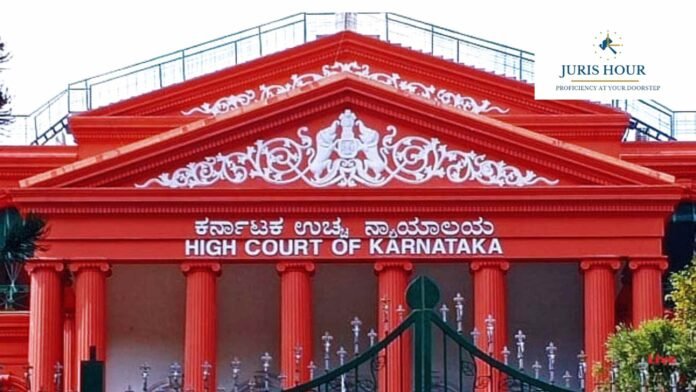
The Karnataka High Court has held that a complainant who provides his own money for laying a trap against an allegedly corrupt CGST officer should not be compelled to suffer financial hardship by waiting until the conclusion of a prolonged criminal trial for its return.
Justice M. Nagaprasanna observed that while the original currency notes used in a trap may have to be retained as material evidence, an equivalent amount can be restored to the complainant without affecting the evidentiary integrity of the criminal proceedings.
The Court was considering a criminal petition filed by a contractor seeking the release of ₹80,000 supplied by him for a trap conducted against a Superintendent of Central Goods and Services Tax (CGST), Preventive Wing, Ballari.
Buy Now: E-Way Bill Judgements From 2020–2026 [Includes Orders of GSTAT]
The petitioner also requested the Court to issue general directions prescribing a procedure for the timely release of money supplied by complainants in corruption trap cases.
According to the order, the petitioner had incurred a GST liability of approximately ₹14 lakh. When he approached the office of the Assistant Commissioner of Commercial Taxes, GST Division, the total amount payable, including the delayed payment charges, was stated to be ₹14.46 lakh.
The petitioner claimed that he cleared the entire outstanding GST liability. However, the CGST Superintendent allegedly demanded ₹1 lakh from him for closing the GST-related proceedings. The amount was subsequently reduced to ₹80,000 after negotiations.
Unwilling to pay the alleged bribe, the petitioner lodged a complaint with the Central Bureau of Investigation’s Anti-Corruption Branch. An FIR was registered for an offence punishable under Section 7 of the Prevention of Corruption Act, 1988.
A trap was thereafter organised by the investigating agency. The CGST officer and another accused were allegedly caught red-handed while accepting the ₹80,000 supplied by the petitioner.
The currency notes were treated with phenolphthalein powder and their details were recorded in the entrustment mahazar. After the trap, the amount was recovered, seized and produced before the jurisdictional court as material evidence. The criminal prosecution is pending as Special C.C. No.2749 of 2022.
The petitioner approached the High Court contending that the ₹80,000 supplied for the trap was his hard-earned money. Since the amount continued to remain in judicial custody during the pendency of the trial, he sought its release with up-to-date interest.
Counsel for the petitioner submitted that corruption trials may continue for five to seven years and complainants are generally made to wait until the conclusion of the proceedings before the trap money is returned.
It was argued that while the amount in the present case was ₹80,000, complainants in other cases may have to arrange ₹10 lakh or ₹15 lakh for conducting a trap. Such money may be arranged by taking loans or from the complainant’s personal savings.
The petitioner contended that a person who cooperates with the investigating agency to expose an allegedly corrupt public servant should not be placed in a worse financial position than the accused officer.
The Special Public Prosecutor appearing for the CBI admitted that the ₹80,000 belonged to the petitioner.
However, the CBI submitted that its manual did not prescribe a procedure for returning trap money to a complainant before the closure of the trial. Investigating agencies were, therefore, following the practice of returning such money only after the criminal proceedings were completed.
Against this background, the High Court identified the principal issue as the legal status and eventual destination of trap money after the purpose of the trap had been accomplished.
The Court noted that there was no dispute that the ₹80,000 belonged to the petitioner and was used by the prosecuting agency to conduct the trap.
The investigating agency had not financed or advanced the amount. It was the complainant who parted with his own money to facilitate the detection of an alleged act of corruption.
The Court consequently held that ownership of the amount did not pass from the complainant to the State merely because the currency notes temporarily acquired the character of material evidence.
Justice Nagaprasanna observed that the complainant remained the rightful owner and lawful custodian of the trap money. Mere recognition of ownership, however, would become meaningless if the owner were denied the enjoyment of the property for several years without any legal necessity.
“A person may possess title in law, but if he is denied enjoyment of the property for years together without any legal necessity, such title becomes illusory and reduced to a mere abstraction,” the Court observed.
The High Court acknowledged that articles seized during an investigation must be preserved so that the criminal prosecution is not prejudiced by the loss or destruction of material evidence.
At the same time, it clarified that seized property need not invariably remain in judicial custody until the conclusion of the trial. The Code of Criminal Procedure and the Bharatiya Nagarik Suraksha Sanhita recognise circumstances in which seized property can be restored to its lawful owner during the pendency of proceedings.
The Court observed that trap cases presented a distinctive problem because the denominations, serial numbers and identifying particulars of the tainted currency notes are recorded in the mahazars. Their physical identity may, therefore, acquire evidentiary significance during the trial.
Nevertheless, the evidentiary value of the currency notes could not override the complainant’s proprietary rights.
“Every successful trap is founded upon the courage of an honest citizen who chooses the path of legality over silent submission,” the Court remarked.
Such a citizen, it said, should emerge from the proceedings with the satisfaction of having assisted the administration of criminal justice and not with the additional burden of financial impoverishment caused by the continued retention of his own money.
Requiring the complainant to wait for several years for restoration of his property merely because he assisted the State would amount to converting his public-spiritedness into an unintended penalty, the Court added.
The High Court held that the interests of the prosecution and the proprietary rights of the complainant could be protected simultaneously.
The original currency notes used in the trap could remain in judicial custody as material exhibits until their evidentiary purpose was exhausted. However, the prosecuting agency, through the State, could restore an equivalent amount to the complainant once the trap proceedings became final for investigative purposes.
According to the Court, there was no legal impediment to adopting such a course.
This arrangement would preserve the sanctity of the evidence required for the criminal trial while ensuring that the complainant was not rendered financially vulnerable merely because he chose to assist the law in exposing alleged corruption.
The Court further observed that timely restoration of trap money would promote public confidence in anti-corruption mechanisms and encourage citizens to lodge complaints against corrupt public servants.
“The fight against corruption cannot be sustained merely by statutory provisions; it must equally be nourished by assuring every complainant that the legal system shall not reward his courage with financial hardship,” the Court stated.
The High Court referred to the Supreme Court’s decision in Sunderbhai Ambalal Desai v. State of Gujarat, in which it was held that courts should exercise their powers concerning seized property expeditiously and judiciously.
The Supreme Court had explained that an owner should not suffer merely because an article remains unused in judicial custody. Where appropriate documentation, photographs and a panchnama are prepared, those records may be used as evidence instead of insisting upon the physical production of the seized article throughout the trial.
The Karnataka High Court also considered decisions dealing with the release of seized currency after preserving its evidentiary value through detailed documentation and colour photographs.
The High Court granted the petitioner liberty to approach the Special Court conducting the corruption trial by filing an appropriate application under Sections 497 and 503 of the Bharatiya Nagarik Suraksha Sanhita, 2023.
The petitioner may seek the release of an amount equivalent to the ₹80,000 supplied by him for the trap.
The Special Court was directed to consider the application in light of the observations made by the High Court. While doing so, it must preserve the evidentiary sanctity of the original trap currency and ensure that the complainant’s ownership rights are not rendered illusory by requiring him to wait until the end of a lengthy criminal trial.
After giving the prosecution an opportunity of hearing, the Special Court must decide the application as expeditiously as possible and, in any event, within four weeks from the date on which it is presented.
The High Court accordingly disposed of the criminal petition. It did not express any opinion on the merits of the corruption allegations pending before the Special Court.
Membership Required to Access Case Details & Order Copy
To view the complete Case Details and Download Order Copy, you must have an active membership. Please subscribe to continue.

