
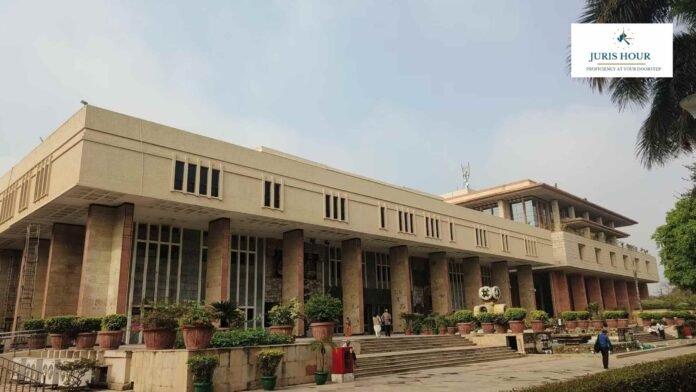
The Delhi High Court has declined to direct the refund of ₹26.55 lakh paid by a taxpayer during GST search proceedings, observing that the question of whether the payment was voluntary or extracted through coercion involved a disputed question of fact that could not be decided in writ jurisdiction.
The bench of Justice Anil Kshetrapal and Justice Shail Jain determining whether the payment of ₹26,55,050 was made voluntarily or under coercion required adjudication of a disputed question of fact.
The petitioner had approached the High Court alleging that two payments made through Form GST DRC-03 during a search at its premises were coerced and involuntary. It sought the recovery and retention of ₹28,34,294, comprising interest and penalty, to be declared unlawful and requested that the amount be refunded directly to its bank account.
Buy Now: E-Way Bill Judgements From 2020–2026 [Includes Orders of GSTAT]
The company also sought interest on the disputed amount from July 30, 2025 until its actual realisation. It requested interest at a rate of at least 6% per annum, rising to 12% if the Department failed to make the payment within the period fixed by the Court.
In addition, the petitioner sought directions for installing CCTV cameras with audio-video and night-vision facilities in the interrogation areas of the respondent Commissionerate. It relied upon the Supreme Court’s decision in Paramvir Singh Saini v. Baljit Singh and requested the preservation and supply of recordings to assessees for use in appropriate legal proceedings.
The petitioner claimed that it was compelled to make payments aggregating to ₹28,34,294, together with interest, while the GST officers were conducting a search at its premises.
According to the company, the collection of the amount during the search violated CBIC Instruction No. 01/2022-23 (GST-Investigation), dated May 25, 2022. The instruction concerns the deposit of tax during search, inspection or investigation and distinguishes voluntary payments made by taxpayers from recoveries allegedly secured by exercising force or coercion.
The petition disclosed that three separate Form GST DRC-03 payments were made during the search proceedings.
The first payment, amounting to ₹67.20 lakh, was made on July 29, 2025 under Section 73(5) of the Central Goods and Services Tax Act, 2017. No refund of this amount was claimed in the writ petition.
A second Form GST DRC-03 was filed at 4:19 a.m. on July 30, 2025 under Section 74(5). It covered interest of ₹16,47,050 and penalty of ₹10,08,000, taking the total payment under that form to ₹26,55,050.
The third Form GST DRC-03 was filed at 4:29 a.m. on the same date. It reflected tax of ₹4,53,628, interest of ₹1,11,200 and penalty of ₹68,044. The amount claimed as refundable from that transaction was ₹1,79,244.
The petitioner described the two early-morning transactions as “dawn debits” and pointed out that they were made while the search officers continued to remain at its premises.
The petitioner admitted that the tax payments of ₹67.20 lakh and ₹4,53,628 had been made voluntarily and were not being claimed back.
The petitioner ultimately confined its allegation of involuntary payment to the sum of ₹26,55,050, consisting of interest of ₹16,47,050 and penalty of ₹10,08,000.
The GST Department disputed the allegation of coercion. Counsel appearing for the respondents submitted that all the payments had been made voluntarily and that the members of the search team had not exercised any coercion upon the petitioner.
The Department also informed the Court that its investigation against the company was still pending and was expected to be concluded shortly.
The Court found this particularly significant because the petitioner did not dispute the voluntary nature of the other two tax payments made during the same search proceedings.
“In the facts of the present case, whether the payment of Rs.26,55,050/- was made voluntarily or under coercion involves a disputed question of fact,” the Court observed.
The Bench added that this conclusion was especially warranted when the petitioner itself accepted that the other two payments made during the very same search were voluntary.
In view of the factual dispute surrounding the circumstances in which the DRC-03 payment was made, the High Court said it was not inclined to exercise its writ jurisdiction to direct the Department to refund the amount.
The Court, however, clarified that the petitioner could avail itself of such alternative remedy as might be available under the law.
The High Court disposed of the writ petition without granting the requested refund. All pending applications were also closed.
Membership Required to Access Case Details & Order Copy
To view the complete Case Details and Download Order Copy, you must have an active membership. Please subscribe to continue.

