
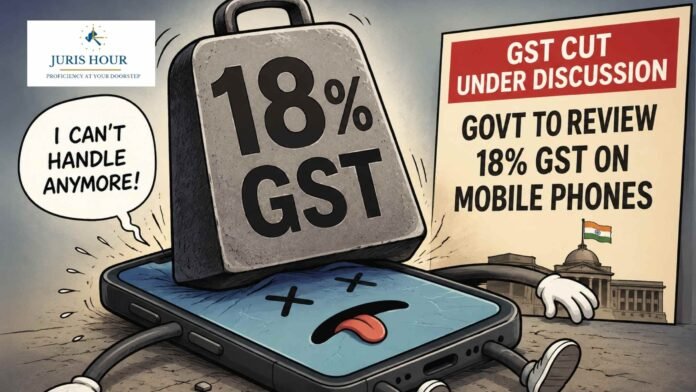
The Goods and Services Tax (GST) Council is reportedly considering a reduction in the GST rate applicable to mobile phones, as policymakers seek to address weakening handset demand and ensure that taxation does not become a constraint on India’s rapidly expanding electronics manufacturing ambitions.
The proposal could involve a reduction in the existing 18% GST rate on mobile phones and may come up for discussion at the GST Council’s meeting expected to be held in September. The agenda for the meeting, however, is yet to be finalised.
Buy Now: E-Magazine: 1000+ Landmark GST Judgments (2017–2026)
The possible rate reduction assumes significance at a time when India’s smartphone market has witnessed a sharp slowdown in shipments. At the same time, the government has been pushing to strengthen domestic mobile-phone manufacturing and expand India’s position in the global electronics supply chain.
GST Council May Review 18% Tax on Mobile Phones
Mobile phones currently attract GST at 18%. The government is now reportedly examining whether the existing tax burden could be affecting consumer demand and, consequently, the growth of domestic handset manufacturing.
The report quoted a person aware of the developments as saying that the GST rate on mobile phones could be considered at the upcoming Council meeting because the government wants to ensure that taxation does not slow mobile-phone manufacturing in India.
Any reduction would require the approval of the GST Council, the constitutional body comprising representatives of the Centre and states that makes recommendations on GST rates and related policy matters.
The proposed discussion comes against the backdrop of smartphone shipments in India declining by around 10-11% year-on-year during the April-June quarter, according to data cited from Counterpoint Research and IDC. The fall was described as the steepest June-quarter decline in six years.
A GST reduction could potentially lower the tax component embedded in retail prices, although the ultimate impact on consumers would depend on how manufacturers and sellers price their products following any rate change.
Mobile Phone Manufacturing Becomes Key Policy Consideration
The reported proposal is also important because mobile phones have become one of the central pillars of India’s electronics manufacturing strategy.
According to government data cited in the report, mobile-phone production reached about ₹6.27 trillion in FY2025-26, accounting for nearly half of India’s overall electronics production of approximately ₹13.11 trillion during the financial year.
The figures highlight the importance of the mobile-phone industry not merely as a consumer market but also as a major manufacturing sector.
The government has over the years introduced various policy initiatives aimed at expanding local manufacturing, increasing value addition, attracting global supply chains and strengthening India’s electronics exports.
Against this backdrop, policymakers are reportedly keen to ensure that the GST structure does not weaken domestic demand at a time when significant investments are being directed towards expanding manufacturing capacity.
Council May Also Examine Whether Earlier GST Cuts Reached Consumers
Apart from mobile phones, the GST Council is also expected to examine a wider issue concerning the actual transmission of earlier GST rate reductions to consumers.
According to the report, concerns have emerged that some companies may have increased prices after earlier GST rationalisation measures, effectively taking prices back towards levels prevailing before the tax reductions.
The Council could therefore review whether the benefits arising from previous GST rate cuts were adequately passed on to customers.
The issue is significant because a reduction in the statutory GST rate does not automatically guarantee an equivalent fall in the final price paid by a consumer. Businesses can alter their base prices depending on input costs, margins and other commercial considerations.
Consequently, policymakers are reportedly considering whether measures may be required to ensure that prices of affected goods return to the lower levels intended following tax rationalisation.
Price Transmission Could Become Important in Future GST Rationalisation
The reported examination of price transmission could have wider implications for GST policy.
If the government proceeds with further rate rationalisation, including a possible reduction for mobile phones, the question of whether consumers actually receive the benefit of lower taxation could become an important part of the policy discussion.
A reduction in GST from 18% would reduce the indirect-tax incidence on mobile phones. However, the actual reduction in retail prices would depend upon the extent to which manufacturers and retailers pass the tax benefit through the supply chain.
The reported move therefore indicates that the GST Council may simultaneously examine two objectives: reducing tax rates where necessary to stimulate demand and manufacturing, while also ensuring that tax reductions translate into tangible benefits for consumers.
Smartphone Shipments Fall Sharply
The possibility of GST relief comes amid signs of weakness in India’s handset market.
Smartphone shipments reportedly declined 10-11% year-on-year during the April-June quarter. A prolonged slowdown in handset purchases could have consequences beyond retailers and smartphone brands because the mobile-phone ecosystem now encompasses manufacturers, component suppliers, contract manufacturers, logistics providers and other businesses.
Lower taxes, if translated into lower retail prices, could potentially improve affordability and support replacement demand, particularly in price-sensitive segments of the Indian smartphone market.
At the same time, any GST rate reduction would have revenue implications for the Centre and states, which the GST Council would need to weigh against the potential benefits of higher consumption and manufacturing activity.
₹62,500-Crore Manufacturing Scheme Adds to Policy Push
The proposed GST review also comes shortly after the government reportedly notified a ₹62,500-crore Mobile Phone Manufacturing Scheme on August 21.
According to the report, the scheme is expected to operate for five years beginning from FY2026-27.
The manufacturing initiative and possible GST review indicate that mobile phones are receiving attention from both the supply and demand sides of economic policy.
While manufacturing incentives seek to strengthen production capacity and investment, a reduction in GST could address affordability and consumer demand. Together, such measures could help the government support the broader domestic electronics ecosystem.
No Final Decision Yet
Importantly, the proposed reduction in GST on mobile phones is under consideration and has not yet been approved.
The matter is expected to be discussed at the GST Council meeting likely to take place in September, but the meeting agenda has not been finalised. Any change in the GST rate would require a formal recommendation by the Council followed by the necessary government notification before becoming effective.
Until such a decision is formally announced, mobile phones will continue to attract GST at the existing rate.
The upcoming GST Council meeting will therefore be closely watched by smartphone manufacturers, retailers and consumers, particularly for any decision concerning the 18% GST rate on mobile phones and the Council’s broader review of whether previous GST reductions have actually been passed on to consumers.
Read More: Foreign Telecom Payments By Jio Not Royalty or FTS: ITAT

