
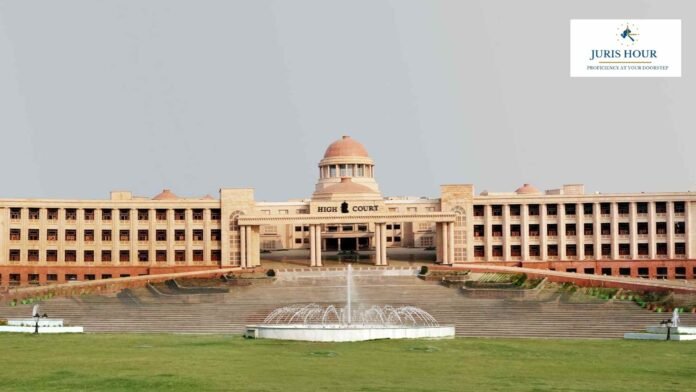
The Allahabad High Court has declined to interfere with a GST penalty proceeding challenged on the ground of lack of jurisdiction, holding prima facie that the Deputy Commissioner of State Tax was competent to issue the show-cause notice under Section 122 of the UPGST Act, 2017.
The bench of Justice Shekhar B. Saraf and Justice Abdhesh Kumar Chaudhary observed that the petitioner, having participated in the proceedings on merits without initially challenging the officer’s jurisdiction, should pursue the statutory appellate remedy rather than invoke the extraordinary writ jurisdiction of the High Court.
The petitioner/assessee approached the High Court under Article 226 of the Constitution seeking quashing of the show-cause notice dated November 19, 2025, issued under Section 122(1)(ii), along with the corresponding DRC-01. It also challenged the consequential penalty order dated June 24, 2026, passed under Sections 122(1)(ii) and 122(1)(vii), together with DRC-07.
Buy Now: 130 GST Judgments – E-Magazine July 2026
The principal contention was that the officer who issued the show-cause notice lacked jurisdiction to initiate the penalty proceedings. The petitioner argued that the expression “proper officer” was not defined under the UPGST Act in a manner that authorised the concerned officer to issue the notice in the circumstances of the case.
The petitioner relied upon Circular No. 254/11/2025-GST dated October 27, 2025, issued by the Central Government. According to the petitioner, the circular clarified the officers competent to issue notices under different provisions of the CGST and IGST Acts, including proceedings under Sections 74A and 122.
It was argued that the circular prescribed monetary limits and identified the appropriate authorities for issuance of notices. Since the penalty proposed in the present case was stated to be above ₹1 crore, the petitioner contended that the notice ought to have been issued by an Additional Commissioner or Joint Commissioner of Central Tax rather than by a Deputy Commissioner of State Tax.
The petitioner further contended that similar clarification was required from the State Government for proceedings under the UPGST Act and that, in the absence of such clarification, the impugned notice was without jurisdiction.
The State opposed the petition and placed before the Court two circulars issued under the UPGST Act, dated December 11, 2018 and May 10, 2022.
The State submitted that the December 11, 2018 circular specifically identified the “proper officer” for issuance of notices under Section 122 by reference to Section 127 of the GST law. According to the State, Section 127 conferred the necessary authority upon the proper officer to impose penalties in cases not covered by specified proceedings under the Act.
The State also relied upon the subsequent circulars to contend that, in cases involving businesses having turnover exceeding ₹2.5 crore, the Deputy Commissioner was empowered to exercise the relevant jurisdiction.
After examining the competing submissions and the applicable circulars, the Division Bench rejected the petitioner’s prima facie jurisdictional objection.
The Court held that, under the UPGST framework and the relevant State Government circulars, the Deputy Commissioner had been vested with the power to issue a show-cause notice under Section 122. The Court further observed that pecuniary jurisdiction in cases involving amounts exceeding ₹2.5 crore lay with the Deputy Commissioner.
This finding was central to the Court’s decision, as it meant that the challenge could not succeed merely on the argument that the Deputy Commissioner lacked authority to initiate the Section 122 proceedings.
The Court also attached significance to the conduct of the petitioner during the original proceedings.
The show-cause notice had been issued in November 2025. However, the petitioner did not approach the High Court at that stage with an objection regarding the jurisdiction of the officer. Instead, the petitioner appeared before the concerned officer and made submissions on the merits of the case.
Only after the adverse penalty order was passed on June 24, 2026 did the petitioner challenge the proceedings on the ground of lack of jurisdiction. The High Court described this as a “volte-face” on the part of the petitioner.
The Bench acknowledged that a pure question of jurisdiction can, in an appropriate case, be raised before a Constitutional Court at any stage. However, it emphasised that the power exercised by a High Court under Article 226 is discretionary and must be exercised judiciously.
In the Court’s assessment, two considerations weighed against interference.
First, the Bench was prima facie of the view that the authority issuing the show-cause notice was not lacking jurisdiction. Second, the petitioner was held to be hit by the doctrine of election because it had participated in the proceedings before the concerned authority and advanced submissions on merits rather than challenging jurisdiction at the appropriate stage.
Rather than examining the merits of the underlying GST penalty proceedings in writ jurisdiction, the Court disposed of the petition by granting the petitioner liberty to avail the statutory appellate remedy available under the GST law.
The Court therefore did not quash the show-cause notice or the penalty order. Instead, the petitioner was relegated to the statutory appellate mechanism, where the merits of the dispute can be examined in accordance with law.
At the same time, the High Court protected the petitioner against the possible limitation consequences arising from the time spent pursuing the writ petition.
The Bench clarified that the benefit of Section 14 of the Limitation Act, 1963 would be available to the petitioner for the period during which the writ petition remained pending before the High Court, subject to fulfilment of the statutory requirements of that provision.
Membership Required to Access Case Details & Order Copy
To view the complete Case Details and Download Order Copy, you must have an active membership. Please subscribe to continue.
Read More: DGGI Meerut | Allahabad High Court Grants Bail in ₹293.68 Crore Fake ITC Case

