
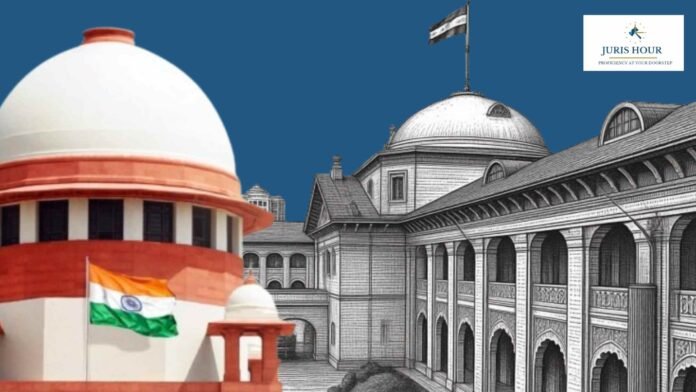
The Supreme Court has dismissed the Special Leave Petition challenging an order of the Allahabad High Court concerning a fresh GST show cause notice issued under Section 74 of the Uttar Pradesh GST Act, 2017 for the financial year 2017-18.
The bench of Justice J.B. Pardiwala and Justice K. Vinod Chandran, found no ground to interfere with the Allahabad High Court’s order and dismissed the petition on August 20, 2026.
The litigation arose from a show cause notice dated July 22, 2026 issued to Petitioner under Section 74 of the UPGST Act for FY 2017-18. Before the Allahabad High Court, the company challenged the notice on several grounds, including limitation, the effect of an earlier writ order, and the alleged prejudice reflected in the language used by the adjudicating authority.
Buy Now: 130 GST Judgments – E-Magazine July 2026
The petitioner argued that the limitation for issuance of the notice had already expired on August 5, 2024 and that there was no statutory basis for issuing a fresh notice beyond that period. It also contended that the earlier writ proceedings had resulted in findings favourable to the company and that the revenue authorities could not reopen the same issues in the manner proposed.
The company further pointed out that the department had initially initiated proceedings under Section 73 for the same tax period through a show cause notice dated September 30, 2023. Those proceedings were subsequently dropped on December 30, 2023. According to petitioner, the department could not thereafter issue another notice under Section 74 on substantially the same issues.
The September 30, 2023 notice under Section 73 raised several GST-related issues for FY 2017-18. These included alleged lack of supporting evidence for input tax credit claimed on imports, ITC availed through TRAN-1, zero-rated supplies allegedly made without adequate LUT documentation, unreconciled ITC reported in GSTR-9C, and alleged excess ITC arising from reconciliation under Rules 42 and 43.
The notice specifically questioned ITC of ₹6,20,875 claimed in relation to imports and ITC of ₹2,19,31,776 claimed through TRAN-1. It also raised issues concerning zero-rated supplies, unreconciled ITC of ₹4,74,921 and alleged excess ITC of approximately ₹22.80 lakh arising from the reconciliation exercise.
The earlier notice quantified the aggregate proposed liability at approximately ₹5.76 crore, comprising tax, interest and penalty. The figures recorded by the High Court show a proposed tax component of ₹2.64 crore, interest of approximately ₹2.85 crore and penalty of approximately ₹26.43 lakh. The notice was ultimately dropped on December 30, 2023.
After dropping the Section 73 proceedings, the department issued another show cause notice dated August 3, 2024 under Section 74 of the Act on the same broad issues.
The petitioner challenged that notice before the Allahabad High Court in Writ Tax No. 1396 of 2024. The High Court examined the distinction between Sections 73 and 74 and emphasised that Section 74 applies where wrongful availment or utilisation of ITC is alleged to have occurred because of fraud, wilful misstatement or suppression of facts to evade tax.
The High Court found that the August 3, 2024 notice did not even contain a basic assertion that the alleged wrongful ITC had arisen because of fraud, wilful misstatement or suppression of facts. In the absence of those jurisdictional ingredients, the Court held that the Section 74 proceedings could not be sustained.
The earlier notice was consequently quashed. However, the High Court expressly left it open to the revenue to initiate fresh proceedings under Section 74, subject to issuance of a fresh show cause notice containing the necessary ingredients relating to fraud, wilful misstatement or suppression of facts, “if they so exist.”
A significant issue before the High Court was whether the revenue could legally issue the fresh Section 74 notice in 2026.
The petitioner contended that the ordinary limitation period had expired and that Section 75(3) could not be used to revive the power to issue a fresh notice after the statutory period had ended.
The revenue, however, relied upon the liberty granted by the High Court in its earlier judgment and Section 75(3) of the Act. The department argued that once the writ court had specifically permitted fresh proceedings, the fresh proceedings could be undertaken within two years from communication of the court’s order dated September 27, 2024.
The Allahabad High Court accepted this reasoning.
Section 75(3) provides that where an order is required to be issued pursuant to the direction of an Appellate Authority, Appellate Tribunal or court, the order is to be issued within two years from the date of communication of such direction.
The High Court acknowledged that the provision principally contemplates a situation where an adjudication order has been set aside and the matter is remanded for fresh adjudication. Nevertheless, the Court held that the specific direction contained in its earlier judgment permitting the department to initiate fresh Section 74 proceedings had to be given effect.
The Court observed that adopting an overly literal interpretation of the word “order” in Section 75(3), so as to exclude a situation where a show cause notice itself had been quashed but the court expressly permitted fresh proceedings, would defeat the effect of the earlier judicial direction.
The High Court therefore concluded that the fresh proceedings would remain within limitation so long as the revenue acted within two years from communication of the September 27, 2024 order.
Although the limitation objection did not succeed, the petitioner obtained relief on another important ground.
The High Court examined paragraph 3(ग) of the impugned show cause notice, which contained allegations suggesting that the taxpayer had “misled the Court” and had made a wilful misstatement in the earlier litigation.
The revenue’s standing counsel fairly conceded before the High Court that these observations were out of place. The High Court went further, holding that such remarks were not merely unnecessary but also indicated an element of prejudice on the part of the adjudicating authority.
The Court particularly took note of the fact that the alleged prejudice appeared to stem, at least in part, from the taxpayer having previously approached the High Court and obtained relief. The Court observed that this compounded the concern regarding the neutrality of the adjudicating process.
The High Court held that the presence of prejudice was sufficient to invalidate the impugned notice.
Accordingly, it set aside the July 22, 2026 show cause notice and remitted the matter for issuance of a fresh Section 74 notice, but only if the necessary jurisdictional facts existed.
Importantly, the Court directed the Additional Commissioner (Grade 1), State Tax, Gautam Budh Nagar, to assign the matter to an officer other than the officer who had issued the impugned notice. The new officer was directed to consider the matter neutrally and without being influenced by any observations made in the proceedings.
The High Court further prescribed a procedural framework for any fresh proceedings. If considered necessary, a fresh notice could be issued within two weeks; petitioner would then have four weeks to file its reply. Documents sought by the taxpayer and available with the department were also to be supplied, subject to a reasoned decision if any document was withheld.
The Court also directed that an appropriate hearing date be fixed with at least 15 days’ advance notice and that any final decision be supported by a reasoned and speaking order.
Taking note of the limitation aspect, the Allahabad High Court directed that the proceedings should be concluded expeditiously and, importantly, by December 31, 2026. The Court cautioned against undue or prolonged adjournments.
Thus, the High Court did not hold that the petitioner was immune from fresh Section 74 proceedings. Rather, it held that the department could proceed afresh if the statutory jurisdictional ingredients existed, but the proceedings had to be undertaken by a fresh adjudicating officer and in accordance with principles of neutrality and procedural fairness.
Membership Required to Access Case Details & Order Copy
To view the complete Case Details and Download Order Copy, you must have an active membership. Please subscribe to continue.

