
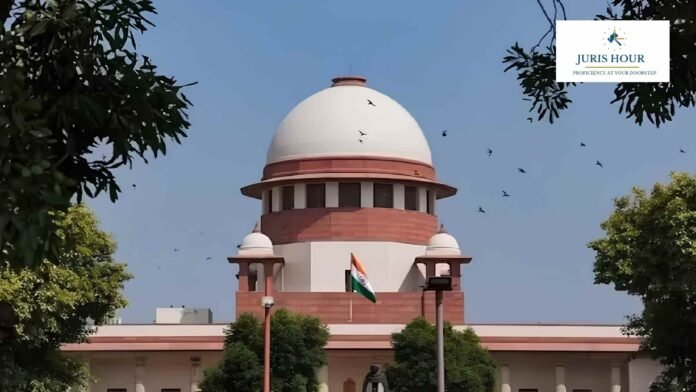
The Supreme Court has issued notice in a significant Goods and Services Tax (GST) matter concerning the legality of retrospective imposition of penalty and the requirement of individual pre-deposit for filing an appeal under Section 107(6) of the Central Goods and Services Tax Act, 2017.
The bench of Justice Ujjal Bhuyan and Justice Atul S. Chandurkar has also granted interim protection to the petitioner by directing that no coercive steps be taken against him pending further proceedings.
The proceedings arise from a challenge brought by Prateek Jain against the Additional Commissioner, Central Tax and CGST Delhi and other respondents. The petition sought special leave to appeal against the Delhi High Court’s decision dismissing his writ petition.
Buy Now: 50+ Supreme Court Judgments – July 2026
During the Supreme Court hearing, senior counsel appearing for the petitioner argued that the High Court had erred in dismissing the writ petition. Two principal issues were placed before the Supreme Court.
The first concerned the retrospective imposition of a penalty. According to the petitioner’s submissions, a penalty could not legally be imposed retrospectively. The contention raises an important question concerning the temporal operation of tax and penalty provisions and whether a taxpayer can be subjected to a penalty on the basis of a provision or requirement that was not applicable to the relevant period.
The second issue relates to the statutory pre-deposit requirement under Section 107(6) of the CGST Act, 2017.
The petitioner’s counsel submitted that, in similar circumstances, identically placed persons had already been granted relief to the extent that they were not required to make an individual pre-deposit under Section 107(6). The submission before the Supreme Court was therefore that comparable treatment ought to be extended to the petitioner as well.
Section 107 of the CGST Act deals with appeals before the Appellate Authority. Section 107(6) prescribes the statutory conditions relating to payment of the required amounts before an appeal can be entertained. The precise applicability of the provision to the circumstances raised in the present case is now before the Supreme Court for consideration.
After hearing the submissions, the Supreme Court directed that notice be issued to the respondents. The matter has been made returnable on September 23, 2026.
The issuance of notice means that the Court has agreed to examine the issues raised in the special leave petition. However, the order does not finally decide either the retrospective-penalty issue or the question concerning the individual pre-deposit requirement. The substantive legal questions will be considered after the respondents have an opportunity to respond.
Of particular significance is the interim protection granted by the Supreme Court. The Court directed that, in the meantime, no coercive steps shall be taken against the petitioner.
The direction provides immediate protection to the petitioner while the Supreme Court considers the challenge. It also ensures that the underlying dispute can proceed before the Court without coercive recovery or other enforcement action against the petitioner during the interim period.
The case raises two issues that could have wider relevance in GST litigation if the Supreme Court ultimately lays down a broader legal principle.
The first is the question of whether a penalty can be imposed retrospectively. Penalties in tax law can have serious financial consequences, and the temporal applicability of a penal provision is therefore an important issue whenever a taxpayer is subjected to a penalty based on a later legal development.
The second concerns the operation of the appellate pre-deposit mechanism under Section 107(6) of the CGST Act. The petitioner’s argument that similarly situated persons have received relief from an individual pre-deposit requirement introduces an issue concerning consistency and equal treatment in the application of the appellate framework.
At this stage, however, the Supreme Court has only issued notice and granted interim protection. No final determination has been made on either issue.
The Supreme Court proceedings originate from the Delhi High Court’s final judgment. The High Court had dismissed the petitioner’s writ petition, prompting the petitioner to approach the Supreme Court through a Special Leave Petition.
The Supreme Court record identifies the matter as a petition for special leave to appeal and records the appearance of senior counsel Pragyan Pradeep Sharma along with other counsel for the petitioner.
Membership Required to Access Case Details & Order Copy
To view the complete Case Details and Download Order Copy, you must have an active membership. Please subscribe to continue.
Read More: Rejection of S. 156(3) Application Does Not Bar Subsequent FIR: Supreme Court

