
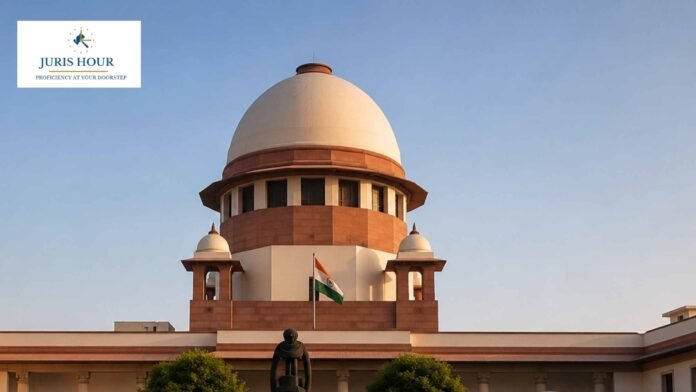
The Supreme Court has held that children who lose a parent in a motor vehicle accident are legally entitled to compensation towards parental consortium, in addition to compensation for loss of dependency.
Applying the principles laid down in National Insurance Company Ltd. v. Pranay Sethi and Magma General Insurance Company Ltd. v. Nanu Ram, the bench of Justice Nongmeikapam Kotiswar Singh and Justice N.V. Anjaria enhanced the compensation payable to the wife and three children of a deceased security personnel from ₹11,00,672 to ₹12,47,272.
Buy Now: JurisHour Ultimate Legal Research Combo – 4 Premium E-Magazines at an Unbeatable Price
Accident Involving Pedestrian Led to Fatal Injuries
The case arose from a motor accident that occurred on June 23, 2012, at Malkajgiri. Shaik Janimiya, who was walking on the road, was hit by a car bearing registration No. AP-29-AK-3717. The vehicle was alleged to have been driven rashly and at high speed.
Janimiya suffered injuries and subsequently succumbed to them while undergoing treatment at Raghavendra Hospital. A criminal case was registered against the driver under Crime No. 284 of 2012. His wife and three children, being his legal heirs and representatives, filed a claim petition seeking compensation of ₹9 lakh.
The deceased was 48 years old and was working as a private security personnel. His family claimed that he was earning ₹9,000 per month. However, the Motor Accidents Claims Tribunal accepted his monthly income at ₹7,000 on the basis of evidence given by the Director of his employer.
Tribunal Awarded ₹8.44 Lakh; High Court Increased It to ₹11 Lakh
The Claims Tribunal awarded a total compensation of ₹8,44,000, with interest at 7.5% per annum from the date of filing of the petition until realisation.
The claimants approached the Telangana High Court, which partly allowed their appeal and enhanced the compensation to ₹11,00,672, with interest at 7.5% per annum from the date of the Tribunal’s order until realisation.
The High Court calculated loss of dependency by taking the deceased’s monthly income at ₹7,000, adding 25% towards future prospects, deducting one-fourth towards personal expenses and applying a multiplier of 13. This resulted in compensation of ₹10,23,672 under loss of dependency.
The dispute before the Supreme Court principally concerned the failure to grant proper compensation under the head of parental consortium to the three children. The appellants had also challenged the determination of the deceased’s monthly income at ₹7,000 instead of the claimed ₹9,000.
Supreme Court Examines Scope of Consortium Compensation
The Supreme Court undertook a detailed examination of the development of the law relating to consortium and referred to several earlier judgments.
The Court noted that in Manjuri Bera v. Oriental Insurance Company Limited, it had held that the entitlement of a legal representative to maintain a compensation claim does not depend solely upon actual financial dependency. The important consideration is also the devolution of the estate of the deceased.
Similarly, in National Insurance Company Limited v. Birender, the Supreme Court had held that even major and married children who are earning can fall within the expression “legal representative” under Section 166(1)(c) of the Motor Vehicles Act, 1988. The absence of complete financial dependency does not by itself extinguish their right to maintain a claim.
The Court also referred to Gujarat State Road Transport Corporation v. Ramanbhai Prabhatbhai, observing that the expression “legal representative” ordinarily covers a person who in law represents the estate of the deceased or upon whom the estate devolves. A legal representative who suffers because of the death of a person in a motor accident has a remedy for compensation under the Act.
Parental Consortium Is a Distinct Head of Compensation
A significant part of the judgment deals with the concept of consortium.
The Supreme Court explained, relying on Magma General Insurance Company Ltd. v. Nanu Ram, that consortium is a comprehensive concept covering spousal, parental and filial consortium. It represents the loss suffered by family members in terms of the company, care, help, comfort, guidance, solace and affection that the deceased would have provided.
The Court specifically explained that parental consortium is the compensation payable to a child following the premature death of a parent. It compensates for the loss of parental aid, protection, affection, society, discipline, guidance and training that the child would otherwise have received from the deceased parent.
The Court therefore treated parental consortium as an independent and legally recognised component of motor accident compensation rather than something that could simply be subsumed into loss of dependency.
Tribunal and High Court Failed to Properly Award Consortium
Applying these principles to the case, the Supreme Court noted that the first appellant was the wife of the deceased, while appellants Nos. 2 to 4 were his sons and daughter. All three children were between 18 and 21 years of age.
The Court found that the children were legal representatives and dependants of the deceased and were consequently entitled to parental consortium.
The Tribunal had awarded only ₹5,000 to the wife under consortium and had granted no amount towards parental consortium to the children. The Supreme Court described this as a manifest error.
The High Court, despite enhancing the overall compensation to ₹11,00,672, had awarded a consolidated amount of ₹77,000 under the conventional heads. According to the Supreme Court, this also failed to satisfy the legal requirement of awarding the appropriate amount towards consortium to each eligible claimant.
₹40,000 Consortium Amount Increased by 10% Every Three Years
The Supreme Court relied particularly on its Constitution Bench ruling in Pranay Sethi, which had prescribed amounts under conventional heads including loss of estate, loss of consortium and funeral expenses and laid down that such amounts should be enhanced by 10% every three years to maintain consistency with changing economic conditions.
The Court reiterated that consortium is an important and indispensable head of compensation in motor accident claims and that the prescribed amount is required to be increased by 10% at the end of every three years in accordance with Pranay Sethi.
Applying the principle, the Court held that each claimant was initially entitled to ₹40,000 towards consortium. After applying the 10% enhancement applicable under the prevailing calculation, the amount payable to each claimant came to ₹48,400.
Thus, the wife became entitled to ₹48,400 towards spousal consortium, while each of the three children became entitled to ₹48,400 towards parental consortium. The total consortium compensation therefore came to ₹1,93,600.
Funeral Expenses and Loss of Estate Also Increased
The Supreme Court further found it appropriate to increase the amounts under the heads of funeral expenses and loss of estate from ₹10,000 each to ₹15,000 each.
The Court retained the loss of dependency amount awarded by the High Court at ₹10,23,672.
The final calculation was therefore:
| Head of Compensation | Amount |
| Loss of dependency | ₹10,23,672 |
| Spousal consortium | ₹48,400 |
| Parental consortium to three children | ₹1,45,200 |
| Total consortium | ₹1,93,600 |
| Funeral expenses | ₹15,000 |
| Loss of estate | ₹15,000 |
| Total compensation | ₹12,47,272 |
The Supreme Court’s calculation, reproduced in the judgment on page 15, increased the total compensation to ₹12,47,272.
Claim for Higher Monthly Income Not Accepted
The appellants had also argued that the deceased’s income should have been taken at ₹9,000 per month because his salary certificate reflected that amount.
The Supreme Court, however, did not disturb the finding that the deceased’s monthly income was ₹7,000. It noted that the Tribunal had relied upon the testimony of PW-3, the Director of the deceased’s employer, who stated that the deceased was earning ₹7,000 per month. The Tribunal therefore had not committed an error in adopting that figure.
Accordingly, the Court maintained the High Court’s calculation of loss of dependency at ₹10,23,672.
Additional ₹1.46 Lakh Payable With 7.5% Interest
As a result of the Supreme Court’s recalculation, the compensation increased from the High Court’s ₹11,00,672 to ₹12,47,272, resulting in an additional amount of ₹1,46,600.
The Court directed that the additional amount would carry 7.5% interest from the date of filing of the claim petition until realisation. The Insurance Company was directed to deposit the additional amount along with applicable interest before the concerned Tribunal within six weeks.
After the deposit, the claimants will receive the amount in equal proportion. The Tribunal has been directed to release the amounts after completing the necessary verification process by directly crediting the respective shares into the bank accounts of the appellants.
Supreme Court’s Broader Significance for Motor Accident Claims
The judgment reinforces that compensation in motor accident death cases is not confined to the financial loss suffered by dependants. The law also recognises the non-pecuniary loss suffered by family members due to the premature death of a spouse or parent.
The ruling is particularly significant for children because it makes clear that parental consortium is a separately recognised head of compensation. Where a parent dies in a motor accident, eligible children cannot be denied consortium merely because the calculation of loss of dependency is separately made.
The judgment also reiterates the importance of applying the structured principles evolved by the Supreme Court in Pranay Sethi and Magma General Insurance. Courts dealing with motor accident claims are required to ensure that the conventional heads of compensation, including consortium, are properly awarded so that the final compensation constitutes “just compensation.”
Appeal Allowed; Compensation Finally Fixed at ₹12.47 Lakh
Modifying the judgment and award of the Telangana High Court, the Supreme Court enhanced the compensation to ₹12,47,272, together with the additional interest directed on the enhanced amount.
The appeal was accordingly allowed in the above terms. The judgment was pronounced at New Delhi on August 14, 2026.
Key Takeaway: The Supreme Court has reaffirmed that spousal and parental consortium are distinct and compensable heads in motor accident death claims, and eligible children are entitled to parental consortium for the loss of the care, guidance, affection and protection of a deceased parent. In the present case, this principle resulted in an additional ₹1,46,600, taking the total compensation payable to the deceased’s family to ₹12,47,272.
Membership Required to Access Case Details & Order Copy
To view the complete Case Details and Download Order Copy, you must have an active membership. Please subscribe to continue.
Read More: CESTAT Allows 12% Interest on Refund of Service Tax Paid by Mistake of Fact

