
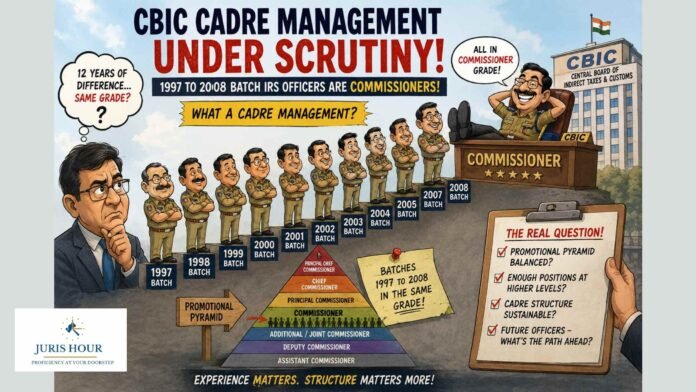
A striking feature of the current cadre structure of the Central Board of Indirect Taxes and Customs (CBIC) has drawn attention within the indirect-tax administration: officers belonging to batches ranging from 1997 to 2008 of the Indian Revenue Service (Customs & Indirect Taxes) are now serving in the Commissioner grade.
The development has renewed questions over the pace of promotions, cadre restructuring, vacancy management and the manner in which senior positions are distributed within the CBIC. The issue is particularly significant because the span covers twelve successive batches, indicating how the promotional structure has evolved over nearly three decades.
The observation is not merely anecdotal. CBIC’s own departmental-officer portal maintains information on the sanctioned strength, vacancies, seniority and posting structure of Group-A IRS officers, while its published records separately list promotion and posting orders for Commissioner and higher grades.
Buy Now: Recovery Of Tax Dues And Penalty Against Legal Heirs Of A Deceased Assessee : Case Compilation
2008 Batch Reaches Commissioner Grade
The most striking development is the elevation of the 2008 batch.
In January 2026, reports based on CBIC’s promotion exercise stated that 55 IRS (Customs & Indirect Taxes) officers of the 2008 batch were empanelled and promoted to the grade of Commissioner of Customs & Indirect Taxes against panel year 2026.
Further promotions and proforma promotions involving officers of the same batch have subsequently been reported. This means that officers recruited in 2008—who have around 18 years of service by 2026—have entered the Commissioner-level structure in significant numbers.
The development provides a concrete basis for understanding the unusual batch spread now visible in the Commissioner cadre.
From 1997 to 2008: A Wide Batch Spread
At the other end of the spectrum, officers from the 1997 batch have been serving in Commissioner and Principal Commissioner-level positions for years.
For instance, publicly available officer records identify 1997-batch IRS (C&IT) officers serving as Commissioners and Principal Commissioners. One such officer is recorded as Commissioner in a CBIC formation, while another 1997-batch officer is recorded as having progressed from Commissioner to Principal Commissioner.
The result is an unusual-looking picture: officers recruited more than a decade apart can simultaneously be found occupying the Commissioner grade.
This does not, by itself, establish that every officer in every batch from 1997 through 2008 is a Commissioner. Individual promotions depend on vacancies, eligibility, empanelment, seniority, vigilance status, service records and other applicable conditions. The more precise observation supported by available records is that the Commissioner-grade cadre now contains officers spanning this broad range of batches.
Why the Batch Spread Matters
The real question is not whether an individual officer deserves promotion. The issue is cadre architecture.
CBIC is a very large tax administration dealing with Customs, GST, Central Excise and related enforcement and administrative functions. Its field organisation includes Principal Chief Commissioner and Chief Commissioner formations as well as numerous Commissionerates and specialised directorates. CBIC’s published organisational information describes a nationwide structure comprising zones, Commissionerates and specialised formations.
Consequently, cadre management becomes critical. The Department has to continuously balance:
- sanctioned posts and actual vacancies;
- promotional avenues at every level;
- seniority and empanelment;
- cadre restructuring;
- creation or abolition of posts;
- deputation and repatriation;
- functional requirements of GST and Customs formations;
- higher administrative posts; and
- career progression of successive IRS batches.
A bottleneck at one level can have a cascading effect on the entire hierarchy.
The Promotion Pyramid
A simplified view of the Group-A structure illustrates the problem.
Assistant Commissioner → Deputy Commissioner → Joint Commissioner → Additional Commissioner → Commissioner → Principal Commissioner → Chief Commissioner/Principal Chief Commissioner
When a large number of officers move into a higher grade simultaneously, the department has to create sufficient functional space for them. Otherwise, officers may technically attain a particular grade while the availability of suitable field or headquarters assignments becomes a separate administrative challenge.
CBIC’s own records show that promotions are periodically issued across different grades, including Joint Commissioner, Commissioner and Chief Commissioner levels.
The 2008-batch Commissioner promotions therefore need to be viewed as part of a much larger promotional chain rather than as an isolated development.
Cadre Management Is a Continuous Exercise
The Department of Revenue specifically deals with cadre control of IRS (Group-A) and IRS (C&CE) Group-A, demonstrating the importance of structured human-resource management in revenue administration.
Within CBIC, the Directorate General of Human Resource Development has a central role in HR-related functions. Its responsibilities include cadre management, performance management and capacity building.
That makes the current batch spread an important administrative issue rather than merely a matter of individual promotions.
The key challenge for cadre managers is to ensure that promotional progression remains reasonably aligned with the sanctioned strength and functional requirements of the organisation.
Is This a Sign of Better Promotion Management?
There are two ways of looking at the development.
One interpretation is positive. Faster progression to Commissioner level can reduce stagnation and provide officers with greater responsibility at a relatively earlier stage of their careers. For a tax administration undergoing substantial transformation following the introduction of GST, having a sufficiently large pool of experienced Commissioners can strengthen field administration, enforcement, taxpayer services and policy implementation.
The 2008-batch promotions could therefore be viewed as the outcome of efforts to clear accumulated promotional requirements and fill senior-level vacancies.
Or Does It Point to a Structural Imbalance?
The other interpretation is more critical.
If officers from successive batches are concentrated within the same senior grade, questions naturally arise about whether the hierarchy has become compressed.
A cadre requires adequate differentiation between levels of responsibility. If the Commissioner grade expands rapidly while higher-level positions do not increase proportionately, the department may eventually encounter another bottleneck at the Principal Commissioner and Chief Commissioner levels.
This is why cadre management cannot be measured simply by the number of promotions made in a particular year. It has to be evaluated across the entire promotional pyramid.
The GST Effect
The introduction of GST fundamentally changed the workload and organisational requirements of indirect-tax administration.
CBIC today administers a system substantially different from the pre-GST Central Excise and Service Tax regime. Commissioners are responsible for increasingly complex areas involving GST compliance, audit, investigation, intelligence, litigation, taxpayer services and inter-agency coordination, alongside Customs and enforcement functions.
A larger Commissioner pool can therefore serve an operational purpose.
At the same time, the creation and allocation of Commissioner-level positions must remain connected to actual organisational requirements rather than merely being treated as a mechanism for career progression.
Commissioner Grade Does Not Mean Identical Responsibilities
It is also important to understand that officers holding the same grade may perform substantially different functions.
A Commissioner may be posted in a GST Commissionerate, Customs formation, audit, appeal, intelligence, anti-smuggling, legal, headquarters or another specialised directorate.
CBIC’s current organisational information, for example, lists Commissioners working in coordination, Customs, Central Excise, PAC, legal and anti-smuggling functions, among others.
Therefore, the presence of multiple batches in the Commissioner grade does not necessarily mean that officers are performing identical jobs or exercising identical operational responsibilities.
The Bigger Question: What Is the Ideal Cadre Structure?
The more important policy question is whether CBIC’s sanctioned strength and promotional structure are keeping pace with the organisation’s expanding responsibilities.
An efficient cadre-management system should ideally provide:
Predictable career progression: Officers should have reasonable clarity regarding the normal trajectory of advancement.
Adequate promotional posts: Vacancies should not accumulate unnecessarily because of structural constraints.
Functional deployment: Promotions should correspond with the actual need for supervisory positions.
Balanced hierarchy: Growth at the Commissioner level should be accompanied by adequate opportunities at Principal Commissioner and Chief Commissioner levels.
Transparent seniority and empanelment: Officers should be able to understand the principles governing their progression.
Long-term manpower planning: Cadre reviews should anticipate future requirements rather than merely respond to accumulated vacancies.
The Numbers Tell Only Part of the Story
The headline fact that 1997-to-2008 batch officers are represented in the Commissioner grade is attention-grabbing, but it should not automatically be characterised as evidence of either successful or failed cadre management.
A proper assessment would require examination of the sanctioned strength of each grade, the number of officers actually in position, vacancy position, batch-wise seniority, promotion dates, empanelment years, deputation, officers on leave or training, and the number of functional Commissioner posts available across CBIC.
CBIC itself publishes information concerning sanctioned working strength and vacancy positions for Group-A IRS officers, underscoring that these are measurable administrative parameters.
A Cadre at an Interesting Inflection Point
The 2026 promotion of a large number of 2008-batch officers to Commissioner grade marks an important point in the evolution of the CBIC cadre.
For officers from the 1997 batch, nearly three decades have passed since recruitment. For officers of the 2008 batch, approximately eighteen years of service have elapsed. Their simultaneous presence in the Commissioner-grade structure demonstrates how the organisation has compressed a significant portion of its senior officer pyramid into a relatively broad band of batches.
The development therefore raises a legitimate administrative question:
Is CBIC witnessing a successful removal of promotional stagnation, or is it creating a new structural challenge at the higher levels of the cadre?
The answer will depend on what happens next—not merely at the Commissioner level, but at the Principal Commissioner, Chief Commissioner and Principal Chief Commissioner levels.
Conclusion
The emergence of Commissioner-level officers from batches stretching from 1997 through 2008 is undoubtedly an unusual feature of the present CBIC cadre landscape. The 2008-batch promotions in particular demonstrate how rapidly the Commissioner cadre has expanded at the junior end of the senior hierarchy.
But the development should be viewed through the wider lens of cadre planning, sanctioned strength, vacancies, organisational requirements and promotional pyramids.
For an organisation as large and strategically important as CBIC, cadre management is not simply about promoting officers. It is about ensuring that the right number of officers are available at the right grade, at the right time, with meaningful responsibilities and a viable promotional pathway ahead.
That is ultimately where the debate over CBIC’s current Commissioner-heavy structure becomes important: the question is not merely “how many Commissioners are there?” but whether the cadre has been designed to make effective use of them while maintaining a healthy promotional pyramid for the generations of IRS officers that follow.
Read More: Reopening Based on Issues Already Examined in Scrutiny Is Mere Change of Opinion: Gujarat High Court

