
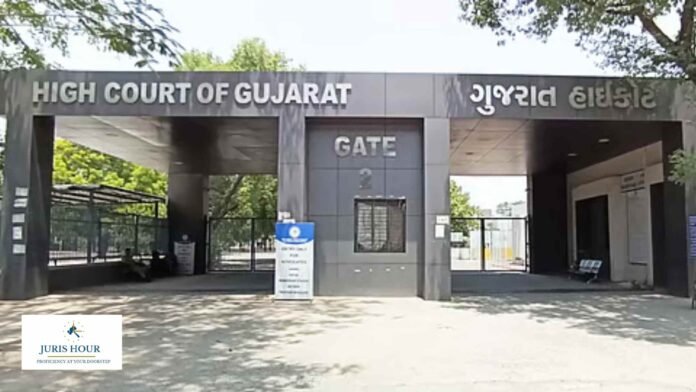
The Gujarat High Court has quashed reassessment proceedings holding that the Income Tax Department could not reopen an assessment on the basis of issues that had already been examined during the original scrutiny proceedings.
The Bench comprising Justice A.S. Supehia and Justice Vaibhavi D. Nanavati set aside both the order passed under Section 148A(3) of the Income Tax Act, 1961, and the subsequent notice issued under Section 148.
The petitioner/assessee is a company engaged in the business of trading and supplying gold and silver jewellery, had filed its income-tax return for A.Y. 2021-22 declaring total income of ₹29,62,190.
Buy Now: Recovery Of Tax Dues And Penalty Against Legal Heirs Of A Deceased Assessee : Case Compilation
The return was initially processed under Section 143(1) and was subsequently selected for complete scrutiny under Computer Aided Scrutiny Selection (CASS). The scrutiny was aimed, among other things, at examining purchases from entities flagged as “high-risk billers” on the insight portal based on information from the Central Board of Indirect Taxes and Customs (CBIC).
During the scrutiny proceedings, the Assessing Officer issued notices under Sections 143(2) and 142(1), requiring the assessee to furnish various documents and explanations. The company responded with detailed submissions and supplied its audited financial statements, purchase and sales ledgers, GST-related records, bank statements, details of unsecured loans and trade payables, stock statements and other supporting material.
The Assessing Officer subsequently issued a show-cause notice dated December 14, 2022, proposing substantial additions. The concerns included purchases from parties identified as “high-risk billers”, alleged discrepancies between purchases recorded in the books and figures reflected in GSTR-2A, non-submission of supporting documents and questions concerning trade payables and unsecured loans.
After considering the assessee’s response, the Department passed the final assessment order on December 27, 2022, under Section 143(3) read with Section 144B.
The Assessing Officer rejected the books of account and estimated profit at 10% of sales, treating certain purchases as bogus. The assessment resulted in determination of total income at approximately ₹28.43 crore, accompanied by a tax demand of approximately ₹12.61 crore under Section 156.
The assessee challenged the assessment order by filing an appeal under Section 246A on January 19, 2023. That appeal remained pending when the reassessment proceedings were subsequently initiated.
Despite the earlier scrutiny assessment, the Department initiated reassessment proceedings for the same assessment year.
A notice dated March 28, 2025, under Section 148A(1), relied upon information uploaded on the insight portal and alleged escapement of income amounting to approximately ₹238.13 crore.
The assessee objected to the proposed reopening, contending that the transactions forming the basis of the reassessment had already been examined during the original scrutiny assessment.
It specifically pointed out that GST data, insight portal alerts, reconciliation statements, purchase and sales ledgers, bank statements, details of unsecured loans and trade payables and other relevant material had already been placed before and examined by the Assessing Officer.
Nevertheless, on June 4, 2025, the Department passed an order under Section 148A(3), concluding that income amounting to approximately ₹30.79 crore had escaped assessment. A notice under Section 148 was thereafter issued, prompting the assessee to approach the Gujarat High Court.
Before the High Court, the assessee argued that the reassessment proceedings were without jurisdiction and represented nothing more than a change of opinion.
It was submitted that the Department had already examined the very transactions now being relied upon to reopen the assessment. According to the assessee, all relevant material—including GST data, insight portal alerts, reconciliation statements, purchase and sales ledgers, bank statements, details of unsecured loans and trade payables, stock records and salary payment details—had been produced during the original scrutiny proceedings.
Therefore, the assessee contended that there was no fresh tangible material available after completion of the original assessment that could legitimately justify reopening the case.
The Revenue opposed the petition and argued that the reassessment proceedings should not be interfered with at that stage.
The Department contended that the Investigation Wing was in possession of tangible material indicating escapement of taxable income. It specifically relied upon information concerning transactions involving M/s SB Jewels and M/s Prestine Jewels, which were allegedly newly tracked by GST intelligence in connection with fake Input Tax Credit.
According to the Revenue, the assessee had allegedly benefited from bogus purchases from non-existent entities and, therefore, the reopening could not be characterised merely as a change of opinion.
The Division Bench examined the record of the original scrutiny assessment in detail.
The Court noted that the assessee’s return had specifically been selected for complete scrutiny concerning purchases from certain “high-risk billers”. During that process, the assessee had furnished extensive documentation, including audited financial statements, GSTR-2A and reconciliation statements, purchase and sales ledgers, supplier confirmations, bank statements, details of unsecured loans and trade payables, stock summaries and salary payment records.
The Assessing Officer had also specifically sought details relating to the credit note ledger of M/s Vishu Gold and Viram Jewellers, which were furnished by the assessee.
After considering the material and submissions, the Assessing Officer completed the assessment on December 27, 2022.
The High Court further noted that the assessee had specifically demonstrated that sales and purchases involving entities such as S.B. Jewels, Vishu Gold, Viram Jewels, Shri Ram Bullion and Prestine Jewels had already been subjected to scrutiny during the original assessment.
The assessee had produced GST two-way reconciliation, party confirmations pursuant to notices under Section 133(6), and proof of payments through banking channels during the original proceedings.
The Court found that these materials had already formed part of the scrutiny assessment process.
The crucial finding of the Gujarat High Court came from its comparison of the original assessment with the subsequent reassessment proceedings.
The Court observed that the original Assessing Officer had rejected the books of account and made a substantial addition by estimating net profit at 10% of total sales turnover.
According to the Bench, the alleged escapement of income referred to in the later reassessment proceedings had already been subsumed in the assessment order dated December 27, 2022.
The Court therefore held that reopening the assessment on the same underlying issues amounted to nothing more than a change of opinion.
The finding is significant because the Department had already undertaken a detailed scrutiny of the assessee’s books and the relevant purchase transactions. Once those matters had been considered and an assessment order had been passed, the subsequent attempt to reopen the assessment on the same factual foundation could not be sustained merely by characterising the information differently.
Allowing the writ petition, the Gujarat High Court quashed the June 4, 2025 order passed under Section 148A(3) as well as the consequential notice issued under Section 148 for A.Y. 2021-22.
The Court made the rule absolute, thereby bringing the impugned reassessment proceedings to an end.
Membership Required to Access Case Details & Order Copy
To view the complete Case Details and Download Order Copy, you must have an active membership. Please subscribe to continue.
Read More: Assessment Already Examined In Scrutiny Can’t Be Reopened On Same Material: Gujarat HC

