
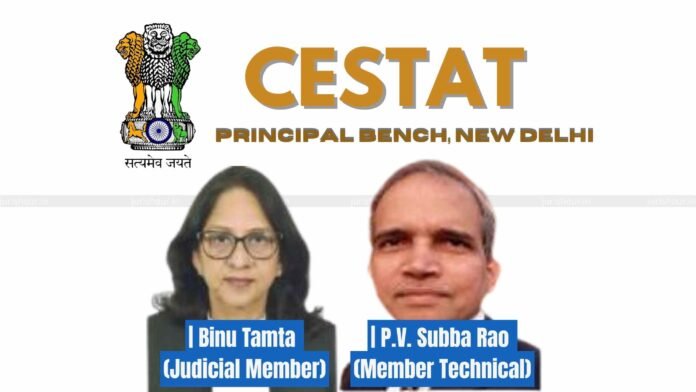
The Customs, Excise & Service Tax Appellate Tribunal (CESTAT), Principal Bench, New Delhi, has dismissed an appeal concerning availment of CENVAT credit of service tax paid on input services received during the period when the assessee was enjoying an area-based Central Excise exemption.
The bench of Binu Tamta (Judicial Member) and P. V. Subba Rao (Technical Member) has observed that the extended period of limitation was validly invoked where the assessee had not disclosed that input service invoices received during the exemption period were being used for claiming CENVAT credit.
The Bench found that the circumstances recorded by the adjudicating and appellate authorities established the necessary ingredients for invoking the extended limitation period.
Buy Now: 70+ Judgements Indirect Tax – July 2026 | E-Magazine
The assessee was engaged in the manufacture of excisable goods, including auto parts and chain components. It had been availing area-based exemption from Central Excise duty under Notification No. 50/2003-CE dated June 10, 2003.
The exemption continued up to November 29, 2016. From November 30, 2016, after completion of the exemption period, the assessee began clearing its finished goods on payment of applicable Central Excise duty.
The dispute arose over CENVAT credit of service tax paid on input services. According to the Department, certain input services had been received during the exemption period and were used in connection with the manufacture of exempted goods. Consequently, credit relating to those services was considered inadmissible under Rule 6(1) of the CENVAT Credit Rules, 2004.
Following an audit, the Department issued a show cause notice dated September 10, 2020, proposing recovery of ₹65,70,212 in CENVAT credit under Section 11A(4) of the Central Excise Act, 1944, read with Rule 14 of the CENVAT Credit Rules, 2004.
The Department invoked the extended period of limitation.
The adjudicating authority subsequently dropped a portion of the proposed demand amounting to ₹2,98,041, relating to rent-a-cab and civil construction services. However, it confirmed the remaining demand of ₹62,72,171, holding that the assessee had availed credit on input services used in the manufacture of exempted goods during the exemption period.
The assessee’s appeal against the adjudication order was dismissed by the Commissioner (Appeals), resulting in the appeal before the CESTAT.
Before the CESTAT, the assessee restricted its arguments to the question of limitation. It contended that the entire demand was time-barred and that the Department could not invoke the extended period in the absence of suppression of facts, wilful misstatement or any intention to evade payment of duty.
The assessee argued that it had regularly filed statutory returns and had disclosed the CENVAT credit availed by it. It also maintained that all material facts were available to the Department and had been verified from time to time.
According to the assessee, it had specifically informed the Department through letters beginning November 30, 2016, that it would clear finished goods on payment of applicable duty after availing CENVAT credit. A further communication dated December 10, 2016 allegedly informed the Department regarding availment of CENVAT credit on input services.
The department defended the invocation of the extended limitation period by relying upon the findings of the authorities below.
The adjudicating authority had distinguished between the assessee’s general intimation regarding availment of CENVAT credit and the specific fact that credit was being claimed in respect of input service invoices received before November 30, 2016, when the assessee was still enjoying the area-based exemption.
According to the adjudicating authority, the assessee had not specifically disclosed this aspect to the Department.
The adjudicating authority also examined the ER-1 returns filed for the period from November 2016 to June 2017. It observed that credit relating to input service invoices received before November 30, 2016 had been taken in returns filed over the subsequent months rather than being disclosed in the November 2016 ER-1 return as a whole.
The authority therefore concluded that the availment could not simply be treated as an inadvertent error or bona fide mistake. It treated the manner in which the credit was availed as evidence supporting the allegation of deliberate suppression.
The CESTAT noted that the undisputed position was that the assessee had availed area-based exemption up to November 30, 2016 and had taken CENVAT credit of service tax paid on services utilised during the exemption period.
The authorities below had proceeded on the basis of Rule 6(1) of the CENVAT Credit Rules, 2004, which restricted availment of credit in respect of input or input services used in the manufacture of exempted goods or provision of exempted services.
Since the assessee’s counsel did not press the appeal on the merits of the credit itself and confined the challenge to limitation, the Tribunal stated that it was unnecessary to independently examine the substantive eligibility of the credit.
Thus, the central question before the Tribunal was not whether the disputed input services could otherwise qualify for credit, but whether the Department was entitled to travel beyond the normal limitation period on the facts of the case.
The Tribunal rejected the assessee’s limitation argument.
It observed that although the assessee had informed the Department that it would avail CENVAT credit after the expiry of the area-based exemption, it had not informed the Department that it would also avail CENVAT credit against input service invoices received during the exemption period.
According to the Bench, this distinction was significant.
The Tribunal noted that the authorities had also found that the assessee had taken credit against input service invoices received before November 30, 2016 in its ER-1 returns covering November 2016 to June 2017, while those invoices were not reflected in the November 2016 return as a whole.
On this factual foundation, the Tribunal held that the authorities below were justified in treating the conduct as more than a mere mistake and in concluding that the ingredients necessary for invoking the extended period were satisfied.
An important aspect of the ruling was the Tribunal’s treatment of an earlier decision involving the same assessee.
The assessee relied upon an earlier decision of a Single Member of the Tribunal, which had dealt with the question of limitation and had held that the Department was aware of the assessee’s area-based exemption and subsequent availment of CENVAT credit.
In that earlier matter, the Tribunal had considered the assessee’s communications to the jurisdictional Superintendent, the particulars of credit reflected in monthly ER-1 returns and a Chartered Accountant’s certificate concerning CENVAT credit on inputs and capital goods received at the factory. The earlier decision had concluded that the Department ought to have issued the show cause notice within the normal period.
However, the present Division Bench declined to follow that earlier view.
The Bench pointed out that the impugned order before it contained additional factual findings concerning input service invoices received before November 30, 2016 and the manner in which the corresponding credit had been reflected in the ER-1 returns.
The Tribunal specifically noted that the disputed credit was not mentioned in the November 2016 ER-1 return as a whole, despite the assessee being in possession of the relevant invoices. In view of these additional circumstances, the Bench held that the earlier Single Member decision could not govern the present case.
The Tribunal ultimately concluded that the assessee was not entitled to CENVAT credit in respect of input service invoices received prior to November 30, 2016.
Having found that the extended limitation period was properly invoked and that the substantive order did not warrant interference, the Bench affirmed the impugned order.
The appeal was accordingly dismissed.
The adjudicating authority had also recorded that the disputed credit was recoverable under Rule 14 of the CENVAT Credit Rules, 2004 read with Section 11A(4) of the Central Excise Act, 1944, along with applicable interest under Section 11AA.
It had further held the assessee liable to penalty under Rule 15(2) of the CENVAT Credit Rules read with Section 11AC of the Central Excise Act, on the basis of its finding that inadmissible credit had been suppressed with intent to evade Central Excise duty.
Membership Required to Access Case Details & Order Copy
To view the complete Case Details and Download Order Copy, you must have an active membership. Please subscribe to continue.

