
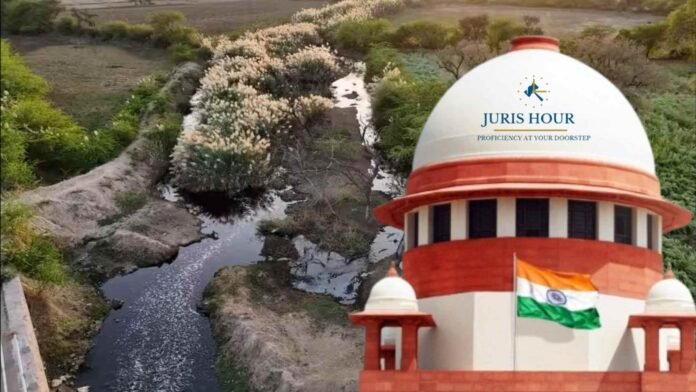
The Supreme Court has directed the Rajasthan Government to establish a comprehensive institutional framework for tackling industrial pollution, riverine degradation, groundwater depletion and ecological damage affecting the Jojari-Bandi-Luni river ecosystem.
The bench of Justice Vikram Nath and Justice Sandeep Mehta held that the material placed before the Court demonstrated severe degradation of the riverine ecosystem, contamination of water bodies, illegal discharge of industrial effluents, deficiencies in land-use regulation and challenges relating to wildlife habitats and ecological restoration.
The bench observed that these problems could not be effectively addressed through isolated departmental action and required a coordinated, multidisciplinary institutional response.
Buy Now: 50+ Supreme Court Judgments – July 2026
The proceedings arose against the backdrop of reports concerning widespread contamination of water bodies, discharge of untreated industrial effluents, groundwater degradation, damage to agricultural land and wildlife habitats, possible encroachments on riverbeds and floodplains, and deficiencies in the identification of High Flood Lines and ecological buffer zones.
The Court also considered concerns regarding ecological restoration, riverine ecosystem protection, river-basin management and the functioning of Common Effluent Treatment Plants (CETPs), particularly the CETP at Sangariya.
The Supreme Court had earlier issued several interim directions, including requiring scientific treatment and safe disposal of accumulated effluents at CETP Sangariya, preventing resumption of industrial operations without appropriate permission, facilitating ecological restoration of identified lands and examining whether graver penal provisions were warranted in environmental offences.
The Special Investigation Team (SIT), constituted pursuant to the Court’s directions, reviewed 16 criminal cases concerning riverine pollution in Jodhpur, Pali and Balotra districts, with four FIRs having been registered pursuant to its constitution.
According to the SIT report, investigations were examining documentary, oral and digital evidence, including CCTV footage, photographs and videography. The SIT also reported arrests and stated that scientific examination of samples and analysis of SCADA inflow and outflow data were underway.
Significantly, the SIT stated that the material collected prima facie indicated connivance between officials of CETPs and member industrial units, allegedly facilitating discharge of untreated industrial effluents by deliberately bypassing prescribed treatment processes.
The investigation is also examining the financial and institutional trail behind the alleged offences and independently scrutinising the role of public servants. The Court directed that the investigation must go beyond the immediate acts of illegal discharge and uncover the complete chain of events, decision-making processes and institutional mechanisms involved.
The Bench further observed that the invocation of graver offences and arrests appeared to have occurred only when the matter approached the hearing date, raising questions regarding the bona fides of the SIT’s actions. It consequently ordered a deeper and more comprehensive investigation.
The Court also examined a report concerning the pink coloration of a pond near the Jojari River at Tanawada.
The Rajasthan Government stated that the district administration had undertaken drone surveys, inspections for illegal pipelines, surveillance operations, vehicle checks, scientific water sampling and installation of CCTV cameras.
The Rajasthan State Pollution Control Board (RSPCB) engaged IIT Jodhpur to undertake a scientific assessment. Its preliminary opinion indicated that saline textile wastewater could not be ruled out, but the available material did not establish any particular dye or identifiable discharge source.
According to the material placed before the Court, the pink coloration was considered most likely to result from a combination of saline and organic contamination, evaporation, stagnation and microbial activity. Further specialised sampling, microscopic and molecular analyses and targeted dye screening were recommended over a period of 10–12 weeks. The Supreme Court directed that the remedial recommendations be implemented expeditiously, subject to the Committee’s approval.
The Court also considered pollution concerns in the Sanganer-Dravyavati-Nevta region.
The State informed the Court that 1,767 textile processing units had been identified. Of these, 892 were members of a 12.3 MLD Zero Liquid Discharge-based CETP, while 875 units remained outside the CETP network.
The existing CETP was operating below designed capacity because of incomplete connectivity and the non-operational status of the Reverse Osmosis reject management system. The State reported that closure directions under Section 33A of the Water (Prevention and Control of Pollution) Act, 1974 had been issued against 814 industrial units, prosecutions had been initiated against the CETP management and 37 illegally operating textile processing units, and environmental compensation had been imposed upon the CETP. A sealing drive had also resulted in 65 industrial units being sealed.
The State further proposed completion of conveyance infrastructure, SCADA-based monitoring, individual Zero Liquid Discharge systems for non-member units and an additional CETP for units outside the existing treatment network.
A central concern identified by the Court was the absence of scientifically determined High Flood Lines and ecological buffer zones.
The Court found that the absence of such demarcation had facilitated indiscriminate industrial development, encroachments on riverbeds and floodplains and degradation of the river ecosystem.
It therefore directed the State to undertake a comprehensive scientific exercise for determining and demarcating the High Flood Line and ecological buffer zones for river systems across Rajasthan, in consultation with the Committee and appropriate expert institutions.
Importantly, until completion of this exercise, no fresh permissions facilitating industrial, commercial or residential development within identified river corridors can be granted by State departments, statutory authorities or local bodies.
The Supreme Court found that the existing Rajasthan River Basin and Water Resources Planning Authority had become largely defunct and had failed to effectively discharge its intended river-basin management functions.
The Court consequently directed Rajasthan to constitute an independent and adequately empowered River Commission/River Rejuvenation Authority for conservation, rejuvenation and integrated management of rivers and river basins.
The Authority will also be responsible for scientific determination of High Flood Lines and protection of riverine ecosystems throughout the State. For the present, it will function under the chairmanship of the Chief Secretary of Rajasthan, who may associate domain experts and technical institutions.
The Court also addressed the State’s heavy dependence on CETPs.
The reports indicated that excessive reliance on common treatment facilities had resulted in operational overload and transportation of industrial effluents over long distances, creating additional environmental risks.
The Court said the State may examine encouraging industries generating 100 KLD or more of industrial effluents to establish captive Effluent Treatment Plants (ETPs), wherever technically and economically feasible.
For smaller industries, the State and RSPCB may consider policies incentivising captive treatment facilities, with the ultimate objective of achieving Zero Liquid Discharge. However, the Court clarified that captive ETPs cannot replace robust common treatment infrastructure. Existing CETPs must also be brought to maximum capacity and additional CETPs may be established where necessary.
The proposed RIICO Industrial Area at Kakani also came under the Court’s scrutiny.
According to the Committee’s material, approximately 12.805 hectares of the proposed industrial area fell within the apparent High Flood Area, while no scientifically determined ecological buffer had been maintained. Proposed textile-processing units were stated to be located approximately 30–60 metres from the apparent high flood/riverine area.
The Court noted the risk that industrial effluents, seepage, storm-water runoff and flood-related dispersion of pollutants could contaminate the river system. Further allotment of plots and statutory consents in the area had already been kept in abeyance pending examination.
The Court directed that, after scientific demarcation of the High Flood Line and ecological buffer, the proposed industrial layout must be comprehensively reviewed. If any portion is found to encroach upon or adversely affect the High Flood Line, floodplains or ecological buffer, corrective measures including modification or relocation of affected industrial plots may be required.
The Court also noted prima facie irregularities concerning the Ambey Valley Industrial Park, including alleged conversion of agricultural land, deviations from the Master Plan, issuance of industrial pattas in an area earmarked for residential use and development of industrial plots close to or apparently within the riverbed and High Flood Area.
The Committee had also identified deficiencies in official records, including the reported non-availability of the layout approval file and several allotment files.
The Chief Secretary has accordingly been directed to undertake an inquiry into the legality of land-use conversions, approvals and allotments and take remedial and corrective measures as warranted by law.
The Supreme Court also linked industrial pollution with groundwater stress.
It observed that excessive industrial dependence on groundwater, combined with contamination of surface water bodies, had contributed to depletion of the water table in affected areas.
The State has been directed to formulate a comprehensive groundwater management strategy covering regulation of industrial groundwater extraction, reuse and recycling of treated wastewater, groundwater recharge and periodic monitoring of groundwater quality and levels.
The Court specifically directed that water-intensive industries shall not be permitted in areas identified as dark zones or over-exploited zones with reference to groundwater availability.
The Court also ordered scientific treatment and disposal of accumulated wastewater at the Ambey Valley and Khed HRTS/SEP sites.
The State informed the Court that nearly 200 million litres of accumulated wastewater remained stored at Ambey Valley and that approximately 1,105.08 metric tonnes of hazardous sludge had already been scientifically disposed of at an authorised facility.
At Khed, four of nine ponds had been dismantled and approximately 332 metric tonnes of hazardous sludge had been removed and scientifically disposed of.
The Court directed that the accumulated wastewater be scientifically treated and disposed of within a time-bound framework. RCC storage tanks and associated infrastructure must thereafter be dismantled and the land ecologically restored, including through plantation of native species and biodiversity conservation.
One of the most significant directions is the creation of an Integrated Coordination Group headed by the Chief Secretary of Rajasthan.
The Group is to include senior officers from the Environment, Forest, Water Resources, Industries, Urban Development, Revenue, Local Self Government and Agriculture Departments, along with the RSPCB and other authorities and experts considered necessary.
It will coordinate implementation of the Court’s directions, monitor ecological restoration and pollution-control measures, resolve policy-level issues and ensure that the actions of different departments form part of a unified strategy.
The State has been given seven days to constitute the Group, following which it must consult the High-Level Ecosystem Oversight Committee and prepare a Comprehensive Resolution Plan.
The Integrated Coordination Group has been directed to prepare and place before the Supreme Court, within three weeks of its constitution, a Comprehensive Resolution Plan.
The Plan must contain clearly identified action points, implementation timelines, monitoring mechanisms and defined responsibilities of concerned departments and statutory authorities.
The Court has also specifically encouraged the use of modern technology, including digitisation of land records, geo-spatial and satellite mapping, GIS-based monitoring and AI-enabled surveillance and analytics for environmental governance and enforcement.
The Court has directed Rajasthan to establish an Integrated Public Reporting and Environmental Grievance Redressal Mechanism.
The mechanism will include a QR-code-based digital platform through which members of the public can report illegal industrial effluent discharge, unauthorised industrial operations, illegal groundwater extraction, riverbed encroachments, hazardous waste dumping and destruction of wildlife habitats.
Complaints may be accompanied by photographs, videos and geo-tagged information. The system is required to provide confidential reporting, generate unique complaint numbers and electronically transmit complaints to the appropriate authorities for action and digital monitoring.
The Court has ordered the SIT to intensify investigations in all pending criminal cases and carry them to their logical conclusion.
The investigation must examine the role of public servants, industrial units, CETP office-bearers and every other person against whom credible material emerges. Appropriate action is to be taken strictly in accordance with law.
The Court also noted that the State’s report was silent regarding action taken against responsible RSPCB officers and directed that details of action taken or proposed against them be placed before the Committee within three days.
The Supreme Court clarified that the present phase of proceedings is primarily focused on the Jojari-Bandi-Luni river ecosystem and the institutional and remedial measures necessary for its restoration.
Issues concerning industrial pollution, illegal industrial operations and environmental degradation in Jaipur and adjoining areas will be considered at the next stage. The Court indicated that, after assessing the effectiveness of the institutional framework and remedial measures ordered in the present proceedings, it may consider extending a similar framework to other river systems and regions of Rajasthan facing comparable ecological problems.
The Supreme Court has directed that the matter be listed on September 22, 2026, as part-heard, for consideration of the Comprehensive Resolution Plan to be submitted by the Integrated Coordination Group in consultation with the Committee.
Membership Required to Access Case Details & Order Copy
To view the complete Case Details and Download Order Copy, you must have an active membership. Please subscribe to continue.

