
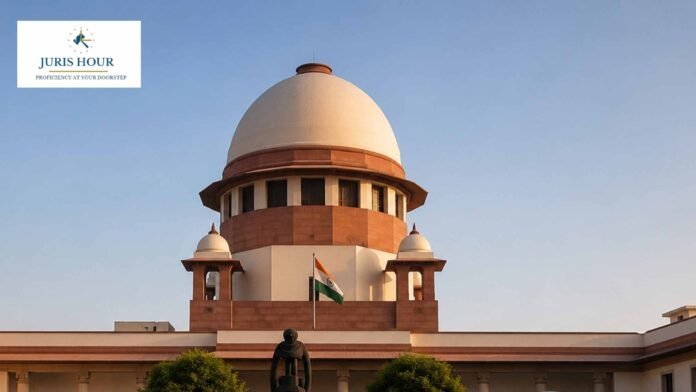
The Supreme Court has ruled that private professional colleges cannot claim continuation of the Central Government’s subvention scheme beyond the academic year 2002-03 merely because students admitted before the scheme’s discontinuation had not completed their courses.
The Bench of Justice Dipankar Datta and Justice Sheel Nagu held that the Karnataka High Court erred in directing the Government of India to continue paying annual subvention for the entire five-year duration of students admitted in the academic year 2002-03. According to the Court, the obligation to provide subvention was annual in nature and could not survive after the constitutional foundation of the scheme disappeared.
The litigation arose after the Government of India discontinued payment of subvention from the academic year 2002-03 onwards through a communication dated May 13, 2005. Sri Devraj Urs Medical College challenged the decision before the Karnataka High Court.
Buy Now: 50+ Supreme Court Judgments – July 2026
The Single Judge had quashed the Central Government’s communication and directed payment of subvention to students admitted up to the academic year 2002-03 until completion of their courses or for five years, whichever was earlier. However, the High Court simultaneously held that no subvention would be payable for admissions made from the academic year 2003-04 onwards because of the Constitution Bench judgment in T.M.A. Pai Foundation. The Division Bench affirmed this view, prompting the Union Government to approach the Supreme Court.
The subvention scheme originated from the Supreme Court’s interim order dated August 11, 1995 in the T.M.A. Pai Foundation litigation. It required the Central Government to pay ₹5,000 per student annually (excluding NRI students) to private professional colleges as a measure intended to eliminate capitation fees and promote merit-based admissions.
However, the interim arrangement itself was made subject to the final outcome of the Constitution Bench proceedings in T.M.A. Pai Foundation.
The principal issue before the Supreme Court was whether the Constitution Bench judgment delivered on October 31, 2002 permitted colleges to continue receiving subvention for students already admitted before the judgment.
The Court disagreed with the Karnataka High Court’s reasoning that a vested right had accrued in favour of colleges to receive subvention for the entire duration of the course.
It held that while the Constitution Bench did not expressly discuss the subvention payments, its declaration that the Unni Krishnan scheme was unconstitutional necessarily brought the interim subvention arrangement to an end. Consequently, the executive scheme “died its own death” on October 31, 2002.
The respondent college had relied heavily upon the Supreme Court’s clarificatory order dated April 1, 2003, arguing that the Constitution Bench judgment operated only prospectively and therefore protected existing entitlements.
Rejecting this submission, the Court observed that the clarificatory order merely directed that statutory enactments, schemes and regulations be brought into conformity with the Constitution Bench decision. It did not declare that the T.M.A. Pai Foundation judgment would operate prospectively in respect of executive schemes like the subvention arrangement.
The Bench further reiterated the settled principle that unless the Supreme Court expressly declares a judgment to have prospective operation, its decisions ordinarily operate retrospectively.
A significant factor influencing the Court was the respondent college’s failure to produce financial data demonstrating that the tuition fees collected and other revenue sources were insufficient to meet operational expenses.
During the hearing, the Bench specifically questioned whether any material had been placed on record regarding fees charged or expenditure incurred before and after the academic year 2002-03. The college admitted that no such material had been furnished.
Relying upon the precedent in Bharat Singh v. State of Haryana, the Court observed that factual assertions requiring proof cannot succeed in writ proceedings unless supported by proper pleadings and evidence. Since the college failed to establish any financial necessity for continuation of subvention, the Court found no basis to sustain the High Court’s directions.
The Bench also clarified the nature of the Government’s obligation under the interim scheme.
According to the judgment, the subvention was payable annually and not as a lump-sum commitment for an entire five-year medical course. Therefore, once the scheme became unconstitutional following the Constitution Bench judgment, the Government could not be compelled to continue annual payments merely because a student had been admitted before October 31, 2002.
The Court held that directing payment for the entire course duration after the scheme had ceased to exist was legally impermissible.
Partly allowing the appeals, the Supreme Court set aside the Karnataka High Court’s directions requiring payment of subvention for the entire five-year course in respect of students admitted during the academic year 2002-03.
The Court affirmed that no subvention is payable beyond the academic year 2002-03 under the interim scheme, thereby granting substantial relief to the Union Government and clarifying that executive benefits flowing from an interim judicial arrangement cannot survive after the legal foundation of that arrangement has been declared unconstitutional.
Membership Required to Access Case Details & Order Copy
To view the complete Case Details and Download Order Copy, you must have an active membership. Please subscribe to continue.
Read More: Non-Signatory Shareholder Bound by Arbitration Clause: Supreme Court

