
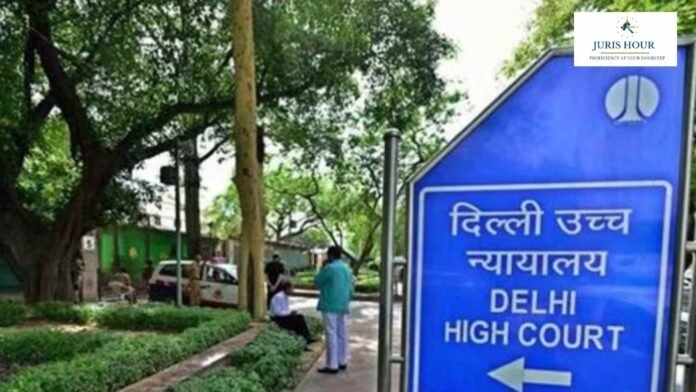
The Delhi High Court has reiterated that writ jurisdiction under Article 226 of the Constitution should not ordinarily be invoked where an effective statutory appellate remedy exists under the Central Goods and Services Tax (CGST) Act, particularly when the dispute involves contested questions of fact regarding service of notices and compliance with statutory procedures.
The bench of Justice Anil Kshetrapal and Justice Amit Mahajan dismissed a writ petition challenging an ex parte GST adjudication order and directed the petitioner to pursue the appellate remedy under Section 107 of the CGST Act.
The petitioner challenged an Order-in-Original passed under Section 74 of the CGST Act and the corresponding provisions of the Delhi GST Act and IGST Act. The adjudicating authority had confirmed a penalty of ₹2.39 crore, equivalent to the input tax credit allegedly passed on wrongly by the petitioner.
Buy Now: GST Judgements E-Compilation – June 2026
According to the petitioner, its business had ceased operations in early 2021 following the COVID-19 pandemic. It claimed to have applied for cancellation of its GST registration on 2 April 2021 and, thereafter, stopped accessing the GST portal. The petitioner asserted that it never received the show cause notice or subsequent notices fixing personal hearings, leading to the ex parte adjudication order.
The GST Department, however, maintained that the show cause notice was issued on 3 August 2024 and several notices of personal hearing were dispatched through Speed Post on different dates during 2025. Since no reply was received, the adjudicating authority proceeded to decide the matter ex parte.
The petitioner argued that the impugned order violated the principles of natural justice because neither the show cause notice nor the hearing notices had been effectively served.
It contended that once the business had shut down and an application for cancellation of registration had been filed, the department ought not to have continued serving notices only at the business premises. The petitioner further argued that the adjudicating authority failed to disclose whether the Speed Post communications were actually delivered or returned undelivered.
It was also submitted that the department should have adopted alternative modes of service permitted under Section 169 of the CGST Act, including service through publication or at the residential addresses of the firm’s partners. The petitioner relied on an earlier Delhi High Court decision in Seagull Maritime Agencies Pvt. Ltd. v. Union of India, where relief had been granted because the taxpayer was unable to access notices uploaded on the GST portal.
The department opposed the writ petition by pointing out that the impugned adjudication order was appealable under Section 107 of the CGST Act, making the writ petition not maintainable.
The department further submitted that the petitioner’s application for cancellation of GST registration had been rejected on 14 May 2024, meaning the registration continued to remain valid. It argued that all statutory notices had been served in accordance with Section 169 of the CGST Act by sending them through Speed Post to the registered address and by uploading them on the GST portal.
The department also emphasized that the CGST Act does not require service of notices upon the residential addresses of partners of a partnership firm and that the burden of establishing entitlement to input tax credit lay upon the taxpayer under Section 155 of the Act.
The High Court began by reiterating the settled principle that when a statute provides a complete appellate mechanism, High Courts ordinarily refrain from entertaining writ petitions against original adjudication orders.
The Bench referred to the Supreme Court’s decision in Assistant Commissioner of State Tax v. Commercial Steel Ltd., observing that although the existence of an alternative remedy is not an absolute bar, writ jurisdiction can be exercised only in exceptional cases involving violations of fundamental rights, breach of natural justice, jurisdictional errors, or challenges to the validity of statutory provisions.
However, the Court stressed that merely alleging a violation of natural justice does not automatically justify invocation of writ jurisdiction. The High Court must first determine whether the alleged violation genuinely falls within the recognized exceptions.
Applying these principles, the Bench found that the controversy revolved around disputed questions of fact.
The petitioner claimed that no notices had been served, whereas the department asserted that notices were validly served through Speed Post and were also uploaded on the GST portal. The Revenue also disputed the petitioner’s claim regarding cessation of business by pointing out that its cancellation application had been rejected.
The Court observed that deciding these rival factual assertions would require appreciation of evidence, something that is ordinarily outside the scope of writ proceedings under Article 226.
The Court further held that the petitioner’s argument that the department should have resorted to alternative modes of service under Section 169 also required factual examination.
Whether service by Speed Post and portal upload satisfied the statutory requirements, whether further modes of service were necessary, and the legal consequences arising from such questions were matters appropriately falling within the jurisdiction of the appellate authority under Section 107.
The Bench distinguished its earlier decision in Seagull Maritime Agencies, observing that the relief granted in that case depended upon its own peculiar facts, where the taxpayer had demonstrated inability to access notices uploaded on the GST portal.
In contrast, the present case involved disputed factual issues concerning service of notices and the status of the petitioner’s GST registration, making it inappropriate for adjudication in writ proceedings.
Holding that no exceptional circumstances existed to bypass the statutory appellate mechanism, the Delhi High Court dismissed the writ petition while granting liberty to the petitioner to file an appeal under Section 107 of the CGST Act.
The Court clarified that if such an appeal is filed, the period during which the writ petition remained pending before the High Court shall not be counted for the purpose of limitation. The appellate authority was directed to consider the appeal independently, including the issue of limitation, without being influenced by any observations made in the High Court’s order.
Membership Required to Access Case Details & Order Copy
To view the complete Case Details and Download Order Copy, you must have an active membership. Please subscribe to continue.

