
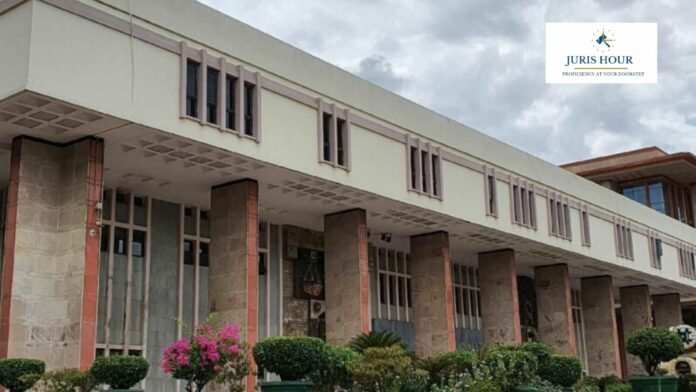
The Delhi High Court has held that a taxpayer challenging a Goods and Services Tax (GST) demand on the ground that he was denied the opportunity to cross-examine witnesses must ordinarily pursue the statutory appellate remedy under Section 107 of the Central Goods and Services Tax Act, 2017 (CGST Act).
The bench of Justice Anil Kshetarpal and Justice Shail Jain observed that although the Appellate Authority cannot remand a matter to the adjudicating authority, it possesses sufficiently wide powers to conduct further inquiry, including permitting cross-examination wherever necessary for a just adjudication.
The petitioner/assessee approached the Delhi High Court seeking to quash an adjudication order dated February 3, 2025, by which the Additional Commissioner (Adjudication), Central GST, Delhi raised a demand of approximately ₹64 crore. The demand was based on the allegation that the petitioner had wrongly availed Input Tax Credit (ITC) on the strength of fake invoices.
Buy Now: GST Judgements E-Compilation – June 2026
The Court noted at the outset that this was not the petitioner’s first attempt before the High Court. Two earlier writ petitions had already been disposed of with liberty to avail the statutory appellate remedy under Section 107 of the CGST Act. Despite those directions, the petitioner once again invoked the writ jurisdiction under Article 226 of the Constitution.
The petitioner contended that the adjudication proceedings suffered from a violation of the principles of natural justice because it had not been granted an opportunity to cross-examine witnesses whose statements formed the basis of the allegations.
It was further argued that Section 107(11) of the CGST Act prohibits the Appellate Authority from remanding a matter back to the adjudicating authority. Consequently, according to the petitioner, the appellate remedy was ineffective for curing the procedural defect arising from the denial of cross-examination.
The petitioner also submitted that it had already deposited approximately ₹64 crore, but the adjudicating authority had failed to appropriately consider this payment while passing the impugned order.
The Division Bench closely examined Section 107(11) of the CGST Act, which empowers the Appellate Authority to confirm, modify or annul the decision appealed against but prohibits it from referring the matter back to the adjudicating authority.
The Court clarified that while the provision bars remand, it simultaneously authorizes the Appellate Authority to undertake such further inquiry as may be necessary before deciding the appeal. According to the Bench, this statutory power is broad enough to enable the appellate forum to permit cross-examination of witnesses whenever it considers such examination necessary to ensure a fair and proper adjudication.
The High Court emphasized that the first appellate authority exercises extensive appellate jurisdiction and is competent to examine both factual and legal issues arising from the adjudication order. Therefore, grievances relating to denial of cross-examination are capable of being effectively addressed in the statutory appeal itself.
With respect to the petitioner’s submission that it had deposited ₹64 crore, the Court observed that the impugned adjudication order itself recorded consideration of this contention. In any event, the Court held that the Appellate Authority is fully empowered to re-examine this issue while deciding the statutory appeal.
Finding that an effective statutory remedy was available, the High Court declined to exercise its extraordinary jurisdiction under Article 226 of the Constitution. The Bench relegated the petitioner to the appellate remedy under Section 107 of the CGST Act.
Recognizing that the petitioner had spent time pursuing the writ proceedings, the Court granted liberty to file an application under Section 14 of the Limitation Act, 1963, seeking exclusion of the period during which the writ petition remained pending for the purpose of computing limitation for filing the appeal.
Membership Required to Access Case Details & Order Copy
To view the complete Case Details and Download Order Copy, you must have an active membership. Please subscribe to continue.

