
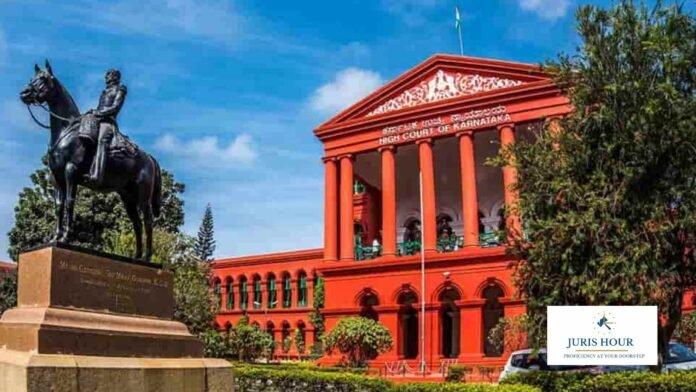
The Karnataka High Court has reiterated that a taxpayer challenging the cancellation of a GST registration must ordinarily avail the statutory appellate remedy under Section 107 of the Central Goods and Services Tax (CGST) Act, 2017, instead of directly invoking the writ jurisdiction under Article 226 of the Constitution.
The bench of Justice C.M. Poonacha declined to interfere with the cancellation of a GST registration, holding that the expression “any order” under Section 107 is broad enough to cover the impugned cancellation order, leaving all issues on merits open for adjudication before the appellate authority.
A writ petition was filed by a retired Executive Engineer whose GST registration had been suspended and subsequently cancelled following a complaint lodged by his wife regarding the business being operated from property standing in her name.
Buy Now: GST Judgements E-Compilation – June 2026
The dispute arose from a family-owned hotel business, “Haripriya International Lodging, Boarding and Restaurant,” operating on property purchased in the petitioner’s wife’s name in 2008. According to the petitioner, although the property was registered in his wife’s name, he had financed the construction and was authorized to operate the business through a registered General Power of Attorney (GPA) executed in 2018.
The petitioner further relied upon a consent letter dated August 5, 2022, allegedly issued by his wife permitting GST registration in his name. Based on that consent, GST registration was granted and the business continued to operate for several years.
However, following a complaint lodged by the petitioner’s wife before the GST authorities, the department issued a show cause notice on February 12, 2026, suspending the GST registration. After considering the petitioner’s reply, the authorities cancelled the registration on March 18, 2026. The petitioner thereafter submitted a representation seeking revocation of the cancellation before approaching the High Court.
The petitioner argued that the GST authorities failed to provide him with a personal hearing before rejecting his request for revocation of cancellation.
Relying upon Sections 29 and 30 of the CGST Act, the petitioner contended that once an application or representation seeking revocation of cancellation was submitted, the authorities were statutorily obligated to provide an opportunity of hearing before rejecting the request. He also invoked Section 75(4) of the CGST Act, which mandates personal hearing whenever an adverse decision is contemplated or when such hearing is sought by the taxpayer.
The petitioner further submitted that had such an opportunity been granted, he would have demonstrated that the General Power of Attorney was one coupled with interest, thereby justifying the GST registration in his own name.
The GST department opposed the writ petition, arguing that adequate opportunity had already been afforded to the petitioner.
According to the department, the suspension notice dated February 12, 2026, itself served as the show cause notice, to which the petitioner had submitted his reply on February 16, 2026. The cancellation order was thereafter passed on March 18, 2026. Since the petitioner had already participated in the proceedings leading to cancellation, the proper remedy against the final order was an appeal under Section 107 of the CGST Act rather than a writ petition.
The petitioner’s wife, who was impleaded as a private respondent, sought vacation of the interim protection earlier granted by the High Court.
She contended that the petitioner had suppressed material facts while obtaining interim relief. According to her, the consent letter relied upon by the petitioner for obtaining GST registration was forged and an FIR had already been registered regarding the alleged forgery.
The petitioner, however, disputed these allegations, maintaining that the consent had genuinely been given in 2022 and that the complaint was lodged only after matrimonial disputes arose between the parties more than three years later.
The High Court observed that irrespective of the inter se matrimonial dispute between the parties, the GST authorities are required to decide questions relating to registration and cancellation strictly in accordance with the provisions of the CGST Act.
The Court examined Sections 29 and 30 dealing with cancellation and revocation of registration, along with Section 75(4), but held that the existence of these provisions did not justify bypassing the statutory appellate mechanism available under Section 107.
The Court emphasized that Section 107 permits an appeal by “any person aggrieved by any decision or order” passed under the CGST Act. The phrase “any order,” the Court observed, is sufficiently wide to include the cancellation order challenged by the petitioner.
The Court rejected the petitioner’s contention that the appellate remedy could not be invoked because his subsequent representation for revocation had not been decided. It held that the cancellation order itself was appealable and that the statutory remedy remained fully available.
Holding that the petitioner had an effective alternate remedy under Section 107 of the CGST Act, the High Court declined to exercise its extraordinary writ jurisdiction under Article 226.
The Court clarified that all rival contentions on the merits of the dispute, including issues relating to the validity of the GST registration and the allegations surrounding the consent letter, were expressly kept open for consideration by the appellate authority.
Membership Required to Access Case Details & Order Copy
To view the complete Case Details and Download Order Copy, you must have an active membership. Please subscribe to continue.

