
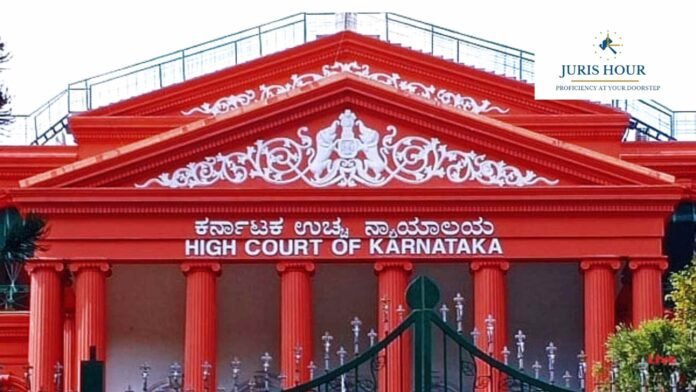
The Karnataka High Court has restored a GST appeal that had been dismissed as time-barred, holding that the peculiar facts of the case warranted the exercise of its extraordinary jurisdiction under Article 226 of the Constitution to ensure that the taxpayer was not deprived of its valuable statutory right of appeal.
The bench of Justice C.M. Poonacha quashed a garnishee notice issued during the pendency of the appellate proceedings and directed the appellate authority to decide the matter on merits.
The case originated from a show cause notice issued under Section 73 of the CGST Act on 27 November 2024 alleging excess availment of Input Tax Credit (ITC). Following the proceedings, the adjudicating authority passed an Order-in-Original under Section 73(9) on 8 January 2025 confirming the tax demand.
Buy Now: June 2026 Ultimate Legal & Taxation Combo
The taxpayer contended that although the order had been uploaded on the GST portal, it was not placed under the regular “View Notices and Orders” tab where taxpayers ordinarily access adjudication orders. Instead, it was uploaded under “Additional Notices and Orders,” due to which the company remained unaware of the order for several months.
According to the petitioner, it came to know of the assessment order only on 8 September 2025 and immediately filed a rectification application. After the rectification request was rejected, it preferred a statutory appeal under Section 107 of the CGST Act and deposited the mandatory pre-deposit amount of ₹4.31 lakh.
The appellate authority dismissed the appeal on the ground that it had been filed beyond the statutory limitation period prescribed under Section 107 of the CGST Act. Since the delay exceeded even the additional condonable period available to the appellate authority, the appeal was rejected without examining the merits of the tax dispute.
Meanwhile, despite the appeal having been filed, the department also issued a garnishee notice seeking recovery of the disputed tax demand. This prompted the taxpayer to approach the High Court challenging the assessment order, the appellate order, and the recovery proceedings.
The High Court observed that although the department claimed to have communicated the assessment order through registered post, the material on record indicated that only a summary of the order had been dispatched and not the complete adjudication order. The Court also noted that the assessment order had not been uploaded in the usual section of the GST portal where taxpayers normally expect to find such orders.
The Court held that in these peculiar circumstances, the taxpayer deserved another opportunity to pursue its statutory appeal, especially since the substantive challenge to the tax demand had never been examined on merits.
It observed that the right of appeal is a valuable statutory right and ordinarily should not be defeated merely because of technical procedural circumstances when sufficient cause exists.
While acknowledging that an appellate authority under Section 107 has no power to condone delays beyond the period expressly prescribed by the statute, the Court reiterated that constitutional courts exercising jurisdiction under Article 226 are not similarly constrained.
Relying upon earlier decisions of the Karnataka High Court as well as judgments of the Andhra Pradesh and Rajasthan High Courts, the Court observed that although statutory authorities are bound by the limitation prescribed under the GST law, High Courts retain constitutional powers to condone delay in appropriate cases to prevent complete denial of justice.
The Court also referred to judicial precedents recognising that the GST framework is intended not merely as a revenue collection mechanism but as a comprehensive fiscal regime facilitating business continuity, and therefore statutory remedies should not become illusory because of technical lapses.
Taking note that the petitioner had already deposited the mandatory pre-deposit and was disputing the tax demand, interest, and penalty on merits, the High Court found it appropriate to interfere.
The Court set aside the appellate order dismissing the appeal as time-barred; quashed the garnishee notice issued by the department; restored the GST appeal to the file of the appellate authority; condoned the delay in filing the appeal; and directed the appellate authority to hear and decide the appeal on merits after providing adequate opportunity of hearing to the taxpayer.
The Court clarified that all contentions on the merits of the tax dispute remain open for adjudication before the appellate authority.
Membership Required to Access Case Details & Order Copy
To view the complete Case Details and Download Order Copy, you must have an active membership. Please subscribe to continue.
Read More: GST Penalty Order Passed Even One Day Beyond S. 129(3) Timeline Is Invalid: J&K HC

