
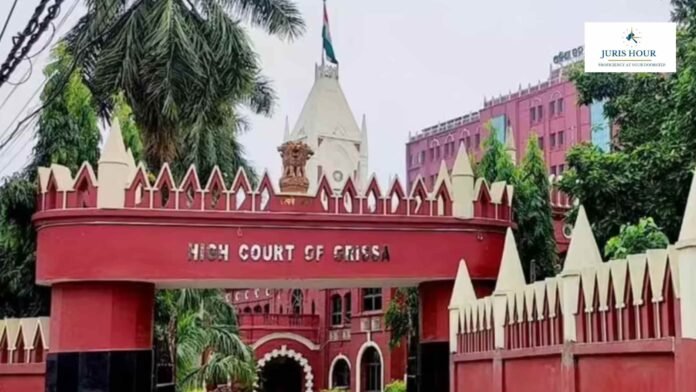
The Orissa High Court has held that the GST department cannot issue a show cause notice or pass an adjudication order against a deceased proprietor, even if the business continues through legal heirs.
Declaring the proceedings to be void in law, the bench of Chief Justice Harish Tandon and Justice Murahari Sri Raman quashed the demand raised under Section 73 of the CGST Act while clarifying that the department is free to initiate fresh proceedings by issuing notice to the legal representative in accordance with Section 93 of the GST Act.
The petitioner/assessee was a proprietorship concern owned by Late Manoranjan Mohapatra, engaged in business under GST registration. The proprietor regularly filed GST returns and discharged tax liabilities during FY 2021-22. Following his death on 24 November 2022, his legal heirs initially continued the business and subsequently constituted a partnership firm under a new GST registration. At the same time, one of the legal heirs, Jyoti Ranjan Mohapatra, also continued the proprietorship business under the existing GSTIN after obtaining approval for a non-core amendment from the GST authorities.
Buy Now: GST Judgements E-Compilation – June 2026
Despite these developments and despite the GST authorities having approved changes reflecting the legal heir’s involvement, the department initiated scrutiny proceedings relating to FY 2021-22 in the name of the deceased proprietor. Notices under Section 73, including Form GST DRC-01, and the eventual Order-in-Original dated 29 December 2025 were all issued against Manoranjan Mohapatra, who had already passed away.
The legal heir challenged these proceedings before the High Court, contending that both the show cause notice and the adjudication order were without jurisdiction as they had been issued against a non-existent person.
The principal question before the Court was whether GST authorities could validly initiate adjudication proceedings under Section 73 of the CGST Act and determine tax liability against a deceased proprietor merely because the business had subsequently been continued by legal heirs.
The High Court noted that the GST department was fully aware of the proprietor’s death. The legal heirs had already informed the department, a new partnership registration had been granted, and amendments had been approved in the GST registration records. Nevertheless, the authorities issued the show cause notice and passed the final order in the name of the deceased proprietor.
Rejecting the department’s contention that the legal heir’s participation in the proceedings cured the defect, the Court held that jurisdiction itself was lacking because the proceedings had been initiated against a dead person. Participation by the legal representative could not validate proceedings that were fundamentally void.
The Bench observed that the requirement of issuing notice to the correct person is not a mere procedural formality but a jurisdictional prerequisite. Proceedings initiated against a deceased person are therefore non est in the eyes of law.
The Court relied extensively on judicial precedents dealing with proceedings against deceased persons, including decisions of the Delhi High Court in Savita Kapila and Sripathi Subbaraya Manohara, which held that notices issued against dead persons are void because jurisdiction cannot be assumed without serving the correct person.
The Bench also referred to GST rulings of the Allahabad High Court, Punjab & Haryana High Court and Andhra Pradesh High Court, all of which recognised that while tax dues may ultimately be recoverable from legal representatives under Section 93, adjudication itself cannot lawfully proceed against a deceased taxpayer.
The Court clarified that Section 93 merely deals with the liability of legal representatives to pay tax, interest or penalty after the death of a taxpayer. The provision does not authorise GST authorities to issue show cause notices or adjudication orders against the deceased person.
Instead, where the business is continued by legal heirs, fresh proceedings must be initiated by issuing notice to the legal representative, who must be given an opportunity to defend the case before any liability is determined.
The Orissa High Court quashed the Summary of Show Cause Notice in Form GST DRC-01 dated 26 September 2025; the accompanying Demand-cum-Show Cause Notice dated 25 September 2025; and the Order-in-Original dated 29 December 2025 passed under Section 73 of the CGST Act.
The Court expressly granted liberty to the GST department to initiate fresh proceedings by issuing notice to the petitioner as the legal representative of the deceased proprietor and to determine the liability in accordance with law after providing due opportunity of hearing. It further clarified that it had expressed no opinion on the merits of the underlying tax dispute concerning FY 2021-22.
Membership Required to Access Case Details & Order Copy
To view the complete Case Details and Download Order Copy, you must have an active membership. Please subscribe to continue.
Read More: Failure to Issue Mandatory ASMT-10 Notice Vitiates GST Proceedings: Rajasthan High Court

