
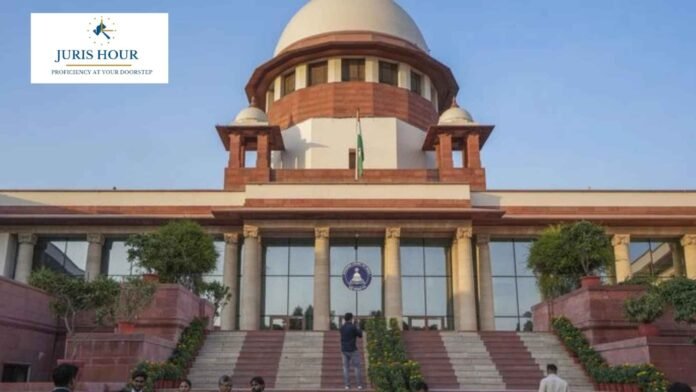
The Supreme Court has clarified the circumstances in which a civil court can try a legal issue as a preliminary issue under Order XIV Rule 2(2) of the Code of Civil Procedure, 1908 (CPC).
The bench of Justice K.V. Viswanathan and Justice Arun Palli has observed that while framing all issues does not by itself prevent a court from directing a qualifying issue to be tried first, such power ceases once the court has actually embarked upon the trial of the issues generally.
Buy Now: Supreme Court Judgments E-Magazine – 5 Month Combo (2026) (1st February – 30th June 2026)
The litigation originated from a suit instituted on June 10, 2013 concerning agricultural property. The Plaintiff had executed a General Power of Attorney (GPA) on May 21, 2005 in favour of Defendant No. 1 for management of the property and certain transactions.
According to the Plaintiff, although the GPA authorised the agent to execute sale deeds and other specified documents in circumstances where the Plaintiff was obliged to execute them, it did not authorise the agent to settle the terms of sale or create a charge over the property. The Plaintiff alleged that the property was nevertheless conveyed through a Sale Deed dated May 25, 2005 in favour of Defendant No. 2, without his consent and without consideration being paid to him.
The Plaintiff subsequently claimed that the conveyance was fraudulent and beyond the authority granted under the GPA and therefore void ab initio. Among other reliefs, he sought a declaration that the Sale Deed was void, declaration of his title and recovery of possession with mesne profits.
The defendants disputed the allegations and contended that the property had been validly transferred with the Plaintiff’s knowledge and consent for consideration of Rs. 4 lakh. They also maintained that the GPA authorised Defendant No. 1 to effect the sale and that the suit was barred by limitation.
After completion of pleadings, the Trial Court framed issues on July 8, 2015, including an issue concerning whether the suit was barred by limitation.
In September 2018, Defendant No. 2 filed an application seeking determination of the limitation issue as a preliminary issue. The Trial Court accepted the application and held that the suit was barred by limitation.
The Trial Court relied upon Article 59 of the Limitation Act, which prescribes a three-year limitation period for a suit to cancel or set aside an instrument, running from the date when the facts entitling the plaintiff to seek cancellation first become known to him. Since the Plaintiff had pleaded knowledge of the Sale Deed on May 22, 2009, but instituted the suit only on June 10, 2013, the Trial Court held the suit to be beyond limitation.
The First Appellate Court affirmed the conclusion and additionally modified the nature of disposal by treating the matter as rejection of the plaint under Order VII Rule 11(d) CPC.
The matter reached the Kerala High Court, where substantial questions of law were framed, including whether the limitation issue could properly have been determined as a preliminary issue under Order XIV Rule 2(2) CPC.
The High Court concluded that the limitation question involved mixed questions of law and fact. It held that the Trial Court should first have determined whether the Sale Deed was void for want of authority under the GPA before conclusively deciding limitation.
The High Court further reasoned that since the Plaintiff had alleged that the Sale Deed was void, and had also sought recovery of possession, Article 65 of the Limitation Act could apply. On that reasoning, it held the suit to be within limitation and remitted the matter to the Trial Court for fresh consideration.
The Supreme Court noted that the appeal raised questions of recurring procedural importance concerning Order XIV Rule 2 CPC, particularly the circumstances in which an issue may be taken up for determination before the remaining issues.
The Court examined the legislative history of the provision, including the amendment brought about by the Code of Civil Procedure (Amendment) Act, 1976.
Prior to the amendment, courts were required to try an issue of law first if the case could be disposed of on that issue. The legislative change was intended to reduce delays caused when a preliminary decision was reversed in appeal, resulting in remand of the case to the Trial Court for determination of the remaining issues.
The present Rule 2(1) establishes the general requirement that courts should pronounce judgment on all issues, subject to Rule 2(2).
Under Rule 2(2), where issues of law and fact arise, a court may try an issue first if: it is an issue of law only; it relates to the jurisdiction of the court or a bar to the suit created by law; and the case, or part of it, can be disposed of on that issue.
The Supreme Court emphasised that even when these conditions are satisfied, the provision uses the expression “may try that issue first”, making the exercise discretionary.
The Court reiterated the established principle that an issue involving both disputed facts and questions of law cannot ordinarily be tried as a preliminary issue.
Referring to earlier decisions including Ramesh B. Desai v. Bipin Vadilal Mehta and Nusli Neville Wadia v. Ivory Properties, the Court observed that where determination of the legal issue depends upon proof of disputed facts, the issue cannot be treated as a preliminary issue under Order XIV Rule 2.
The Court explained that limitation itself may sometimes constitute a pure question of law—for example, where the foundational facts determining the starting point of limitation are admitted or clearly established from the pleadings. But where the facts relevant to limitation are disputed, the question becomes a mixed question of law and fact and cannot ordinarily be decided as a preliminary issue.
The Court also referred to Sukhbiri Devi v. Union of India, where it was recognised that limitation could be decided as a preliminary issue where the foundational facts determining the commencement of limitation were clearly established from the plaint.
A significant part of the judgment concerns the distinction between framing an issue, trying an issue and determining an issue.
The Court noted that these expressions are not interchangeable under the CPC. Order XIV Rule 5 permits issues to be amended or additional issues to be framed before a decree, while Order XLI Rule 25 recognises circumstances where an appellate court may deal with an issue that was omitted to be framed or tried by the court of first instance.
According to the Supreme Court, the fact that all issues have already been framed does not by itself exhaust the power under Order XIV Rule 2(2). A court may still direct a qualifying issue to be tried first, provided that the trial of the issues generally has not already commenced.
The Court identified four possible procedural situations.
First, the court may frame only the qualifying issue of law, postpone the settlement of the remaining issues and try the qualifying issue first.
Second, the court may frame all issues but direct that the qualifying preliminary issue be tried first.
Third, even after all issues have been framed and the matter has been listed for evidence, a party may invoke Rule 2(2), provided the court has not yet embarked upon the trial of the issues generally.
Fourth, once the court has actually embarked upon the trial of the issues generally, the power under Rule 2(2) to direct one issue to be “tried first” is no longer available.
The Supreme Court stressed that “first” is relational. The expression refers to the sequence in which issues are tried. Once issues have entered a common trial, one of them cannot subsequently be taken out and retrospectively designated as having to be tried first.
Thus, Order XIV Rule 2(2) provides for a prospective ordering of trial, and not a retrospective reordering of a trial that has already commenced.
The Court also examined the Full Bench decision of the Himachal Pradesh High Court in Prithvi Raj Jhingta v. Gopal Singh.
The Supreme Court approved the principle that once all issues have been taken up for trial together, one issue cannot subsequently be severed and treated as an issue to be “tried first”.
However, the Court declined to approve the broader proposition that Order XIV Rule 2(2) can operate only where the legal issue alone was framed at the outset and settlement of all other issues was postponed.
The Supreme Court held that the language of Rule 2(2) makes postponement of the settlement of other issues optional. Consequently, all issues may already have been framed without necessarily exhausting the court’s power to direct a qualifying issue to be tried first.
The Bench further clarified the scope of its earlier decision in Sathyanath v. Sarojamani.
In that case, the Court had disapproved treating res judicata as a preliminary issue because res judicata involved a mixed question of law and fact and did not fall within the permissible categories under Order XIV Rule 2(2).
The Supreme Court in the present judgment held that the observations in Sathyanath should be understood in that context. They did not abolish the exception contained in Rule 2(2), nor did they establish that all issues must invariably be tried and decided together even where a qualifying preliminary issue validly exists.
Applying these principles to the case before it, the Supreme Court found that all issues had been framed as early as July 8, 2015, including limitation as Issue No. 5.
More importantly, the suit had already entered the evidentiary stage. The Plaintiff had completed his entire evidence, while the Defendants had already entered upon their evidence and had adduced evidence-in-chief.
It was only at that stage, in 2018, that Defendant No. 2 filed the application seeking to have limitation determined as a preliminary issue.
The Supreme Court held that this procedural stage was decisive.
The limitation issue was already part of the trial along with the other issues. Therefore, there was no longer any statutory occasion under Order XIV Rule 2(2) to direct that the issue should be “tried first”.
The Court observed that allowing such a course would effectively require a court to treat an event already occurring concurrently with the trial as though it had occurred earlier. Such retrospective reordering of the trial is not contemplated by Rule 2(2).
The Supreme Court also rejected the argument that the inherent powers under Section 151 CPC could overcome the procedural limitation.
It held that the nomenclature of an application cannot determine the source or extent of the court’s power. In substance, the application sought to sever an issue already forming part of an ongoing trial and adjudicate it in advance.
Since the CPC specifically regulates that course through Order XIV Rule 2, Section 151 could not be invoked to circumvent the conditions, sequence and temporal limitations governing the exercise of that power.
The Supreme Court found that the Trial Court had proceeded directly from the Plaintiff’s pleaded date of knowledge to Article 59 of the Limitation Act and concluded that the suit was barred by limitation.
However, the Trial Court did not consider whether, by the time the application was filed, the suit had already progressed to a stage at which Issue No. 5 could be detached from the ongoing trial.
The First Appellate Court similarly failed to address this procedural question, even though its judgment recorded that evidence had already been adduced by the Plaintiff.
Importantly, the Supreme Court did not finally decide whether Article 59 or Article 65 of the Limitation Act applies to the suit.
The Court held that once Issue No. 5 could not have been segregated from the ongoing trial for preliminary determination, the limitation issue had to return to the ordinary course of trial.
The Court expressly left open the applicability of the relevant limitation provision, the legal character of the Sale Deed and the ultimate determination of Issue No. 5. It also clarified that the observations of the High Court on those questions could not govern the further proceedings.
The Supreme Court ultimately held that the Trial Court’s order, the First Appellate Court’s judgment and the High Court’s decision were unsustainable on the procedural issue.
The application seeking preliminary determination of limitation was dismissed and O.S. No. 337 of 2013 was restored to the file of the Munsiff Court, Kottarakara.
The Trial Court was directed to resume proceedings from the stage immediately before the interruption caused by the application seeking preliminary determination of Issue No. 5.
The Supreme Court also directed the Trial Court to decide the suit within three months from receipt of a copy of the judgment, noting that a suit instituted in 2013, with issues framed in 2015, was being remitted after more than a decade for adjudication on merits.
Membership Required to Access Case Details & Order Copy
To view the complete Case Details and Download Order Copy, you must have an active membership. Please subscribe to continue.

