
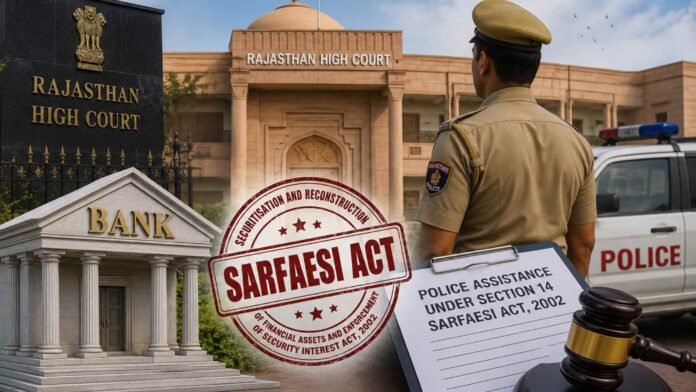
The Rajasthan High Court has taken up an important legal challenge concerning whether the State can levy charges on banks for providing police assistance during the recovery of secured assets under Section 14 of the Securitisation and Reconstruction of Financial Assets and Enforcement of Security Interest (SARFAESI) Act, 2002.
Observing that the matter raises substantial questions regarding the interplay between the SARFAESI Act, the Rajasthan Police Act, and constitutional principles governing the levy of fees by State authorities, the bench of Justice Sameer Jain has permitted the petitioner to amend its writ petition before proceeding further.
The writ petition was filed challenging the legality of demands raised by the Rajasthan Police Department for providing police assistance during the execution of possession orders under Section 14 of the SARFAESI Act.
Buy Now: June 2026 Ultimate Legal & Taxation Combo
The dispute concerns the practice of charging banks for police deployment when they seek to take physical possession of secured assets after obtaining orders from the competent authority under Section 14 of the SARFAESI Act.
The bank contended that once the Chief Judicial Magistrate or other competent authority directs police assistance for taking possession of secured assets, the police are merely executing a judicial order. According to the petitioner, such assistance constitutes a sovereign or judicial function, for which no fee can be levied unless there is specific statutory authority authorising such recovery.
Appearing for the petitioner, senior counsel argued that the bank is a private financial institution funded by private equity and that the imposition of police charges during SARFAESI proceedings has no statutory backing.
The petitioner relied upon Section 46 of the Rajasthan Police Act, 2007 read with Rule 10 of the Rajasthan Police Rules, 2008. It was argued that these provisions specifically enumerate the categories of services for which the Police Department may recover prescribed charges. Since police assistance rendered pursuant to judicial directions under Section 14 of the SARFAESI Act does not figure among those notified services, the State cannot recover any fee for such deployment.
According to the petitioner, the demand exceeds the statutory framework and is therefore arbitrary and legally unsustainable.
The bank further submitted that the controversy is no longer res integra, relying upon several judicial precedents including:
- Gopal v. Amarjeet Singh decided by the Allahabad High Court;
- Tyger Home Finance Pvt. Ltd. v. State of Rajasthan decided by the Rajasthan High Court;
- M/s S. Jhalani & Co. v. District Collector and District Magistrate; and
- An earlier interim order passed by the Rajasthan High Court in another writ petition involving AU Small Finance Bank itself.
The petitioner also pointed out that no appeals had been filed by the State against the earlier Rajasthan High Court decisions, and additionally relied upon an order dated February 3, 2026 passed by the competent authority determining the appropriate charges payable by the bank.
Opposing the petition, the State argued that the amounts demanded are not taxes but fees based on the principle of quid pro quo.
According to the respondents, banks are commercial, profit-making institutions that seek specialised police services for securing possession of mortgaged assets. Consequently, they are liable to bear the prescribed charges for those services.
The State further argued that because the recovery is in the nature of a fee rather than a tax, Article 265 of the Constitution—which prohibits taxation without authority of law—is inapplicable. It also contended that the petitioner had not challenged the underlying circular authorising such recovery, making the earlier judgments distinguishable on facts.
During rejoinder, counsel for the petitioner sought permission to amend the writ petition to challenge the foundational circular governing the levy of charges.
Accepting the request, Justice Sameer Jain granted liberty to amend the petition and directed the petitioner to carry out the necessary amendments. The Court also directed that an advance copy of the amended petition be supplied to the respondents before the next hearing.
Court Notes Significant Constitutional Questions
While passing the procedural order, the High Court observed that the matter raises issues of considerable public importance involving substantial questions of law relating to:
- the interaction between the SARFAESI Act and the Rajasthan Police Act;
- the authority of State instrumentalities to levy fees;
- the scope of police assistance rendered pursuant to judicial orders; and
- the constitutional framework governing recovery of such charges.
Recognising the significance of these issues, the Court directed that a copy of the writ petition be supplied to the office of the Advocate General and listed the matter for further hearing on July 22, 2026.
Membership Required to Access Case Details & Order Copy
To view the complete Case Details and Download Order Copy, you must have an active membership. Please subscribe to continue.
Read More: Unsigned Reassessment Notice Invalid: ITAT Quashes Entire Income Tax Reassessment Proceedings

