
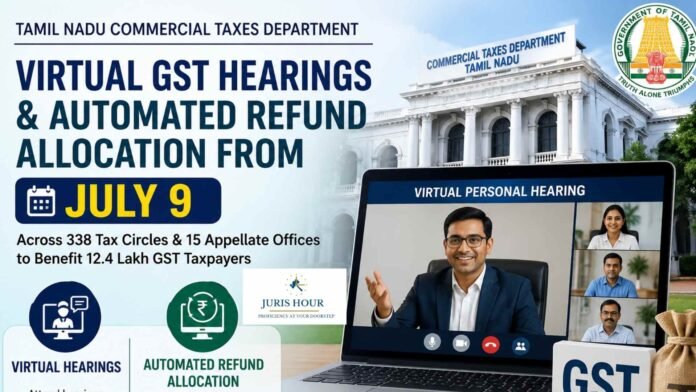
The Tamil Nadu Commercial Taxes Department has announced the rollout of virtual personal hearings and an automated randomised allocation system for GST refund applications across the State from July 9. The initiative is expected to significantly improve the ease of compliance for nearly 12.4 lakh registered GST taxpayers while strengthening transparency and efficiency in tax administration.
The reforms will be implemented across all 338 State Tax Circles and 15 appellate offices, following a departmental review chaired by T. Lokesh Tamizhselvan, Tamil Nadu’s Minister for Commercial Taxes and Registration.
Virtual Personal Hearings Introduced
One of the most significant changes is the introduction of virtual personal hearings for GST adjudication proceedings.
Until now, taxpayers receiving scrutiny notices under the GST law were generally required to appear physically before their jurisdictional tax officers to explain discrepancies identified during return scrutiny and verification. According to the department, nearly 58,000 scrutiny cases have already involved personal hearing opportunities.
With the new system, taxpayers who are unable to attend physically due to unavoidable circumstances or because they are located in distant parts of the State will now be permitted to participate through virtual hearings.
The department stated that the initiative is intended to:
- Reduce travel time and compliance costs for taxpayers;
- Improve accessibility to tax administration;
- Ensure adherence to the principles of natural justice; and
- Make adjudication proceedings more efficient without compromising procedural fairness.
The facility will also extend to the department’s appellate offices, enabling taxpayers to participate in appeal proceedings remotely wherever permitted.
Automated GST Refund Allocation System
Alongside virtual hearings, Tamil Nadu has also introduced an automated electronic allocation mechanism for GST refund applications.
Under the earlier system, refund claims were manually assigned to jurisdictional officers. The new process eliminates manual intervention by electronically assigning refund applications to any jurisdictional officer within a division through a randomised allocation mechanism.
According to the department, the reform seeks to:
- Improve transparency in refund processing;
- Ensure uniform distribution of workload;
- Minimise human intervention;
- Reduce processing delays; and
- Facilitate timely sanction of legitimate refund claims.
Importance of GST Refunds
GST refunds constitute a critical component of business cash flows, particularly for:
- Exporters claiming refunds on zero-rated supplies;
- Businesses operating under inverted duty structures; and
- Taxpayers with accumulated Input Tax Credit (ITC).
Prompt refund processing helps businesses maintain liquidity and reduces working capital blockage.
The Commercial Taxes Department disclosed that during the previous financial year, it sanctioned approximately ₹5,000 crore in GST refunds.
Most refund applications relate to:
- Unutilised Input Tax Credit on exports without payment of tax;
- Refunds arising from inverted duty structures; and
- Other refund categories prescribed under the GST law.
The department expects the automated allocation system to ensure eligible taxpayers receive refunds within statutory timelines.
Industry Welcomes the Reform
The move has received a positive response from industry representatives.
Ponnuswami, representing the Confederation of Indian Industry (CII), stated that the industry had earlier requested the State Government to implement an automated electronic allocation system for GST refunds.
According to him, removing manual intervention will:
- Enhance transparency;
- Improve consistency in refund processing; and
- Strengthen industry confidence in the GST refund mechanism.
Suggestions on Virtual Hearings
S. Chandramohan, Director and Group President – Corporate Affairs at TAFE, welcomed the introduction of virtual hearings, observing that they would significantly reduce the need for physical appearances before tax authorities and help expedite assessment proceedings.
However, he suggested that taxpayers should continue to be allowed to submit additional documentary evidence after completion of the virtual hearing. He also recommended that assessment orders should be passed only after such supplementary submissions have been duly considered.
Views on Refund Allocation
On the automated refund allocation mechanism, Chandramohan observed that retaining the refund process within the State GST administration would be beneficial because assessing officers are generally familiar with taxpayers’ business operations.
He estimated that around 15–20% of assessees under the State GST administration—primarily those not administered by the Central GST authorities—would directly benefit from faster refund processing, leading to improved working capital management.
A Step Towards Digital Tax Administration
The twin reforms reflect Tamil Nadu’s continued emphasis on digitising tax administration and reducing compliance burdens for businesses.
By combining virtual adjudication with automated refund allocation, the State aims to create a more transparent, technology-driven GST ecosystem that balances taxpayer convenience with administrative efficiency.
For businesses, particularly exporters and MSMEs dependent on timely refunds, the reforms are expected to reduce procedural delays, improve cash flow, and strengthen confidence in the State’s GST administration.

