
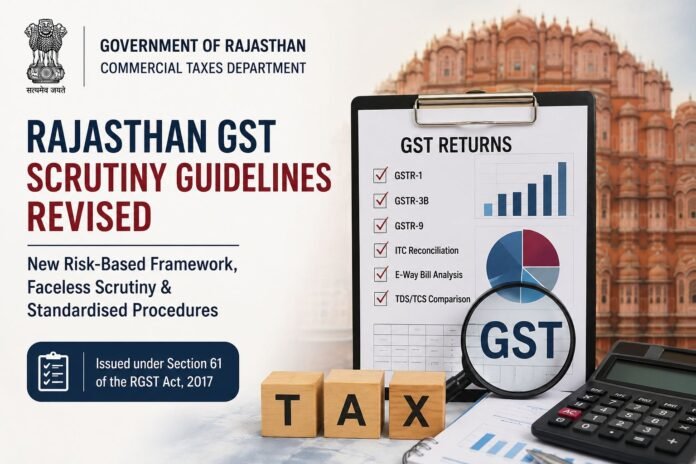
The Rajasthan Commercial Taxes Department has issued a comprehensive circular laying down fresh guidelines for scrutiny of returns under Section 61 of the Rajasthan Goods and Services Tax (RGST) Act, 2017.
The new instructions superseded the earlier circular dated January 7, 2022, and established a standardized framework for scrutiny proceedings, including subsequent demand and recovery actions under Sections 73, 74 and 74A of the Act.
The circular, issued by Chief Commissioner, State Tax, Anandhi Palaniswamy, is intended to streamline return scrutiny across the State through data analytics, faceless scrutiny, standardized procedures, and improved monitoring. It also includes a detailed operational manual for officers undertaking scrutiny outside their territorial jurisdiction.
Buy Now: GST Judgements E-Compilation – June 2026
Risk-Based Selection of Returns
Under the revised framework, the Business Intelligence Unit (BIU) will periodically analyse GST data available on the GSTN portal to identify taxpayers for scrutiny based on predefined risk parameters. These include:
- Excess outward tax reported in GSTR-1 compared with GSTR-3B or GSTR-9.
- Lower turnover declared in GSTR-3B compared with GSTR-7 (TDS).
- Lower turnover in GSTR-1 vis-à-vis GSTR-8 (TCS).
- Reverse charge liability mismatches.
- Higher outward liability reflected through e-way bills than declared in GSTR-3B.
- Excess Input Tax Credit (ITC) claimed compared with GSTR-2A/2B.
- ITC availed from non-filers or cancelled taxpayers.
- ITC claimed beyond the statutory time limit under Section 16(4).
- Delayed filing of GSTR-3B with unpaid or short-paid interest.
The circular specifies that three parameters—excess outward tax in GSTR-1, excess liability reflected in e-way bills, and ITC claimed from cancelled suppliers—will be mandatory triggers for scrutiny, while the remaining parameters will be assigned suitable weightage for preparing the scrutiny list. Additional risk parameters may also be introduced with prior approval of the Chief Commissioner.
BIU to Prepare Statewide Scrutiny List
The Business Intelligence Unit will prepare a list of registered taxpayers selected for scrutiny, clearly indicating the parameters on which the selection has been made. Before finalisation, the list will be cross-verified against audit selections to eliminate duplication.
The approved cases will thereafter be allocated through the Integrated Tax Management System (ITMS) either for faceless scrutiny or to jurisdictional officers, depending upon administrative decisions.
Officers Directed to Conduct Holistic Examination
Although cases will be selected based on specific risk parameters, the circular requires scrutiny officers to conduct a comprehensive review of taxpayer records.
If officers identify discrepancies beyond those originally flagged by the BIU, they are authorised to include such discrepancies while issuing Form GST ASMT-10. Likewise, if discrepancies relating to other tax periods or taxpayers come to light, officers must update the ITMS portal and initiate separate scrutiny proceedings.
Standard Procedure for Scrutiny
The circular reiterates the statutory procedure prescribed under Section 61 and Rule 99 of the RGST Rules.
Where discrepancies are noticed, officers must issue Form GST ASMT-10, detailing all discrepancies and uploading the notice on the departmental portal.
The taxpayer may:
- submit an explanation in Form GST ASMT-11, or
- accept the discrepancies and discharge tax, interest and other liabilities through Form GST DRC-03.
If the explanation is satisfactory or dues are paid, the officer must close the proceedings by issuing Form GST ASMT-12.
Unsatisfactory Replies to Lead to Demand Proceedings
If the taxpayer fails to respond within the prescribed period or provides an unsatisfactory explanation, the matter will move to adjudication.
In faceless scrutiny cases, the scrutiny officer must transfer the matter to the jurisdictional proper officer through the Boweb Portal along with a detailed scrutiny report and recommendations.
The jurisdictional officer will thereafter initiate proceedings under Sections 73, 74 or 74A of the RGST Act for determination and recovery of tax dues.
Prior Approval Required in High-Value Cases
The circular introduces an additional safeguard for high-value disputes.
Where scrutiny results in detection of tax not paid, short-paid, or wrongly availed/utilised ITC exceeding ₹5 crore, adjudication proceedings may be initiated only after obtaining prior approval from the concerned Additional Commissioner (Administration).
Timeline for Transfer of Pending Cases
The department has directed that all scrutiny cases relating to financial year 2022-23 should be transferred to jurisdictional officers by August 25, 2026, wherever necessary.
Further, if scrutiny reveals no discrepancy, officers must record their findings along with reasons on the ITMS feedback module. Senior officers have been directed to closely monitor compliance with the revised guidelines and prescribed timelines.
Manual Introduces ‘Scrutiny Officer’ Role for Cross-Jurisdiction Cases
An important feature accompanying the circular is a detailed manual introducing the Scrutiny Officer role.
The manual enables specially authorised officers to undertake statewide scrutiny beyond territorial jurisdiction, allowing faceless examination of returns across Rajasthan. It prescribes the process for assigning the Scrutiny Officer role, creating scrutiny cases, uploading approval letters, issuing notices, and recommending cases to jurisdictional officers for adjudication.
The manual clarifies that although scrutiny may be conducted across jurisdictions, the subsequent adjudication under Sections 73, 74 or 74A will continue to be undertaken by the taxpayer’s jurisdictional officer.
Membership Required to Access Notification Details & Copy
To view the complete Notification Details and Download Copy, you must have an active membership. Please subscribe to continue.
Read More: JURISHOUR | TAX LAW DAILY BULLETIN : 10 JULY, 2026

