
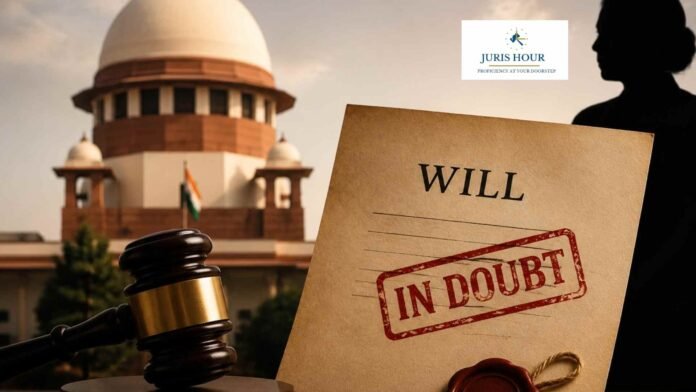
The Supreme Court has reiterated that merely proving the formal execution of a Will is insufficient where suspicious circumstances surround its execution.
The Court restored the concurrent findings of the Trial Court and the First Appellate Court, holding that the propounders of a disputed Will had failed to dispel serious doubts regarding its genuineness.
The appeal arose from a long-running property dispute involving agricultural land and residential property owned by late Chhajju Ram, an illiterate agriculturist from Himachal Pradesh. After his death in 1992 without children, his widow, Bhambo Devi, instituted a civil suit claiming that she was the sole legal heir entitled to inherit the estate through intestate succession.
Buy Now: Supreme court Judgements E-Compilation – JUNE 2026
The defendants, however, relied upon a registered Will allegedly executed by Chhajju Ram on November 6, 1974, under which the entire estate was bequeathed in their favour. They claimed that they had cared for the deceased and his wife for many years and were therefore chosen as beneficiaries.
The widow challenged the Will as forged, fraudulent and executed under suspicious circumstances, contending that her husband had never intended to deprive her of the property.
The Trial Court examined the evidence led by the defendants, including one attesting witness and evidence regarding registration of the Will. After evaluating the record, it concluded that the Will could not be accepted as genuine because numerous suspicious circumstances remained unexplained.
Among the major concerns identified by the Trial Court were the complete exclusion of the widow from inheritance despite her admittedly cordial relationship with the deceased. The absence of convincing reasons for disinheriting the wife except a vague statement that she already possessed jewellery and cash.
Unexplained alterations and cuttings in the registration endorsement on the reverse side of the Will, where another person’s name appeared to have been replaced with that of the testator. Failure to examine the Sub-Registrar or produce evidence explaining these alterations. Lack of convincing evidence showing why the beneficiaries deserved the bequest or had actually rendered the services claimed.
Holding that the Will was surrounded by serious suspicion, the Trial Court declared the widow as the owner in possession of the property and restrained the defendants from interfering with her possession.
The First Appellate Court independently reassessed the evidence and agreed with the Trial Court.
It highlighted several suspicious features, including the unnatural exclusion of the widow, who was the sole Class-I heir. Failure to establish the alleged close relationship between the beneficiaries and the deceased. Execution of the Will nearly eighteen years before the testator’s death without any convincing explanation. Selection of attesting witnesses from another village despite availability of local witnesses. Non-examination of the second attesting witness, although he was alive. Serious unexplained cuttings in the registration endorsement indicating possible manipulation.
The appellate court concluded that these circumstances collectively created substantial doubt about the authenticity of the document and that the propounders had failed to satisfy the judicial conscience regarding its validity.
The Himachal Pradesh High Court allowed the defendants’ second appeal.
It held that since one attesting witness had duly proved execution of the Will as required under the Indian Succession Act, the document stood legally proved. The High Court considered that the alterations appearing on the registration endorsement did not affect the validity of the Will itself and observed that the lower courts had attached undue importance to surrounding circumstances.
Accordingly, it dismissed the widow’s suit.
Allowing the appeal, the Supreme Court set aside the High Court’s judgment and restored the decree passed in favour of the widow.
The Bench explained that proof of a Will involves much more than satisfying the formal requirements of execution and attestation under the Indian Succession Act and the Evidence Act.
The Court observed that where suspicious circumstances exist, the burden lies squarely on the propounder of the Will to dispel every legitimate doubt and satisfy the judicial conscience that the document genuinely represents the free and informed intention of the testator.
The Supreme Court extensively surveyed earlier precedents governing proof of Wills and reaffirmed settled legal principles.
It held that suspicious circumstances may include unnatural exclusion of legal heirs. Doubtful or unfair disposition of property. Active participation of beneficiaries in preparation of the Will. Unexplained alterations or discrepancies in the document. Any circumstance creating legitimate doubt regarding the testator’s free and informed consent.
The Court emphasised that such suspicion must be genuine and supported by evidence rather than mere imagination. However, once legitimate suspicion arises, the burden remains on the propounder to remove it satisfactorily.
One of the principal reasons for restoring the Trial Court’s findings was the complete exclusion of the widow from succession.
The Supreme Court observed that although a testator is legally free to distribute property according to personal wishes, disinheriting a spouse who had lived with and cared for the deceased throughout his life, in favour of distant relatives, naturally invites closer judicial scrutiny.
The explanation contained in the Will—that the widow already possessed sufficient jewellery and cash—was found wholly inadequate, particularly when no details were provided and the evidence showed that she had continuously cared for her husband until his death.
The Court also considered the unexplained cuttings and overwriting appearing in the registration endorsement.
According to the record, another individual’s name had initially appeared before being replaced with that of the deceased testator without any initials or explanation from the Sub-Registrar. The Court agreed with the Trial Court that such discrepancies significantly weakened the credibility of the document and remained entirely unexplained by the defendants.
The Supreme Court further held that the High Court exceeded its jurisdiction while exercising powers under Section 100 of the Code of Civil Procedure.
The Trial Court and the First Appellate Court had concurrently recorded detailed factual findings after appreciating oral and documentary evidence. Those findings were neither perverse nor unsupported by evidence.
The Supreme Court observed that the High Court effectively re-appreciated evidence and substituted its own conclusions on factual issues, which is impermissible in a second appeal unless substantial questions of law warrant such interference.
Membership Required to Access Case Details & Order Copy
To view the complete Case Details and Download Order Copy, you must have an active membership. Please subscribe to continue.

