
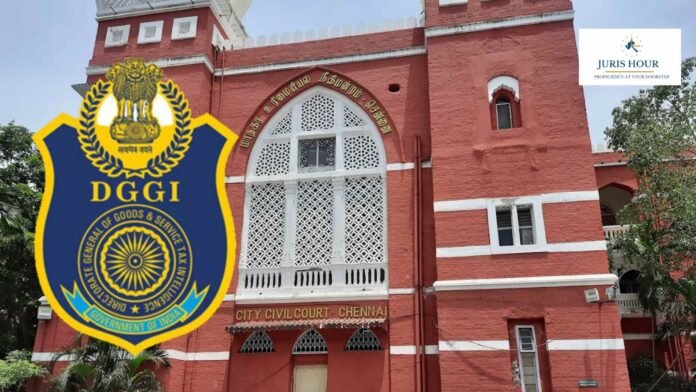
The Principal Sessions Court, Chennai, has held that the Directorate General of GST Intelligence (DGGI) is empowered to arrest an accused before completion of tax adjudication, provided there exists sufficient material giving rise to a statutory “reason to believe” that an offence under Section 132 of the Central Goods and Services Tax (CGST) Act, 2017 has been committed.
The Court made the observation while dismissing the bail application of Dr. Obed Ulla A, Director of M/s. Attica Gold Private Limited, who was arrested in connection with an alleged GST evasion exceeding ₹100 crore.
The petitioner was arrested on 12 June 2026 by the DGGI, Chennai Zonal Unit, after obtaining approval under Section 69(1) of the CGST Act. He sought bail contending that the alleged tax liability had neither been assessed nor adjudicated and that his arrest violated the principles laid down by the Supreme Court in Radhika Agarwal v. Union of India. The defence argued that the prosecution had merely made a bald allegation of tax evasion exceeding ₹100 crore without producing any adjudicated demand or conclusive evidence to justify arrest.
Buy Now: GST Judgements E-Compilation – June 2026
According to the DGGI, Attica Gold Private Limited, which operates more than 200 branches across India, was engaged in purchasing old gold jewellery from customers under the Margin Scheme prescribed under Rule 32(5) of the CGST Rules, 2017.
However, investigations allegedly revealed that instead of reselling the old jewellery as declared in GST returns, substantial quantities of gold were transported to Bengaluru, melted into “Gatti Gold” and sold to jewellery manufacturers, thereby attracting a different GST treatment.
The agency alleged that the company systematically suppressed taxable turnover by falsely claiming the benefit of the Margin Scheme, resulting in GST evasion estimated to exceed ₹100 crore.
During the investigation, the DGGI conducted extensive searches at the company’s corporate office and branches between 29 May and 2 June 2026, seizing hard disks, Tally accounting data, transport records, melting reports, CCTV footage, electronic devices and other documents.
A search was also conducted at the petitioner’s residence on 12 June 2026. Although no incriminating material was recovered from his home, the department relied upon evidence gathered from the business premises, employee statements and electronic records to justify the arrest.
The petitioner argued that he had joined the company only in 2024, whereas the alleged tax evasion related to transactions beginning in 2020-21. It was further contended that the Commissioner had failed to properly record the mandatory “reason to believe” before authorising arrest and that the safeguards prescribed in the CBIC’s arrest guidelines had not been complied with.
The defence also submitted that arrest cannot be used as a mechanism for recovery of alleged tax dues and relied upon various judicial precedents, including Radhika Agarwal, Jayachandran Alloys, MakeMyTrip India, Akhil Krishan Maggu, and Arnesh Kumar, to contend that criminal prosecution should ordinarily follow determination of tax liability.
Opposing the bail application, the DGGI submitted that the petitioner had repeatedly failed to cooperate with the investigation despite several summons.
The prosecution informed the Court that although the petitioner had initially agreed to furnish certain information within seven days, he neither produced the promised documents nor appeared in response to subsequent summons. It was also pointed out that after giving a statement during investigation, he later retracted it, indicating unwillingness to cooperate.
According to the department, custodial interrogation remained necessary as the investigation was still at a preliminary stage and the actual magnitude of tax evasion could exceed the amount presently estimated.
After examining the records, the Court rejected the argument that arrest under the CGST Act must necessarily await completion of adjudication. It observed that Section 69 requires the competent authority to possess sufficient material to form a “reason to believe” that an offence punishable under Section 132 has been committed.
The Court clarified that the law does not require a final assessment or adjudication of tax liability before the power of arrest can be exercised. Instead, the existence of credible material indicating commission of a cognizable and non-bailable offence is sufficient at the investigation stage.
The Sessions Court further held that the “reason to believe” recorded by the Additional Director General of GST was not mechanical. It noted that the approval for arrest was based on statements of employees, transporter records, CCTV footage, melting reports, Tally data, seized electronic devices and other documentary evidence collected during the searches.
Accordingly, the Court found that there was adequate material available with the investigating agency to justify the arrest under Section 69 of the CGST Act.
The Court also observed that the petitioner’s repeated non-compliance with summons and subsequent retraction of his earlier statement demonstrated a lack of cooperation with the investigation.
The court held that custodial interrogation was necessary to ensure effective investigation and to prevent possible interference with the collection of evidence. The Court emphasised that while deciding a bail application, it is not confined only to examining the “reason to believe” note but may also consider the entire material collected during investigation.
Another factor that weighed with the Court was the petitioner’s alleged involvement in a separate money laundering prosecution, which it considered while evaluating his antecedents. Taking into account the gravity of the alleged economic offence, the stage of investigation, the need for further custodial interrogation and the material collected by the DGGI, the Principal Sessions Court dismissed the bail application.
Membership Required to Access Case Details & Order Copy
To view the complete Case Details and Download Order Copy, you must have an active membership. Please subscribe to continue.
Read More: Telangana High Court Grants Bail to Woman Arrested in Bangkok–Hyderabad Marijuana Smuggling Case

