
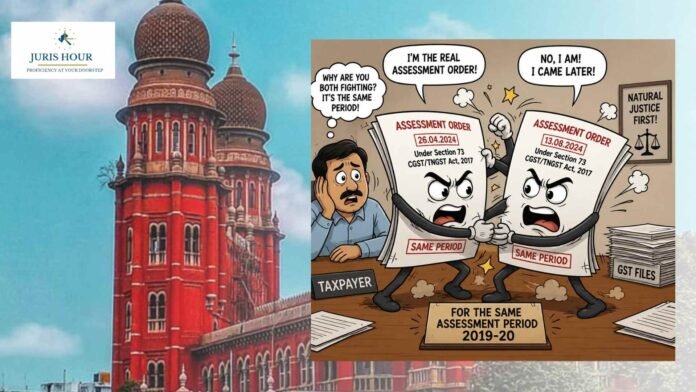
The Madras High Court has set aside two overlapping GST assessment orders passed for the same assessment period after finding that they substantially dealt with identical issues.
The bench of Justice Senthilkumar Ramamoorthy has held that the duplication warranted reconsideration and remanded the matter to the tax authorities for fresh adjudication after granting the taxpayer an opportunity of hearing.
The petitioner contended that the two assessment orders overlapped and dealt with the same issues, resulting in duplication of tax demands. Both orders had culminated in issuance of Form GST DRC-07, prompting the taxpayer to approach the High Court seeking quashing of the proceedings on the ground that they were contrary to the provisions of the CGST/TNGST Act and violative of the principles of natural justice.
During the hearing, counsel for the petitioner submitted that the business was engaged in the transportation of goods, where output tax liability was discharged under the Reverse Charge Mechanism (RCM).
It was further argued that while purchasing vehicles, the corresponding Input Tax Credit (ITC) had been duly reflected in the auto-populated GSTR-2A and was also disclosed in the petitioner’s GSTR-3B returns. According to the petitioner, following the first assessment order dated 26 April 2024, the entire ITC had already been reversed from the Electronic Credit Ledger. Consequently, since the credit had never been utilised, levy of interest under Section 50 of the CGST Actwas not justified.
During the proceedings, the Government Counsel appearing for the State, upon instructions, acknowledged that the issues addressed in both assessment orders were substantially the same.
Taking note of this submission, the Court observed that there was clear duplication between the two impugned orders. It held that this duplication alone justified reconsideration of the matter. The Court also noted that the petitioner’s Electronic Credit Ledger had already been debited pursuant to the first assessment order, making fresh consideration appropriate.
Accepting the petitioner’s challenge, the High Court set aside both assessment orders and remanded the matter to the jurisdictional tax officer for fresh adjudication.
The Court directed the department to provide the petitioner with a reasonable opportunity of hearing and pass a fresh order in accordance with law within three months from the date of receipt of the Court’s order.
The writ petitions were accordingly disposed of without any order as to costs.
Membership Required to Access Case Details & Order Copy
To view the complete Case Details and Download Order Copy, you must have an active membership. Please subscribe to continue.
Read More: Madras High Court Quashes GST Demand and Bank Attachment After LLP Agrees to Deposit 25% Tax Demand

