
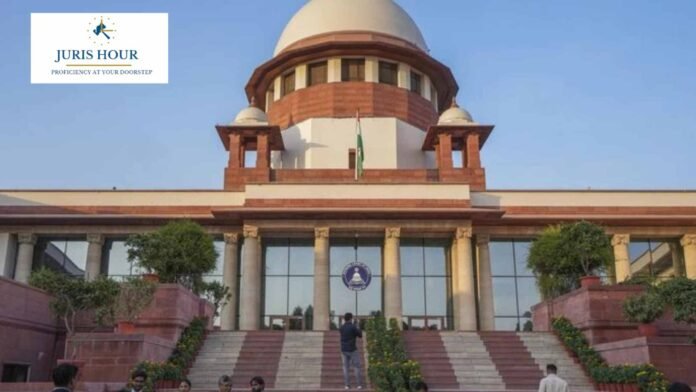
The Supreme Court has held that a purchaser seeking enforcement of an agreement to sell must establish continuous readiness and willingness to perform contractual obligations throughout the relevant period.
The bench of Justice Prashant Kumar Mishra and Justice N.V. Anjaria ruled that financial documents created years after the institution of a suit cannot be relied upon to prove readiness at the time performance was due.
The dispute arose from an agreement to sell executed on 20 December 1990 under which the respondent agreed to sell a vacant site measuring 100 feet by 78 feet for a total consideration of ₹3 lakh. The purchaser paid ₹25,000 as earnest money, while the balance amount of ₹2.75 lakh was to be paid at the time of registration of the sale deed, which was scheduled to be completed within four months.
The seller handed over various title documents to the purchaser, including original property records, tax receipts, encumbrance certificates and related documents. The purchaser subsequently claimed that the seller had also undertaken to arrange an approach road to the property and that possession had been handed over under the agreement.
Differences soon emerged between the parties regarding the formation of the approach road and the obtaining of permissions under the Urban Land (Ceiling and Regulation) Act, 1976 (ULCRA). Multiple legal notices were exchanged, with the seller ultimately rescinding the agreement and forfeiting the earnest money on the ground that the purchaser had failed to obtain the necessary permission and complete the transaction within the stipulated time.
The purchaser instituted a suit for specific performance in December 1993 seeking execution of the sale deed and possession of the property, or alternatively compensation for breach of contract.
The Trial Court decreed the suit in favour of the purchaser. It held that possession had been delivered under the agreement, that time was not the essence of the contract, that the purchaser had demonstrated readiness and willingness to perform his obligations, and that the seller had rescinded the agreement without justifiable cause.
Notably, the seller did not enter the witness box or lead any oral evidence during the trial proceedings.
The Karnataka High Court reversed the Trial Court’s findings and dismissed the suit. The High Court concluded that the purchaser had failed to establish readiness and willingness, had not complied with requirements relating to ULCRA permission, and had delayed approaching the court despite being aware of the seller’s refusal to perform the contract.
The Supreme Court observed that Section 16(c) of the Specific Relief Act, 1963 requires a plaintiff seeking specific performance to both plead and prove continuous readiness and willingness to perform contractual obligations. The Court reiterated that “readiness” relates to financial capacity, while “willingness” concerns the conduct and intention of the party seeking relief.
Relying on a long line of precedents including N.P. Thirugnanam v. Dr. R. Jagan Mohan Rao, His Holiness Acharya Swami Ganesh Dassji v. Sita Ram Thapar, Umabai v. Nilkanth Dhondiba Chavan, and Man Kaur v. Hartar Singh Sangha, the Court emphasized that readiness and willingness must be demonstrated continuously from the date of the agreement until the passing of the decree.
A key issue before the Court was whether the purchaser had demonstrated financial capacity to pay the balance sale consideration.
The appellants relied on four Fixed Deposit Receipts (FDRs) of ₹70,000 each, aggregating ₹2.80 lakh, to contend that sufficient funds were available. However, the Supreme Court noted that all four FDRs were created between 1999 and 2001, several years after the suit had already been filed in December 1993. Consequently, they could not establish financial readiness during the relevant period when the contract was required to be performed.
The Court held that although a purchaser is not required to physically deposit the consideration amount before the court, reliable evidence must be produced to show availability of funds at the relevant point in time. In the present case, no evidence existed to demonstrate that the purchaser had the balance consideration either at the time of the agreement, during the contractual period for performance, or when the suit was instituted.
The Court further found that permission under the Urban Land Ceiling law had to be obtained by both parties. The evidence on record indicated that the purchaser had not furnished the necessary affidavit and forms required for obtaining such permission and had instead remained passive while expecting the seller to undertake all steps. Such conduct, according to the Court, undermined the claim of continuous readiness and willingness.
One of the most important aspects of the judgment concerns the effect of delay in seeking specific performance.
The Supreme Court observed that merely filing a suit within the statutory limitation period does not automatically entitle a party to equitable relief. Courts are entitled to examine whether the plaintiff acted with diligence and promptitude. The Bench relied on several earlier decisions, including K.S. Vidyanadam v. Vairavan, Azhar Sultana v. B. Rajamani, Saradamani Kandappan v. S. Rajalakshmi, and Atma Ram v. Charanjit Singh, which emphasize that unexplained delays may disentitle a plaintiff from obtaining specific performance.
In the present case, the seller had clearly refused performance in April 1991. Despite this, the purchaser waited nearly two years and nine months before instituting the suit on 20 December 1993. The Court held that such conduct reflected a lack of continuous readiness and willingness, which is indispensable for securing the discretionary remedy of specific performance.
Dismissing the appeal, the Supreme Court held that the appellants failed to satisfy the twin statutory requirements of readiness and willingness and also failed to approach the court with sufficient promptitude. Consequently, they were not entitled to the equitable and discretionary relief of specific performance. The Court therefore upheld the High Court’s judgment and dismissed the appeal.
Membership Required to Access Case Details & Order Copy
To view the complete Case Details and Download Order Copy, you must have an active membership. Please subscribe to continue.
Read More: Customs Appeal Pending? That Alone Can’t Stop Return of Bail Surety Amount, Says Telangana HC

