
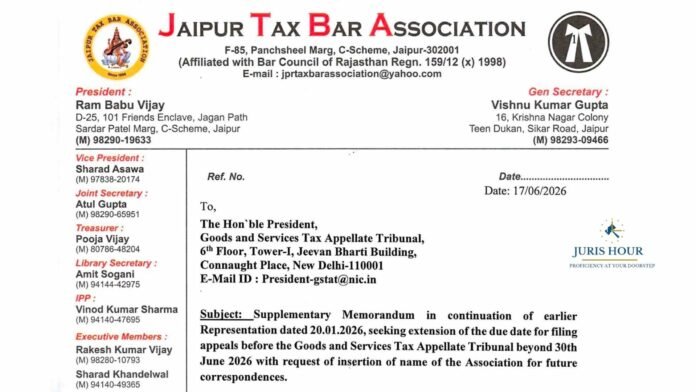
In a significant representation to the Goods and Services Tax Appellate Tribunal (GSTAT), the Jaipur Tax Bar Association (JTBA) has sought an extension of the June 30, 2026 deadline for filing transitional and backlog GST appeals before GSTAT, citing persistent technical issues on the GSTAT portal, procedural challenges, and the enormous volume of pending appeals yet to be filed.
The supplementary memorandum, dated June 17, 2026, was addressed to the President of GSTAT and submitted as a continuation of JTBA’s earlier representation made on January 20, 2026. While appreciating the Tribunal’s efforts in operationalising GSTAT and acknowledging the positive recommendations emerging from the Committee for Resolution of Representations from Trade and Bar Associations, the Association stressed that several critical issues remain unresolved, particularly those affecting taxpayers’ right to appeal.
Extension Sought Till March 31, 2027
The Association has requested that the current outer deadline of June 30, 2026, applicable to appeals against orders communicated before March 31, 2026, be extended at least up to March 31, 2027. According to JTBA, the present deadline is a transitional facilitative cut-off rather than an ordinary statutory limitation period and should be relaxed in the interest of justice.
The memorandum highlights that the GSTAT was constituted years after the introduction of GST, leading to an accumulation of a massive backlog of appeals dating back to 2017. Despite estimates indicating that the legacy backlog may exceed four lakh appeals nationwide, only around 15,000–16,500 appeals have reportedly been filed so far, representing less than five percent of the likely pending cases.
GSTAT Portal Still in Early Transition Phase
JTBA pointed out that the GSTAT e-filing portal is a completely independent digital platform and not an extension of the GST common portal. Taxpayers and professionals have had to navigate fresh registration requirements, new filing procedures, digital signature protocols, court-fee payment mechanisms, and pre-deposit compliance processes.
According to the memorandum, the portal became practically effective for meaningful large-scale filing only recently after overcoming initial difficulties relating to account creation, authorised representative registration, Aadhaar OTP authentication, portal navigation and document uploads. The Association contends that stakeholders have not been provided sufficient time to adapt to the new ecosystem before the expiry of the transitional deadline.
Technical Failures and Aadhaar Authentication Issues
The representation also lists several practical obstacles faced by taxpayers and professionals. These include Aadhaar-based e-sign authentication failures, mobile number update issues, browser compatibility problems, difficulties in retrieving old records and supporting documents, and mandatory taxpayer registration requirements before authorised representatives can file appeals.
Additionally, the memorandum notes recurring issues involving DRC-03 and DRC-03A tagging, which have reportedly prevented many appellants from completing their filings despite having all required documentation ready.
Association Reports Recent GSTAT Portal Breakdown
One of the most pressing concerns raised by JTBA is the alleged non-functionality of the GSTAT portal during the final fortnight preceding the June 30 deadline. The Association stated that on the morning of June 17 itself, users experienced login failures, inability to retrieve data, and complete inaccessibility of the filing system.
The memorandum further refers to recurring “ARN loop” errors, where users are repeatedly redirected without reaching the actual filing interface. It also mentions BharatKosh payment failures, instances where court fees were debited but appeals were not registered, and session timeouts that resulted in the loss of entered data.
According to JTBA, such technical breakdowns at a critical stage could permanently deprive taxpayers of their statutory right to appeal through no fault of their own.
Alternative Reliefs Proposed
Apart from seeking an extension of the filing deadline, the Association has proposed that taxpayers who can demonstrate attempted filing before June 30, 2026—through portal-generated errors, grievance tickets, payment receipts, screenshots or other documentary evidence—should be treated as having filed within time.
It has also requested the GSTAT Registry to establish a formal grievance and ticketing mechanism to document unsuccessful filing attempts so that such evidence can be relied upon in future condonation or extension proceedings.
Request for Inclusion in Future GSTAT Communications
In a separate request, JTBA urged GSTAT authorities to include the Association in future stakeholder consultations, meetings and communications. The Association stated that despite representing more than 250 tax practitioners, it was not informed about a recent national-level conference attended by various stakeholders. It has sought inclusion of its details in GSTAT’s communication records to facilitate wider dissemination of important information among practitioners.
Conclusion
The Jaipur Tax Bar Association has urged GSTAT to issue appropriate administrative, technical and legal directions at the earliest to safeguard taxpayers’ appellate rights. With less than two weeks remaining before the June 30 deadline, the representation underscores growing concerns within the tax community regarding portal readiness, procedural bottlenecks and the practical feasibility of disposing of the vast backlog of GST disputes within the current timeline.
Membership Required to Access Representation
To view the complete Representation and Download Copy, you must have an active membership. Please subscribe to continue.
Read More: JURISHOUR | TAX LAW DAILY BULLETIN : 19 June, 2026

