
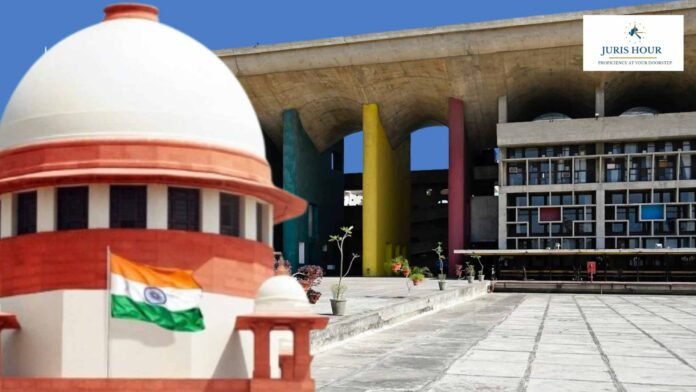
The Supreme Court has refused to interfere with the Punjab & Haryana High Court’s judgment holding that GST authorities cannot create a negative balance in a taxpayer’s Electronic Credit Ledger (ECL) by invoking Rule 86A of the CGST Rules.
The Bench of Justice S.V.N. Bhatti and Justice Atul S. Chandurkar stated, “No case for interference is made out in exercise of our jurisdiction under Article 136 of the Constitution of India. The Special Leave Petitions are accordingly dismissed.”
The petitioner challenged the action of GST authorities in blocking ITC amounting to over ₹1.16 crore on August 27, 2025 and a further ₹3.19 lakh on August 29, 2025 through entries made in its Electronic Credit Ledger. According to the petitioner, the authorities had blocked ITC in excess of the credit actually available in the ledger, thereby creating an artificial negative balance and preventing utilization of future ITC accruals.
The taxpayer argued that Rule 86A merely empowers authorities to restrict the utilization of existing credit available in the Electronic Credit Ledger and does not authorize the creation of a negative balance or blocking of credit that does not exist in the ledger.
The principal question considered by the High Court was:
“Whether Rule 86A of the GST Rules permits the Commissioner or an authorized officer to block a taxpayer’s Electronic Credit Ledger by an amount exceeding the credit available at the time of issuance of such order?”
Both parties agreed that the dispute involved a pure question of law, enabling the Court to proceed with final adjudication without awaiting a formal reply from the department.
The petitioner relied upon several High Court decisions, including those of the Gujarat High Court in Samay Alloys India Pvt. Ltd., and the Delhi High Court in Best Crop Science Pvt. Ltd., Kings Security Guard Services Pvt. Ltd., and Karuna Rajendra Ringshia. It was also pointed out that Special Leave Petitions challenging the Delhi High Court rulings had already been dismissed by the Supreme Court.
The Court noted that it had recently examined the identical issue in M/s Shyam Sunder Strips v. Union of India decided on November 4, 2025, where an extensive review of judicial precedents from Gujarat, Delhi, Telangana, Bombay, Calcutta, Allahabad and Andhra Pradesh High Courts had been undertaken.
The Bench observed that Rule 86A is a preventive provision that allows authorities to temporarily restrict utilization of ITC where there are reasons to believe that such credit has been fraudulently availed or is otherwise ineligible. However, the exercise of this power is subject to strict statutory conditions.
The Court emphasized that one of the primary preconditions for invoking Rule 86A is the existence of credit in the Electronic Credit Ledger. If no credit is available, the provision cannot be triggered. The Bench endorsed the reasoning adopted by the Gujarat High Court that availability of ITC in the ledger is a condition precedent for the exercise of powers under Rule 86A.
According to the Court, Rule 86A authorizes only the restriction of debit from an existing credit balance and does not empower officers to make debit entries themselves or create a negative balance. Such an interpretation would effectively amount to recovery of tax without following the statutory procedures prescribed under Sections 73 or 74 of the CGST Act.
The High Court reiterated that while authorities may restrict utilization of available ITC in emergent circumstances, they cannot create a negative balance in the Electronic Credit Ledger. The Bench observed that Rule 86A is not a recovery mechanism and cannot be expanded beyond its plain language.
The Court further clarified that if the department believes that ITC has been wrongly availed, it remains free to initiate proceedings under Sections 73 or 74 of the CGST Act, seek cancellation of registration where warranted, or invoke provisional attachment powers under Section 83. However, those statutory remedies cannot justify negative blocking under Rule 86A.
Applying the principles laid down in Shyam Sunder Strips, the Punjab & Haryana High Court held that the impugned entries were unsustainable to the extent they blocked credit beyond the ITC available in the Electronic Credit Ledger at the relevant time. The Court consequently allowed the writ petition and directed that the matter be governed by the same terms as its earlier judgment.
At the same time, the Bench clarified that the GST authorities remain at liberty to pursue any other recovery mechanisms available under law.
Membership Required to Access Case Details & Order Copy
To view the complete Case Details and Download Order Copy, you must have an active membership. Please subscribe to continue.

