
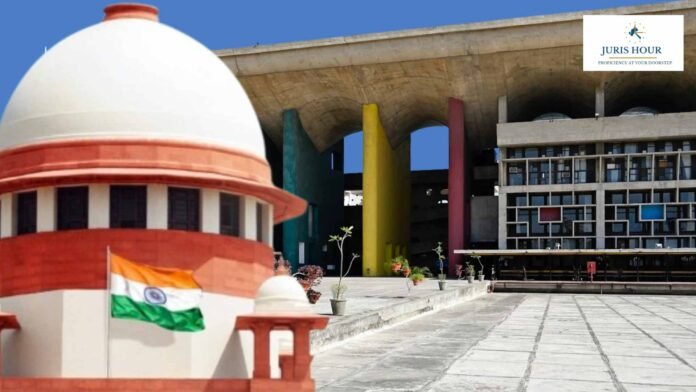
The Supreme Court has held that the High Court cannot force the plaintiff to accept compensation instead of encroachment removal.
The Bench of Justice S.V.N. Bhatti and Justice Atul S. Chandurkar has set aside a Punjab & Haryana High Court judgment that had substituted decrees for removal of encroachments with directions for payment of compensation and remanded the matter for fresh adjudication.
The litigation originated from two civil suits filed by Om Parkash, whose legal heirs later pursued the matter before the Supreme Court.
In the first suit filed in 1996, the plaintiff sought a mandatory injunction directing removal of an alleged illegal wall constructed by the defendants on a common open space adjoining his property. He also sought a permanent injunction restraining any further construction. The Trial Court decreed the suit in February 2006 and ordered removal of the encroaching wall. The decree was affirmed by the first appellate court.
In the second suit filed in 2000, the plaintiff challenged the construction of a lintel of a school building allegedly erected on the wall of his house. The Trial Court again ruled in his favour and directed removal of the offending structure while restraining future interference. This decree too was upheld in appeal.
The defendants challenged both decrees before the Punjab & Haryana High Court through Regular Second Appeals.
In 2011, the High Court modified the decrees and directed the defendants to pay ₹10,000 and ₹7,000 respectively, along with interest, representing half the expenditure incurred on the constructions. It further ordered that upon payment, the walls would be treated as common walls between the parties.
The legal heirs of the original plaintiff approached the Supreme Court, which in 2013 set aside the High Court’s judgments on the ground that no substantial questions of law had been framed while deciding the second appeals and remanded the matters for fresh consideration.
After remand, the High Court once again declined to enforce the decrees directing removal of the structures. Observing that the construction had existed for a long period and that valuation evidence was lacking, the High Court directed the Executing Court to assess the value of the constructions through a valuer and ordered the defendants to deposit the assessed amount for payment to the plaintiff’s legal heirs. The decrees passed by the Trial Court and affirmed by the first appellate court were consequently set aside.
Aggrieved by this course of action, the legal heirs once again approached the Supreme Court.
The Supreme Court held that the High Court committed a serious error by replacing decrees for mandatory injunction with monetary compensation.
The Court noted that the original plaintiff had never sought damages or compensation. His suits were specifically for removal of encroachments and unauthorized structures. In such circumstances, the High Court could not compel the legal heirs to accept monetary compensation in lieu of the relief granted by the Trial Court.
The Bench emphasized that there was no consent from the legal heirs for such substitution of relief and that courts cannot create a new form of relief that was never pleaded or claimed by a litigant.
Another major flaw identified by the Supreme Court was the High Court’s direction requiring the Executing Court to determine the value of the structures after simultaneously setting aside the decrees.
According to the Court, once the decrees in favour of the plaintiff had been annulled, there was no executable decree remaining. Consequently, the Executing Court lacked any legal basis to undertake valuation proceedings or award compensation. Such a direction, the Court observed, found no support under Order XXI of the Code of Civil Procedure, 1908.
The Supreme Court further remarked that the High Court had effectively repeated the very mistake for which its earlier judgments had been set aside in 2013.
While the earlier judgments had awarded fixed compensation, the later judgments attempted to achieve the same result through valuation by the Executing Court. The Bench held that both approaches suffered from the same legal defect, namely the grant of monetary relief that had never been sought by the plaintiff.
The Court also noted procedural deficiencies in the High Court’s exercise of jurisdiction under Section 100 of the Code of Civil Procedure.
Although the High Court referred to certain proposed questions, the impugned judgment did not demonstrate that any of them had been formally framed as substantial questions of law. Nevertheless, the High Court proceeded to answer them and set aside concurrent findings of fact recorded by the Trial Court and the first appellate court.
The Supreme Court observed that the decrees were overturned without a valid substantial question of law and on the basis of a new relief never sought by the plaintiff, resulting in a miscarriage of justice.
The Supreme Court set aside the common judgment of the Punjab & Haryana High Court dated May 2, 2016 in RSA Nos. 363 and 364 of 2008. The Court remanded both second appeals to the High Court for fresh consideration in accordance with Section 100 of the Code of Civil Procedure and directed that they be decided on their own merits expeditiously, considering that the appeals have been pending since 2008.
Membership Required to Access Case Details & Order Copy
To view the complete Case Details and Download Order Copy, you must have an active membership. Please subscribe to continue.
Read More: Same Officer Can’t Act As Auditor & Adjudicator: Karnataka High Court

