
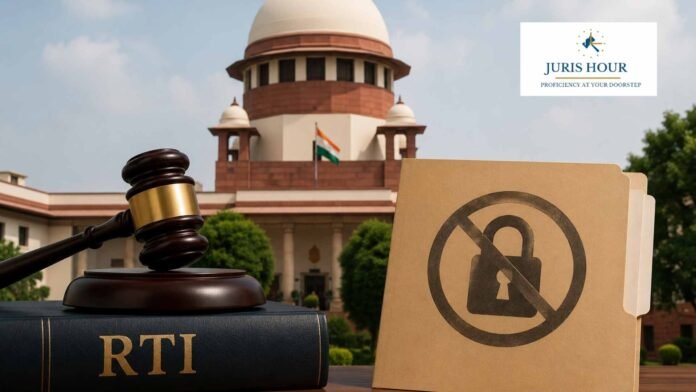
The Supreme Court has held that the Madhya Pradesh Special Police Establishment (SPE) of the Lokayukta Organisation cannot claim blanket exemption from the RTI Act by treating itself as an “intelligence and security organisation.”
The bench of Justice J.K. Maheshwari and Justice Atul S. Chandurkar has upheld the right of an accused public servant to seek information relating to the process of grant of sanction for prosecution under the Prevention of Corruption Act.
The case arose from a corruption trap case registered by the Madhya Pradesh Special Police Establishment against a Town Inspector in 2017 under the Prevention of Corruption Act. Following the grant of prosecution sanction by the State Government in May 2020, the officer sought information under the RTI Act regarding the decision-making process that led to the grant of sanction and the communications exchanged in that regard.
His RTI application was rejected. The State Information Commission also upheld the denial, relying on Section 8(1)(h) of the RTI Act, which exempts disclosure of information that may impede investigation, apprehension, or prosecution of offenders.
However, the Madhya Pradesh High Court found that the investigation had already been completed and directed disclosure of the requested information. The Special Police Establishment challenged that decision before the Supreme Court.
Before the Supreme Court, the SPE argued that a notification dated 25 August 2011 issued under Section 24(4) of the RTI Act exempted the Lokayukta’s Special Police Establishment from the operation of the RTI Act. According to the agency, information relating to investigations could not be disclosed because the organisation stood excluded from the Act’s ambit.
The State Government supported the notification, contending that the SPE functioned as an investigative arm of the Lokayukta and deserved treatment similar to intelligence and security agencies that enjoy RTI exemptions under Section 24.
A central issue before the Court was whether the SPE could legitimately be classified as an “intelligence and security organisation” for the purposes of Section 24(4) of the RTI Act. The Bench noted that Section 24 grants exemptions only to intelligence and security organisations established by the Central or State Governments.
The Court observed that the organisations listed in the Second Schedule of the RTI Act—including agencies such as the Enforcement Directorate, CRPF, BSF, CISF and NIA—perform functions directly connected with intelligence gathering, national security, border protection, or internal security.
In contrast, the SPE’s jurisdiction is confined to investigating corruption offences and specified offences under the Indian Penal Code involving public servants. The Court held that such an anti-corruption investigative agency could not automatically be equated with intelligence or security organisations merely because it investigates crimes.
The Court examined the legislative history of the Madhya Pradesh Lokayukta legislation and noted that the institution was created to investigate allegations of corruption against public servants and high-ranking officials. The Statement of Objects and Reasons behind the legislation emphasised the need for an independent anti-corruption mechanism rather than an intelligence or security apparatus.
The Supreme Court also referred to the Lokpal and Lokayuktas Act, 2013, which recognises Lokayuktas as bodies dealing with complaints relating to corruption against public functionaries.
Accordingly, the Bench found that the SPE’s core function is anti-corruption investigation and not intelligence or security operations.
The Court scrutinised the 25 August 2011 notification which had excluded investigations conducted by the Madhya Pradesh Special Police Establishment and the State Economic Offences Wing from the operation of the RTI Act. The notification was justified on the ground that disclosure could reveal informers’ identities or impede investigations.
However, the Supreme Court held that Section 24(4) permits exemptions only for organisations that are genuinely “intelligence and security organisations.” Since the SPE did not fall within that category, the State Government lacked authority to extend such blanket protection through a notification. The notification was therefore held to be beyond the scope of the parent statute.
The Court reiterated that subordinate legislation can be struck down when it exceeds the authority conferred by the enabling law or fails to conform to the parent statute.
The Supreme Court also agreed with the High Court’s reasoning that the investigation against the officer had already concluded and a charge-sheet had been filed. Therefore, disclosure of records relating to the sanction process would not automatically attract the exemption under Section 8(1)(h) of the RTI Act.
The Court noted that the information sought pertained to the manner in which sanction for prosecution had been granted and the communications exchanged in that process. Such information could not be withheld merely by making a general claim that disclosure would hamper investigation.
Membership Required to Access Case Details & Order Copy
To view the complete Case Details and Download Order Copy, you must have an active membership. Please subscribe to continue.

