
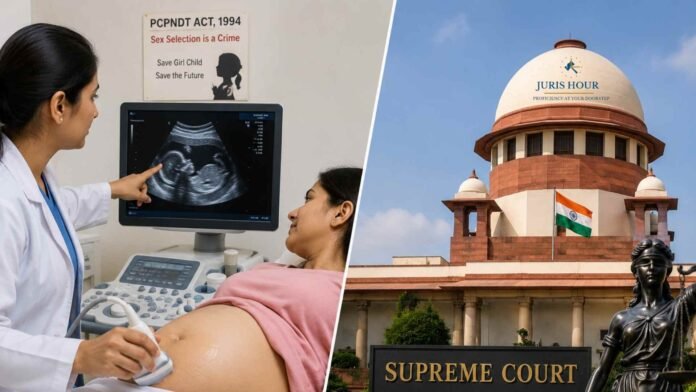
In a judgment reinforcing the strict enforcement of the Pre-Conception and Pre-Natal Diagnostic Techniques (Prohibition of Sex Selection) Act, 1994 (PCPNDT Act), the Supreme Court has dismissed an appeal filed by a Maharashtra-based doctor challenging criminal proceedings initiated against him for alleged violations of the Act.
The Bench of Justice Sanjay Karol and Justice Prashant Kumar Mishra held that deficiencies and inaccuracies in mandatory Form ‘F’ records are not mere clerical or technical lapses but strike at the very heart of the legislation enacted to combat female foeticide and sex-selective practices.
The case arose after authorities conducted an inspection of the appellant’s sonography centre and allegedly found multiple violations relating to maintenance of records under the PCPNDT Act. Following the inspection, the sonography machine was seized and the registration of the centre was suspended.
Subsequently, criminal proceedings were initiated before the Judicial Magistrate First Class, Ardhapur, who took cognizance of offences punishable under Section 23 of the PCPNDT Act for alleged violations of Sections 4(3), 5, 6 and 29 of the Act along with relevant Rules framed thereunder.
The doctor challenged the initiation of proceedings before the Sessions Court and later before the Bombay High Court, Aurangabad Bench, contending that:
- The Civil Surgeon was not the competent “Appropriate Authority” under the Act.
- The deficiencies found in Form ‘F’ were merely inadvertent and technical in nature.
Both contentions were rejected by the High Court, prompting the appeal before the Supreme Court.
The Court began its judgment by recalling the social purpose behind the PCPNDT Act and the need to protect the dignity and right to life of the girl child.
Referring to the continuing challenge of female foeticide in India, the Court observed that the legislation was enacted to ensure that every woman can experience the joy of motherhood without the threat of sex-selective practices that discriminate against unborn girls.
The Bench also referred to its earlier decision in Voluntary Health Association of Punjab v. Union of India, reiterating that destruction of a female foetus amounts to denying future generations the contribution and presence of women in society.
A major issue before the Court was whether deficiencies in Form ‘F’ records could be dismissed as minor technical mistakes.
The Court reproduced the statutory Form ‘F’, which requires detailed information regarding the patient, pregnancy, referral details, medical indications for ultrasound examinations, declarations by the patient and doctor, and confirmation that sex determination has neither been conducted nor disclosed.
The Bench stressed that maintaining accurate records is essential because such records often constitute the only evidence available to ensure that clinics are not engaging in illegal sex determination practices.
Relying on its earlier judgment in Federation of Obstetrics & Gynaecological Societies of India v. Union of India, the Court reiterated that “Non-maintenance of record is springboard for commission of offence of foeticide, not just a clerical error.”
The Court noted that complete and accurate maintenance of Form ‘F’ is mandatory and any deficiency or inaccuracy attracts the statutory presumption of contravention under the Act unless the contrary is proved.
The Supreme Court rejected the argument that the alleged violations were too trivial to justify criminal prosecution.
According to the Bench, the PCPNDT Act treats record maintenance as a substantive obligation because proper documentation enables authorities to detect and prevent unlawful sex determination practices.
The Court observed that whether the deficiencies were intentional or otherwise is a matter to be examined during trial and cannot be used as a ground to quash proceedings at the threshold.
It further upheld the High Court’s finding that the Civil Surgeon had been duly notified as the Appropriate Authority and was therefore competent to initiate action under the statute.
In a notable portion of the judgment, the Supreme Court examined national statistics relating to sex ratio trends and female child welfare.
The Court acknowledged that India’s overall sex ratio has improved over the years but observed that the sex ratio at birth remains below biologically expected levels and continues to reveal the persistence of gender bias in several regions of the country.
The judgment extensively discussed various Central and State Government schemes such as:
- Beti Bachao Beti Padhao
- Janani Suraksha Yojana
- Sukanya Samriddhi Account
- Mukhyamantri Kanya Sumangala Yojana
- Kanyashree Prakalpa
- Ladli Lakshmi Yojana
These initiatives, according to the Court, demonstrate continuing governmental efforts to eliminate discrimination against the girl child and improve gender equality.
Dismissing the appeal, the Supreme Court held that the statutory framework and previous judicial precedents leave no room for treating deficiencies in Form ‘F’ casually.
The Court concluded that strict compliance with the PCPNDT Act remains indispensable for combating female foeticide and ensuring gender justice. It observed that although India has made progress, the fight against sex-selective practices is far from over and continued enforcement of the legislation remains necessary.
Accordingly, the appeal was dismissed and the criminal proceedings against the doctor were allowed to continue.
Membership Required to Access Case Details & Order Copy
To view the complete Case Details and Download Order Copy, you must have an active membership. Please subscribe to continue.

