
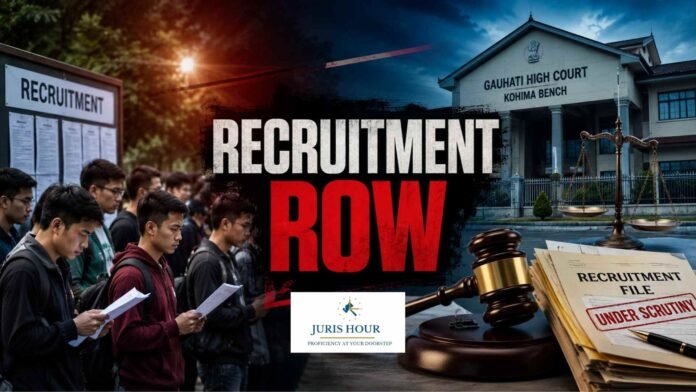
The Dimapur Naga Students’ Union (DNSU) has renewed its demand for a fresh recruitment process for 46 Excise Constable posts in Nagaland, urging the state government to ensure transparency, fairness, and adherence to recruitment rules. The demand comes against the backdrop of an ongoing controversy surrounding the recruitment exercise, which had earlier been questioned before the courts over alleged procedural irregularities.
In a recent statement, the student body emphasized that all vacant posts should be filled only through a fresh and legally compliant recruitment process. DNSU also called for a comprehensive review of appointments within the department to determine whether any unauthorized or irregular appointments were made outside the prescribed recruitment procedure.
Background of the Recruitment Dispute
The controversy traces its origins to an earlier recruitment process for Excise Constable posts conducted by the Departmental Recruitment Board (DRB). The recruitment exercise subsequently came under judicial scrutiny, with the Kohima Bench of the Gauhati High Court reportedly setting aside the process after identifying deviations from prescribed recruitment norms and service rules. The Single Judge’s decision was challenged before the Division Bench of the Gauhati High Court, Kohima Bench. The Division Bench had earlier permitted continuation of the recruitment process while restraining declaration of final results without the Court’s approval. Public reports indicate that the matter continues to remain under judicial consideration.
The DNSU has consistently maintained that candidates who participated in the recruitment process suffered due to administrative lapses rather than any fault of their own. The organization has previously highlighted the hardships faced by aspirants who invested considerable time, effort, and financial resources in preparing for the examinations.
According to the student body, restoring public confidence requires a fresh recruitment exercise conducted strictly in accordance with applicable rules and established procedures.
Demand for Investigation into Appointments
Apart from seeking fresh recruitment, DNSU has urged the government to verify whether any appointments were made through what is commonly referred to as “backdoor entry”—appointments allegedly made without following open competitive recruitment procedures.
The union has sought a thorough review of appointments within the department and has recommended that any vacancies resulting from the identification of irregular appointments should be merged with the existing vacant posts and advertised through a single competitive recruitment process.
The student body argues that such a step would ensure equal opportunity for all eligible candidates and reinforce public trust in government recruitment.
Why Recruitment Transparency Matters
Government jobs in India are governed by constitutional principles that require fairness, equality, and non-arbitrariness in public employment.
Article 14 of the Constitution
Article 14 guarantees equality before law and equal protection of laws. In recruitment matters, this means that all eligible candidates must be treated fairly and without arbitrary discrimination.
Article 16 of the Constitution
Article 16 provides equality of opportunity in matters relating to public employment. The provision seeks to ensure that appointments to government posts are made through transparent procedures that provide all eligible candidates an equal chance to compete.
Courts across India have repeatedly held that public employment cannot be distributed as a matter of favour and must ordinarily be filled through a fair, open, and competitive process.
The Principle Against “Changing Rules Midway”
One of the significant legal issues highlighted in the recruitment dispute relates to the principle that recruitment rules should not be altered after the selection process has begun.
Indian courts have consistently held that authorities cannot change eligibility conditions, selection criteria, or recruitment procedures after candidates have already entered the process. Doing so may violate the principles of fairness and legitimate expectation.
This doctrine is often described as the prohibition against “changing the rules of the game after the game has started.” The principle aims to protect candidates from arbitrary administrative decisions and preserve the integrity of recruitment processes.
Legal Consequences of Irregular Appointments
If any appointment is found to have been made in violation of recruitment rules, authorities may be required to take corrective action in accordance with law.
Depending on the circumstances, consequences may include:
- Cancellation of irregular appointments.
- Fresh recruitment exercises.
- Departmental inquiries.
- Administrative action against responsible officials.
- Judicial review by constitutional courts.
However, courts generally examine each case individually and balance competing considerations such as fairness, public interest, and the rights of affected individuals.
Impact on Job Aspirants
The dispute has attracted considerable attention because government employment remains a highly sought-after career option among educated youth.
Recruitment controversies often create uncertainty for candidates who spend months or even years preparing for examinations and physical tests. When recruitment processes are cancelled or challenged, candidates frequently face emotional, financial, and professional setbacks.
The DNSU has stated that the interests of students, unemployed youth, and job seekers must remain a central consideration while resolving the dispute.
Looking Ahead
With the matter continuing to attract public attention, the focus now remains on the actions of the state government and the outcome of ongoing judicial proceedings.
The DNSU has expressed confidence that the legal process will reinforce the principles of accountability, transparency, and the rule of law in public recruitment. At the same time, it has reiterated its demand that all vacancies be filled only through a fresh, transparent, and merit-based recruitment exercise that gives every eligible candidate an equal opportunity to compete.
The case is likely to serve as another important reminder of the constitutional requirement that government recruitment must not only be fair but must also appear to be fair, thereby preserving public confidence in the administration of public employment.
Read More: UK Economy Shrinks as Iran War Starts Hitting Businesses and Families

