
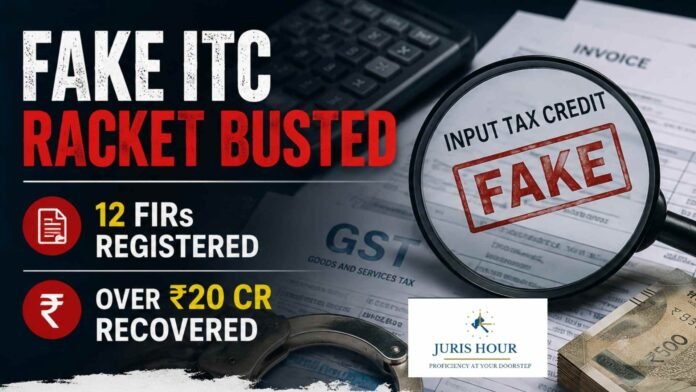
In a major crackdown on Goods and Services Tax (GST) fraud, the Punjab State Taxation Department has uncovered a large-scale fake Input Tax Credit (ITC) racket, resulting in the registration of 12 First Information Reports (FIRs) and recovery of more than ₹20 crore.
The fraud was detected during an extensive data analytics exercise conducted by the department. Officials compared purchase details reported in taxpayers’ GSTR-2A and GSTR-2B returns with corresponding e-way bill records and identified significant mismatches that pointed towards suspicious transactions and potential misuse of GST registrations.
According to the department, the investigation revealed that several entities had allegedly obtained GST registrations using forged or manipulated documents. Authorities suspect that these registrations were either fraudulently secured at the time of application or subsequently misused to create fictitious chains of transactions aimed at generating and passing on fake input tax credit.
Fake Invoices Without Actual Supply
The probe found that multiple firms had issued tax invoices without undertaking any genuine supply of goods or services. These invoices were allegedly used to claim and distribute inadmissible ITC, enabling beneficiaries to reduce their tax liabilities unlawfully.
Officials stated that such practices not only resulted in substantial revenue losses to the state exchequer but also distorted fair competition and adversely affected legitimate businesses operating within the GST framework.
E-Way Bill Discrepancies Triggered Investigation
The fraud came to light when tax authorities noticed that several entities had reported large volumes of inward supplies in their GST returns, while corresponding e-way bills either did not exist or contained serious inconsistencies regarding the movement of goods.
The discrepancies prompted a deeper examination of the businesses involved. During field verification and document scrutiny, authorities uncovered multiple irregularities linked to the registrations.
Identity Misuse and Fake Aadhaar Details
Investigators discovered instances where individuals listed as proprietors of registered firms denied any knowledge of the businesses. Several persons reportedly informed authorities that they had neither applied for GST registration nor authorised anyone to use their identities for such purposes.
The department further found that mobile numbers associated with certain GST registrations were linked to fake Aadhaar-based identities. In addition, several bank accounts furnished during the registration process were either unverifiable or failed validation checks.
These findings strengthened the department’s suspicion that organised networks were using forged credentials and fabricated business profiles to facilitate fraudulent ITC claims.
Criminal Proceedings Initiated
Based on the evidence gathered during the investigation, the Punjab State Taxation Department initiated criminal action against the persons and entities allegedly involved in the fraud.
A total of 12 FIRs have been registered in the Ludhiana Division under various provisions of the Bharatiya Nyaya Sanhita, 2023, including offences relating to cheating, impersonation, forgery, possession of counterfeit materials, preparation of false documents, and use of forged documents as genuine.
The cases have been registered under Sections 318(2), 319(2), 338, 336(3), and 340(2) of the BNS.
Department Intensifies Anti-Evasion Measures
Tax officials indicated that the action forms part of a broader initiative to curb GST evasion through technology-driven monitoring and verification mechanisms. Authorities have emphasized that data analytics, return reconciliation, and e-way bill matching are being increasingly used to identify suspicious patterns and dismantle fraudulent ITC networks.
The department has also cautioned taxpayers against participating in fake invoicing arrangements, warning that stringent civil and criminal consequences may follow for those found involved in fraudulent GST practices.
The latest crackdown highlights the growing focus of tax authorities on combating fake ITC fraud and safeguarding government revenue through enhanced compliance and enforcement measures.
Read More: NCLT Makes Filing of Vakalatnama Mandatory Before Advocates Can Appear

