
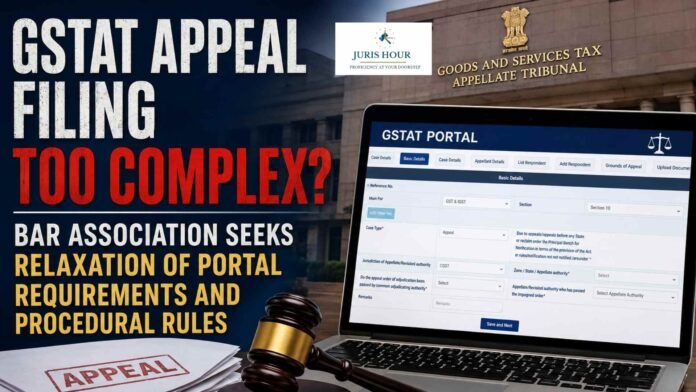
The Marwar GST Appellate Tribunal Bar Association (MGTBA) has submitted a detailed representation to the President of the Goods and Services Tax Appellate Tribunal (GSTAT), highlighting a series of practical and procedural difficulties being faced by taxpayers and professionals while filing appeals on the newly operational GSTAT portal. The Association has urged the Tribunal to adopt a more facilitative approach during the initial phase of GSTAT implementation and to simplify filing requirements in line with the objective of ensuring accessible and expeditious justice.
The representation, dated June 10, 2026, comes amid the rollout of the GSTAT framework and the expected influx of appeals relating to disputes arising since the implementation of GST on July 1, 2017. According to the Association, despite GSTN’s earlier indication that a large volume of appeals was anticipated, actual filing numbers appear significantly lower, suggesting that procedural and technical challenges may be discouraging litigants from approaching the Tribunal.
Tribunal Must Remain Accessible to Taxpayers
The Association emphasized that GSTAT serves as the final fact-finding authority under the GST law and occupies a unique position in the dispute resolution hierarchy. It argued that the Tribunal was conceived as an accessible and cost-effective forum where taxpayers could seek speedy justice without being burdened by excessive procedural formalities.
Referring to Articles 323A and 323B of the Constitution and observations contained in the 215th Report of the Law Commission of India, the representation noted that tribunals are intended to provide specialized adjudication free from many technicalities associated with conventional courts. The Association warned that overly complex filing requirements could undermine this constitutional objective and create barriers to justice.
Appeal Form More Complex Than Appeal Drafting
One of the principal concerns raised relates to the complexity of the GSTAT appeal filing form itself.
According to the Association, preparing the online appeal form often takes more time than drafting the substantive appeal. While the appeal memorandum is prepared as a coherent legal document, the portal requires the same information to be broken into numerous separate fields, forcing taxpayers and professionals to repeatedly extract and restructure information.
The Association particularly criticized the requirement to enter chronological events individually on the portal instead of permitting a consolidated chronology document, describing the process as duplicative and unnecessarily burdensome.
Key Relaxations Sought by the Association
To address these concerns, the representation proposes several reforms and temporary relaxations during the initial operational phase of GSTAT:
1. Optional Case Summary Fields
The Association has requested that several fields, including the “Case Summary” section, be made optional initially. It suggested that appellants should only be required to provide information necessary for basic scrutiny and eligibility verification, while detailed summaries can be provided through the appeal memorandum itself.
2. Consolidated Chronology Upload
Instead of requiring separate entry of each event and date, taxpayers should be allowed to upload a consolidated chronology document. According to the Association, this would substantially reduce compliance burdens while still providing all necessary information to the Tribunal.
3. GSTN Integration and Automatic Import of Records
The representation points out that Form GST APL-04 can already be imported from GSTN systems. It therefore recommends extending similar integration for all relevant documents and records already available on the GST portal. Such integration would eliminate repetitive uploads and reduce procedural duplication.
4. Relaxation of 29-Point Checklist
The Association has also sought temporary relaxation of the 29-point checklist currently prescribed on the portal, arguing that it should not become a barrier during the early stages of Tribunal operations.
5. Simplified Signature Requirements
Another recommendation is the adoption of a consolidated signature mechanism. Since all documents are uploaded electronically and remain accessible on the portal, requiring multiple signatures at various stages is viewed as unnecessary.
Concerns Over Incorrect Fee Calculation
The Bar Association has further raised concerns regarding fee computation on the GSTAT portal.
According to the representation, the portal is reportedly calculating appeal fees that are not always consistent with statutory provisions. In some cases, taxpayers are allegedly being charged higher fees than prescribed, while in others the portal computes lower fees, potentially leading to defect notices and procedural complications later. The Association has requested that the Registry be empowered to verify such discrepancies and facilitate refunds where excess fees have been paid due to portal errors.
Jurisdiction Selection Problems on GSTAT Portal
A significant portion of the representation focuses on technical defects relating to jurisdiction selection.
The Association states that the dropdown menus for selecting the “State/Zone of the Appellate Authority” and “Jurisdiction of the Appellate/Revisional Authority” are incomplete and often do not reflect actual administrative jurisdictions.
As an example, for appeals relating to Jodhpur under Central jurisdiction, users reportedly find only limited options such as Jaipur while relevant jurisdictional choices like Jodhpur are absent. Similarly, taxpayers dealing with authorities in Jammu allegedly cannot find “Jammu & Kashmir” as an available option in the dropdown menu.
The representation also points out that when “State” jurisdiction is selected, multiple identical entries for appellate authorities appear, creating confusion despite there being only one relevant authority in certain locations. The Association has urged immediate correction of these dropdown anomalies and issuance of appropriate clarifications to ensure accurate filing of appeals.
Wider Concerns Regarding GSTAT Procedure Rules
Beyond portal-related issues, the Association has sought a broader review of several provisions contained in the GSTAT (Procedure) Rules, 2025.
Among the concerns highlighted are:
- Interlocutory and inspection fee burdens;
- Inconsistencies relating to certified copies and acknowledgments;
- Multiple certification and signature requirements;
- Mandatory English translation requirements;
- Restrictions relating to additional evidence;
- Procedural rigidity concerning authorized representatives;
- Consequences arising from place-of-supply bench references; and
- Rectification limitation periods that may be shorter than statutory provisions.
The Association has requested a comprehensive review of these provisions to ensure they align with the statutory framework and the objective of expeditious dispute resolution.
Earlier Representations Still Await Consideration
The Bar Association also reminded the Tribunal that several issues raised in its earlier representations dated January 29, March 4, and June 2, 2026, remain pending. It urged the GSTAT administration to address those concerns at the earliest to ensure smooth functioning of the appellate mechanism.
Call for a Facilitative Initial Phase
Concluding the representation, the Association stressed that taxpayers approaching GSTAT have already pursued statutory remedies before lower appellate authorities and therefore cannot be presumed to be lacking diligence. It argued that any filing difficulties presently being experienced arise primarily from systemic and procedural challenges rather than taxpayer negligence.
The Association has therefore urged the Tribunal to adopt a calibrated and facilitative approach during the initial phase of GSTAT operations, allowing taxpayers and professionals to gradually adapt to procedural requirements while preserving effective access to justice. According to the representation, such an approach would help streamline appellate proceedings, reduce unnecessary litigation over procedural defects, and improve the overall efficiency of the GST dispute resolution system.
Membership Required to Access Case Details & Order Copy
To Read the complete Representation and Download Representation Copy, you must have an active membership. Please subscribe to continue.

