
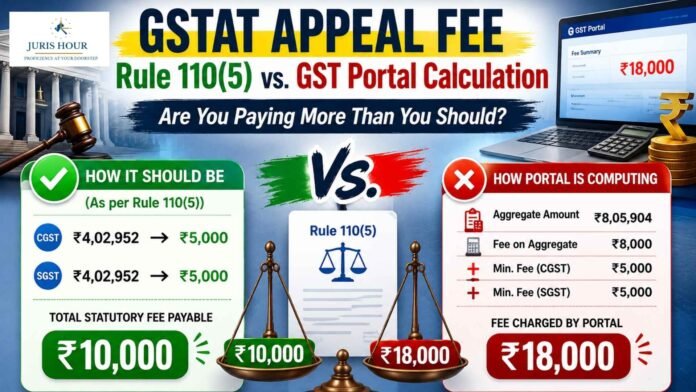
A fresh controversy has emerged over the manner in which the GST Appellate Tribunal (GSTAT) appeal fee is being computed on the GST portal. Tax professionals and taxpayers have raised concerns that the portal’s methodology may be resulting in higher fees than what is prescribed under Rule 110(5) of the Central Goods and Services Tax (CGST) Rules, 2017.
The issue revolves around whether the statutory minimum fee prescribed under Rule 110(5) should be treated as a floor limit within the fee calculation or added separately after computing the fee based on the disputed tax amount.
What Does Rule 110(5) Say?
Rule 110(5) of the CGST Rules provides:
“One thousand rupees for every one lakh rupees of tax or input tax credit involved or the difference in tax or input tax credit involved or the amount of fine, fee or penalty determined in the order appealed against, subject to a maximum of twenty-five thousand rupees and a minimum of five thousand rupees.”
The provision lays down a formula-based mechanism:
- ₹1,000 for every ₹1 lakh of disputed tax or ITC.
- Maximum fee capped at ₹25,000.
- Minimum fee fixed at ₹5,000.
Notably, the rule does not contain the phrase “or part thereof,” nor does it expressly provide for adding the minimum fee separately after the fee has been calculated.
Illustration of the Dispute
The controversy has been highlighted through an example involving:
- CGST disputed amount: ₹4,02,952
- SGST disputed amount: ₹4,02,952
Fee as Per a Literal Reading of Rule 110(5)
For CGST:
- Tax involved: ₹4,02,952
- Rounded computation: approximately 4 lakh units
- Fee: ₹4,000
- Since this falls below the minimum threshold, fee payable becomes ₹5,000.
For SGST:
- Tax involved: ₹4,02,952
- Computed fee: ₹4,000
- Minimum fee applies: ₹5,000.
Thus:
| Component | Fee |
| CGST | ₹5,000 |
| SGST | ₹5,000 |
| Total Fee | ₹10,000 |
According to this interpretation, the statutory fee payable should be ₹10,000.
How the Portal Appears to Be Computing the Fee
Tax practitioners have observed that the GST portal appears to be following a different methodology.
Step 1: Aggregate Tax Amount
CGST Tax: ₹4,02,952
SGST Tax: ₹4,02,952
Total Tax Involved:
₹4,02,952 + ₹4,02,952 = ₹8,05,904
Step 2: Compute Fee on Aggregate Amount
₹8,05,904 ÷ ₹1,00,000 ≈ 8
Fee calculated:
8 × ₹1,000 = ₹8,000
Step 3: Add Minimum Fee Separately
The portal is alleged to be adding:
- ₹5,000 minimum fee for CGST
- ₹5,000 minimum fee for SGST
Result:
| Component | Amount |
| Fee on Aggregate Amount | ₹8,000 |
| Minimum Fee (CGST) | ₹5,000 |
| Minimum Fee (SGST) | ₹5,000 |
| Total Fee Charged | ₹18,000 |
This leads to a total fee demand of ₹18,000 instead of ₹10,000.
Core Legal Question
The central legal issue is whether the minimum fee prescribed under Rule 110(5) is:
Interpretation 1: A Floor Limit
Under this view, the minimum fee simply ensures that the fee payable cannot fall below ₹5,000.
If the calculated fee is less than ₹5,000, it is increased to ₹5,000.
If the calculated fee is already higher than ₹5,000, there is no separate addition.
This is the conventional understanding of minimum fee provisions across taxation and court-fee statutes.
Interpretation 2: An Additional Levy
The alternative interpretation, reflected in the alleged portal computation, treats the minimum fee as an amount that can be added separately over and above the fee already computed under the formula.
Critics argue that Rule 110(5) contains no language supporting such an addition.
Importance of the Missing Phrase “Or Part Thereof”
Another point raised by professionals is that Rule 110(5) uses the expression:
“One thousand rupees for every one lakh rupees”
but does not include the words:
“or part thereof”
In many statutory fee provisions, the phrase “or part thereof” authorises charging for even a fraction of a lakh.
The absence of this phrase has led to arguments that fee computation should be strictly confined to completed lakh units, making the portal’s approach vulnerable to challenge if it adopts a broader interpretation.
Potential Grounds for Challenge
Taxpayers may argue that:
- The portal cannot override the statutory rule.
- A minimum fee is ordinarily a threshold, not an additional charge.
- Rule 110(5) does not authorise separate addition of minimum fees after formula-based computation.
- Any fee collection beyond the express language of the rule may lack legal backing.
- Automated portal calculations must conform strictly to the parent statutory provision.
Revenue Perspective
The tax administration may contend that:
- CGST and SGST liabilities arise under separate enactments.
- Separate minimum fees may therefore be justified.
- The portal’s methodology reflects the legislative structure of dual GST.
However, whether such an interpretation can be sustained would ultimately depend upon the precise wording of Rule 110(5) and judicial scrutiny.
Read More: JURISHOUR | TAX LAW DAILY BULLETIN : 08 June, 2026

