
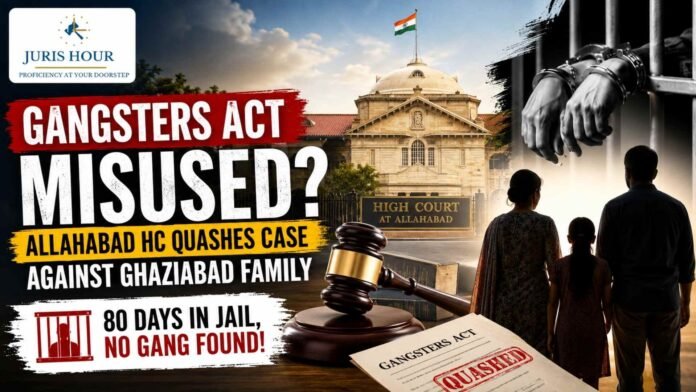
Concerning the application of the Uttar Pradesh Gangsters and Anti-Social Activities (Prevention) Act, 1986, the Allahabad High Court has quashed criminal proceedings initiated against Rajendra Tyagi, his son Deepak Tyagi, and daughter-in-law Lalita Tyagi, holding that the material on record failed to establish the essential ingredients required for invoking the stringent anti-gangster legislation.
Justice Vinod Diwakar, while allowing an application under Section 482 CrPC, set aside the entire proceedings arising out of FIR No. 101 of 2023 registered at Nandgram Police Station, Ghaziabad, and the consequential Special Sessions Trial pending before the Additional Sessions Judge, Ghaziabad.
Court Finds Dispute Rooted in Financial Transactions
The prosecution had alleged that Rajendra Tyagi was the leader of an organized criminal gang engaged in large-scale fraud, forgery and intimidation in connection with land transactions. Based on two earlier criminal cases involving allegations of cheating, criminal breach of trust and intimidation, authorities invoked Sections 2 and 3 of the Gangsters Act against Rajendra Tyagi, Deepak Tyagi and Lalita Tyagi.
However, the High Court found that both foundational FIRs were essentially linked to financial and property transactions between private parties. According to the Court, the allegations may have disclosed offences such as cheating or breach of trust, but they did not demonstrate the existence of an organized gang operating in a manner contemplated under the Gangsters Act.
The Court observed that there was no material indicating the use of violence, intimidation, coercion or other methods aimed at disturbing public order or securing undue pecuniary advantage through organized criminal activity. Consequently, the statutory requirements contained in Section 2(b) of the Act were not satisfied.
Relief to Homemaker Daughter-in-Law
An important aspect of the judgment concerns Lalita Tyagi, a homemaker and daughter-in-law of Rajendra Tyagi, who was arrested shortly after registration of the Gangsters Act case.
The Court noted that the charge sheets in the underlying criminal cases did not contain any specific allegations against her capable of establishing her involvement in organized criminal activity. Justice Diwakar held that no material had been placed on record to justify her arrest and described the action as “patently illegal, arbitrary and wholly unwarranted.”
The judgment records that Lalita Tyagi remained in judicial custody for approximately 80 days before securing bail.
Examination of Commissionerate System and Gang Chart Approvals
Although the case arose from an individual challenge, it evolved into a broader judicial examination of the process followed for approval of gang charts in police commissionerate districts.
The Court extensively reviewed whether the approval mechanism under the U.P. Gangsters and Anti-Social Activities (Prevention) Rules, 2021 was being properly implemented after the introduction of the Commissionerate system in certain districts of Uttar Pradesh.
Questions were raised regarding the exclusion of District Magistrates from the approval process and the extent to which Commissioners of Police, acting under powers delegated through government notifications issued under Section 20 of the Code of Criminal Procedure, could independently exercise functions traditionally performed by District Magistrates.
During the proceedings, the Home Department filed multiple affidavits defending the Commissionerate model, asserting that metropolitan policing requires specialized expertise to combat organized crime, cyber offences and economic fraud. The State also furnished comparative data claiming higher enforcement rates and greater asset seizure efficiency in Commissionerate districts.
However, the Court repeatedly expressed dissatisfaction with the quality of compliance by the Home Department and sought empirical data, accountability records, training details and comparative crime statistics to justify policy decisions.
Sharp Remarks on Administrative Functioning
The judgment contains extensive observations on criminal administration, misuse of police powers and institutional accountability.
Justice Diwakar expressed concern that stringent provisions of the Gangsters Act are frequently invoked against petty or localized offenders while sophisticated organized crime networks often escape effective prosecution. The Court also highlighted systemic deficiencies including delays in gangster trials, weak witness protection mechanisms, inadequate prosecution management and lack of accountability within investigative and prosecutorial agencies.
The Court emphasized that selective prosecution and arbitrary use of criminal law undermine public confidence in governance and the rule of law.
Concerns Over Police Supervision
After reviewing affidavits and records placed before the Court, Justice Diwakar observed that the then Commissioner of Police, Ghaziabad, appeared to have failed in exercising adequate supervisory control while approving proceedings under the Gangsters Act.
The Court noted that despite earlier directions requiring authorities to produce material justifying the gang chart and explaining the methodology used to assess alleged criminal gains, no substantive material was furnished beyond general assertions.
According to the judgment, mere allegations without supporting evidence cannot justify invocation of the Gangsters Act.
Court Refrains From Wider Constitutional Adjudication
During the proceedings, the State informed the Court that the constitutional validity of the Gangsters Act and the Rules framed under it is presently under consideration before a three-judge Bench of the Supreme Court in pending matters, including Rameez Nemat v. State of Uttar Pradesh and Irfan Solanki v. State of Uttar Pradesh.
Taking note of the pending proceedings before the apex court, the High Court refrained from delivering a final ruling on broader constitutional questions concerning the Act and related government notifications. However, it proceeded to examine the facts of the present case and the administrative issues that surfaced during the litigation.
Proceedings Quashed
Concluding that the allegations against the applicants failed to meet the statutory threshold required under the Gangsters Act, the High Court quashed the entire criminal proceedings arising out of the 2023 Gangsters Act FIR.
While recording concern regarding the manner in which the case had been handled, the Court ultimately adopted a lenient approach toward the officer concerned and directed him to remain vigilant and exercise greater caution in discharging official responsibilities in future.
Case Details
Case Title: Rajendra Tyagi And 2 Others Versus State of U.P. and Another
Citation: JURISHOUR-1547-All-2026
Case No.: APPLICATION U/S 482 NO.- 6547 of 2025
Date: 03/06/2026

