
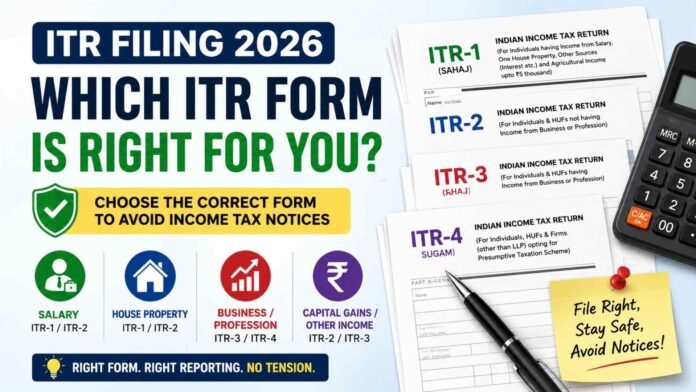
The Income Tax Return (ITR) filing season for Assessment Year (AY) 2026-27 has begun, and one of the most important decisions taxpayers must make is selecting the correct ITR form. Filing an incorrect return form can result in defective return notices, delayed processing of refunds, and, in certain cases, scrutiny by the Income Tax Department.
With the Income Tax Department increasingly relying on data available through the Annual Information Statement (AIS), Taxpayer Information Summary (TIS), TDS statements, and other reporting mechanisms, taxpayers must ensure that the form they choose accurately reflects their income profile and tax obligations.
Why Choosing the Correct ITR Form Matters
Every ITR form is designed for a specific category of taxpayers based on the nature and source of income. Filing a return in the wrong form may render the return defective under the Income Tax Act. A defective return can lead to notices from the department requiring rectification within the prescribed time.
Moreover, if income is not disclosed in the appropriate manner due to the use of an incorrect form, the taxpayer may face inquiries regarding mismatches between reported income and information available with the tax authorities.
ITR-1 (Sahaj): Who Can File?
ITR-1 is intended for resident individuals whose total income does not exceed ₹50 lakh and comprises:
- Income from salary or pension;
- Income from one house property (excluding certain complex cases);
- Income from other sources such as interest income; and
- Agricultural income up to the prescribed limit under the applicable rules.
Taxpayers with straightforward income profiles generally use ITR-1. However, individuals having capital gains, business income, foreign assets, or multiple complex income sources should carefully examine whether they remain eligible to use this form.
ITR-2: For Individuals Without Business Income
ITR-2 is applicable to individuals and Hindu Undivided Families (HUFs) who do not have income from business or profession but have income that cannot be reported in ITR-1.
Common situations where ITR-2 may be required include:
- Capital gains from shares, mutual funds, or property;
- Income from multiple house properties;
- Foreign assets or foreign income;
- Directorship in a company;
- Investments in unlisted equity shares; and
- Other income categories not covered under ITR-1.
Taxpayers earning capital gains should pay particular attention while selecting the appropriate form, as filing ITR-1 despite having taxable capital gains may invite complications.
ITR-3: For Business and Professional Income
ITR-3 is generally used by individuals and HUFs earning income from business or profession.
This form is relevant for:
- Proprietors carrying on business activities;
- Freelancers and consultants;
- Professionals such as advocates, doctors, architects, and chartered accountants;
- Individuals earning commission income; and
- Persons having income from trading activities.
Taxpayers with business or professional income should not use forms intended for salaried individuals merely because salary constitutes a substantial portion of their earnings.
ITR-4 (Sugam): Presumptive Taxation Scheme
ITR-4 is available to eligible resident individuals, HUFs, and firms (other than LLPs) opting for the presumptive taxation scheme under the Income Tax Act.
The form is generally used by small businesses and professionals who declare income under the presumptive provisions and satisfy the prescribed eligibility conditions.
Before choosing ITR-4, taxpayers should verify whether they qualify under the applicable presumptive taxation provisions and whether any exclusion applies to their case.
Common Mistakes That Trigger Tax Notices
Many notices arise not because of tax evasion but due to reporting errors and incorrect return filing. Some common mistakes include:
Reporting Capital Gains in the Wrong Form
Taxpayers often sell shares, mutual funds, or immovable property and continue filing ITR-1. Since capital gains information is separately available to the department through reporting systems, such mismatches can lead to queries.
Ignoring AIS and TIS Information
The Annual Information Statement contains details of several financial transactions reported to the department. Taxpayers should reconcile their income and transactions with AIS before filing returns.
Non-Disclosure of Interest Income
Interest earned from savings accounts, fixed deposits, recurring deposits, and other financial instruments is often reflected through reporting mechanisms. Failure to disclose such income may result in discrepancies.
Incorrect Reporting of Foreign Assets
Resident taxpayers required to disclose foreign assets must carefully review disclosure requirements and ensure accurate reporting in the applicable form.
Failure to Report Business or Freelance Income
Individuals receiving payments through online platforms, consultancy assignments, professional services, or freelancing arrangements should determine whether such receipts constitute business or professional income requiring filing through the appropriate form.
How to Avoid Income Tax Notices
While no taxpayer can guarantee that a notice will never be issued, the following measures can significantly reduce the risk of compliance-related notices:
- Select the correct ITR form based on the nature of income.
- Reconcile income with AIS and TIS before filing.
- Verify TDS details with Form 26AS and relevant statements.
- Disclose all taxable income sources.
- Report capital gains accurately.
- Maintain supporting documents and records.
- Ensure consistency between return disclosures and financial transactions.
Conclusion
Selecting the correct ITR form for AY 2026-27 is one of the most important aspects of tax compliance. Taxpayers should evaluate all sources of income, review reporting obligations carefully, and choose the form that accurately reflects their financial profile. A properly filed return not only facilitates smooth processing but also minimizes the chances of receiving avoidable notices arising from reporting mismatches and procedural errors.
As the Income Tax Department continues to strengthen data analytics and information matching systems, accuracy in return filing has become more important than ever.

