
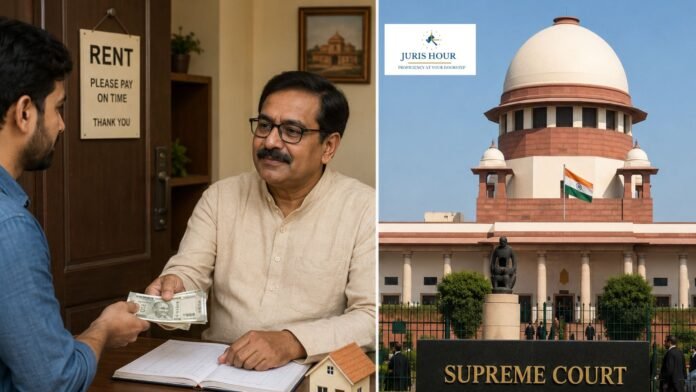
The Supreme Court has held that landlords of premises leased to the State Government and other protected public bodies can continue to seek enhancement of rent under Section 21(8) of the Uttar Pradesh Urban Buildings (Regulation of Letting, Rent and Eviction) Act, 1972, despite the deletion of certain provisions referred to in that section.
However, the bench of Justice Sanjay Karol and Justice Nongmeikapam Kotiswar Singh also ruled that the High Court cannot, in the absence of supporting evidence on record, directly determine and enhance rent while exercising powers under Article 227 of the Constitution.
The dispute arose from a building in Bahraich that had been leased to the Trade Tax Department of the Government of Uttar Pradesh since 1966. The landlords sought enhancement of rent under Section 21(8) of the 1972 Act, arguing that the property was situated in a prime commercial location and that the Government was paying significantly higher rent for nearby premises.
The Rent Control Authority considered the location of the property and comparable rentals in the area and fixed rent at Rs.14,400 per month by applying a rate of Rs.4 per square foot. Subsequently, the appellate authority found deficiencies in the order, particularly regarding the date from which enhanced rent would be payable and the requirement of periodic revision every five years. It therefore remanded the matter back to the Rent Control Authority for fresh adjudication.
High Court Directly Enhanced Rent
The landlords challenged the remand order before the Allahabad High Court. Instead of sending the matter back for reconsideration, the High Court accepted the submission that an adjoining property occupied by the Government was fetching rent at the rate of Rs.14 per square foot. Considering the prolonged litigation, the High Court modified the rent determination and directed payment at that rate from the date of filing of the application under Section 21(8).
The State challenged this decision before the Supreme Court.
Key Legal Issue Before Supreme Court
The principal legal question before the Court was whether the deletion of Clauses (ii) and (iv) of the Explanation to Section 21(1) rendered Section 21(8) inoperative, thereby depriving landlords of the right to seek rent enhancement against government tenants.
The State contended that once the referenced clauses were deleted by the 1976 amendment, the proviso permitting rent enhancement could no longer survive. The landlords argued that such an interpretation would effectively deprive them of any meaningful remedy against government tenants.
Supreme Court Upholds Landlords’ Right to Seek Rent Enhancement
Rejecting the State’s argument, the Supreme Court held that the deletion of Clauses (ii) and (iv) did not affect the operation of the proviso contained in Section 21(8).
The Court examined the legislative framework and observed that government bodies, local authorities, public sector corporations and recognized educational institutions enjoy extensive protection against eviction under the Act. Following the 1976 amendment, even the limited exceptions that earlier permitted eviction in specific circumstances were removed. Consequently, the only meaningful remedy left to landlords was the statutory mechanism for enhancement of rent.
The Bench observed that accepting the State’s interpretation would produce an absurd result whereby landlords would be unable either to recover possession of their property or obtain fair financial compensation through rent enhancement. Such a construction, the Court held, would effectively convert the tenant into the dominant beneficiary of the property relationship.
Accordingly, the Court held that applications for enhancement of rent under the proviso to Section 21(8) remain maintainable notwithstanding the deletion of the clauses referred to therein.
Important Clarification on Article 227 Powers
The judgment also contains an important discussion on the scope of the High Court’s powers under Article 227 of the Constitution.
The Supreme Court reiterated that the power of superintendence is intended to ensure that subordinate courts and tribunals act within the limits of their jurisdiction. It is not an appellate power permitting the High Court to substitute its own factual conclusions merely because it may prefer a different outcome.
The Court summarized settled principles governing Article 227 jurisdiction, emphasizing that intervention is generally justified only when:
- A court exercises jurisdiction it does not possess;
- A court fails to exercise jurisdiction vested in it;
- The manner of exercising jurisdiction results in grave injustice or jurisdictional transgression.
The Bench further stressed that rent control statutes are special legislations and routine interference in rent fixation matters under Article 227 is not warranted.
High Court Erred in Fixing Rent Without Evidence
Applying these principles, the Supreme Court found that the High Court had fixed rent at Rs.14 per square foot solely on the basis of a statement made on behalf of the landlords that a neighbouring government-occupied building was paying rent at that rate.
The Court noted that no documentary material supporting this assertion was placed on record and there was neither an admission nor a concession from the State accepting the alleged comparable rent. In such circumstances, the High Court could not have directly determined the rent payable.
The Bench therefore concluded that while Article 227 jurisdiction can be exercised in exceptional rent control matters, the High Court’s order in the present case could not be sustained due to lack of evidentiary support.
Matter Remanded for Fresh Determination
Setting aside the High Court’s order, the Supreme Court remanded the matter to the Rent Control Officer, Bahraich, for fresh adjudication on the question of rent enhancement and related issues identified by the appellate authority. The Court directed that the exercise be completed within four months.
Importantly, the Court clarified that any revised rent ultimately determined would apply retrospectively from the date of institution of the original application filed in 2008.
Case Details
Case Title: State Of U.P. & Ors. Versus Raghvendra Nath Srivastava & Ors.
Citation: JURISHOUR-1484-SC-2026
Case No.: Special Leave Petition (Civil) Nos. 38495-38496 of 2025
Date: 29/05/2026
Read More: Ignoring Court Notice Can Trigger Limitation Clock: Supreme Court

