
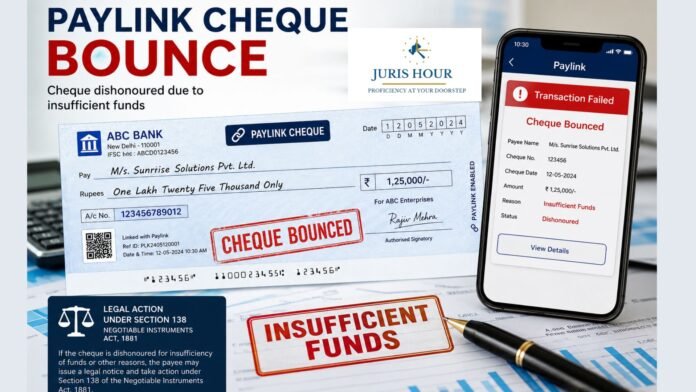
One of the most important legal questions surrounding Paylink Cheques is whether their dishonour can result in criminal prosecution under Section 138 of the Negotiable Instruments Act, 1881. The answer largely depends on whether the Paylink Cheque satisfies the statutory requirements of a “cheque” under Section 6 of the Act and whether it represents a legally enforceable debt or liability.
Section 138 was introduced to enhance the credibility of cheque transactions and ensure financial discipline in commercial dealings. It provides criminal consequences where a cheque issued towards discharge of a legally enforceable debt or liability is returned unpaid due to insufficiency of funds or because it exceeds the arrangement made with the bank.
Since a Paylink Cheque ultimately operates through the banking system and represents an instruction to pay a specified sum of money, its digital linkage does not alter its fundamental legal character. Therefore, if the instrument qualifies as a cheque under law, the drawer remains exposed to Section 138 proceedings upon dishonour.
Essential Conditions for Invoking Section 138
For a dishonoured Paylink Cheque to attract Section 138, the following conditions must be fulfilled:
- The cheque must have been issued for discharge of a legally enforceable debt or liability.
- The cheque must be presented within its validity period.
- The cheque must be dishonoured due to insufficient funds, account closure, payment stopped by drawer (in appropriate circumstances), or similar reasons recognised by law.
- The payee must issue a statutory demand notice within 30 days of receiving information regarding dishonour.
- The drawer must fail to make payment within 15 days of receipt of the notice.
- The complaint must be filed within the prescribed limitation period.
The digital features associated with a Paylink Cheque do not dispense with these statutory requirements.
Digital Authentication Strengthens Evidence
A unique feature of Paylink Cheques is that they are often accompanied by digital records such as:
- Payment links generated through banking applications.
- Positive Pay confirmations.
- Electronic acknowledgements.
- Transaction logs.
- SMS and email records.
- Cheque verification records.
These electronic records can become crucial evidence in Section 138 litigation. In many cheque bounce cases, accused persons dispute issuance of the cheque or allege misuse of signed instruments. The digital trail generated in Paylink transactions may significantly strengthen the payee’s case by establishing:
- Issuance of the cheque.
- Authentication by the drawer.
- Intention to make payment.
- Acknowledgement of the transaction.
- Existence of the underlying liability.
Thus, Paylink mechanisms may reduce evidentiary disputes commonly witnessed in traditional cheque bounce litigation.
Presumption Under Sections 118 and 139
Once execution of a cheque is established, the law raises important presumptions in favour of the holder.
Section 118 presumes consideration, while Section 139 presumes that the cheque was issued towards discharge of a debt or liability.
In the case of Paylink Cheques, electronic records linked to the cheque may further support these presumptions. If the drawer generated the Paylink instruction, authenticated the transaction through internet banking, mobile banking, or Positive Pay verification, it may become more difficult to rebut the statutory presumptions available to the holder.
Impact of Positive Pay Verification in Section 138 Cases
The RBI’s Positive Pay System requires the drawer to pre-confirm critical cheque details such as:
- Cheque number,
- Amount,
- Date,
- Payee name.
When these details are verified and subsequently matched during presentation, the drawer may find it difficult to argue that the cheque was issued without authority or that material particulars were altered later.
Consequently, Positive Pay compliance can provide an additional layer of evidentiary support in cheque dishonour proceedings.
Whether Technical Failure Can Defeat Section 138 Proceedings
Not every unsuccessful Paylink transaction would automatically result in Section 138 liability. If the cheque fails due to:
- Banking system errors,
- Technical platform malfunction,
- Network failures,
- Processing defects unrelated to the drawer’s funds or liability,
courts may examine whether the statutory ingredients of Section 138 are actually satisfied.
The penal provisions are attracted only when the dishonour falls within legally recognised grounds and all statutory requirements are met.
Judicial Trend Towards Technology-Neutral Interpretation
Indian courts have consistently adopted a technology-neutral approach while interpreting the Negotiable Instruments Act. Legislative recognition of electronic cheques and truncated cheques demonstrates Parliament’s intention to accommodate technological advancements without diminishing the enforceability of cheque transactions.
Accordingly, courts are likely to treat Paylink Cheques in the same manner as conventional cheques for the purposes of Section 138, provided the statutory ingredients are established.
Conclusion
The legal consequences of dishonour under Section 138 apply equally to Paylink Cheques. The digital linkage associated with such cheques does not alter their status as negotiable instruments nor dilute the liability of the drawer. In fact, electronic verification mechanisms, Positive Pay confirmations, transaction logs, and digital authentication records may strengthen the evidentiary foundation of a cheque bounce case.
As banking transactions become increasingly digitised, Paylink Cheques represent a technological evolution of traditional cheque payments, but their enforceability continues to rest upon the well-established principles of the Negotiable Instruments Act, 1881. Where a Paylink Cheque is issued towards a legally enforceable debt and is dishonoured for recognised reasons, the payee can invoke the remedies available under Section 138 just as in the case of any conventional cheque.
Read More: How Do Paylink Cheques Looks and Their Legal Validity – 2026

