
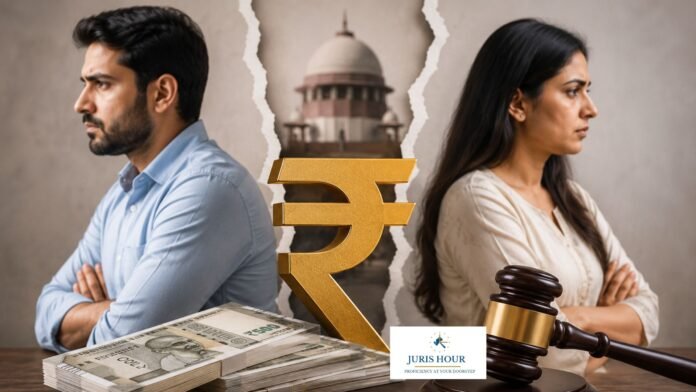
The Supreme Court has exercised its extraordinary powers under Article 142 of the Constitution to dissolve a marriage on the ground of “irretrievable breakdown of marriage” despite the wife opposing the grant of divorce through mutual consent proceedings and granted permanent alimony of Rs. 50 lakh to the wife and ordered closure of all pending civil and criminal proceedings between the parties.
The Bench of Justice Vikram Nath and Justice Sandeep Mehta has observed that the marriage had irretrievably broken down and existed “only on paper.” The parties had been living separately for more than eight years and had initiated numerous civil and criminal proceedings against each other. It held that compelling the parties to continue in such a marriage would serve no useful purpose.
The parties were married on 19 April 2017 according to Hindu rites and ceremonies. The husband is an officer in the Indian Army, while the wife is a qualified dental surgeon. Marital discord soon emerged, with the wife alleging adultery on the part of the husband and eventually leaving the matrimonial home.
Thereafter, multiple proceedings were initiated between the parties. The wife sought maintenance under Section 90(i) of the Army Act, 1950, following which deductions were made from the husband’s salary until September 2019. She also filed proceedings under the Protection of Women from Domestic Violence Act, 2005 and lodged a criminal complaint before the Mahila Thana in Noida. Later, she instituted proceedings under Section 125 of the Code of Criminal Procedure seeking maintenance before the Family Court at Gautam Budha Nagar.
During mediation proceedings before the Mahila Thana, the parties entered into a settlement agreement on 21 February 2019. Under the settlement, both sides agreed to seek divorce by mutual consent, with the husband agreeing to pay ₹31 lakh as permanent alimony. The wife also agreed to withdraw the domestic violence and maintenance proceedings. Pursuant to the settlement, ₹10 lakh was initially paid to the wife and disputes relating to jewellery and other articles were resolved.
Subsequently, an ex parte maintenance order directing payment of ₹30,000 per month was passed against the husband under Section 125 CrPC. The husband later sought recall of that order. According to the husband, the settlement amount was later verbally renegotiated and increased to ₹32 lakh. The first motion petition for mutual consent divorce was filed on 2 January 2020, at which stage another ₹10 lakh was paid. However, the wife did not proceed with the second motion petition, resulting in disposal of the mutual consent proceedings after expiry of the statutory period.
The Allahabad High Court upheld the Family Court’s decision, observing that mutual consent divorce could not be granted because the wife had withdrawn consent at the second motion stage. The High Court also directed that the ₹20 lakh already received by the wife be adjusted against maintenance arrears payable under the Army Act and Rules.
Before the Supreme Court, the husband argued that the marriage had completely broken down and there was no possibility of reconciliation. He urged the Court to invoke Article 142 to dissolve the marriage and grant finality to all disputes. He also reiterated willingness to pay ₹32 lakh as permanent alimony.
The wife, however, opposed dissolution of marriage through Article 142 and stated that she intended to pursue a contested divorce petition under Section 13(1)(i) of the Hindu Marriage Act on the ground of adultery. She argued that the husband should not be allowed to take advantage of his own alleged misconduct.
The Bench further emphasised that while granting divorce under Article 142, it was necessary to ensure a comprehensive and final settlement of all claims arising out of the matrimonial relationship. Although the parties had earlier agreed on ₹32 lakh as permanent alimony, the Court found it appropriate to enhance the amount considering factors such as the earning capacities of both parties, their standard of living, duration of marriage, long separation, and the wife’s future financial security.
The Court therefore fixed ₹50 lakh as one-time permanent alimony in full and final settlement of all present and future claims. It clarified that after payment of the said amount, no further maintenance claims would survive under Section 125 CrPC or the Army Act and Rules.
The amount is to be paid in two instalments — ₹25 lakh on or before 15 June 2026 and the remaining ₹25 lakh on or before 15 September 2026.
The Supreme Court also directed closure of all pending proceedings between the parties, including the domestic violence complaint, maintenance proceedings under Section 125 CrPC, applications under Section 128 CrPC, and contempt proceedings pending before various courts.
Accordingly, the appeal was disposed of with a direction to draw up a decree of divorce upon proof of payment of the permanent alimony amount.
Case Details
Case Title: Salil Dhawan Versus Priyanshi Ghai
Citation: JURISHOUR-1453-SC-2026
Case No.: SLP (C) No.971 of 2025
Date: 27/05/2026

