
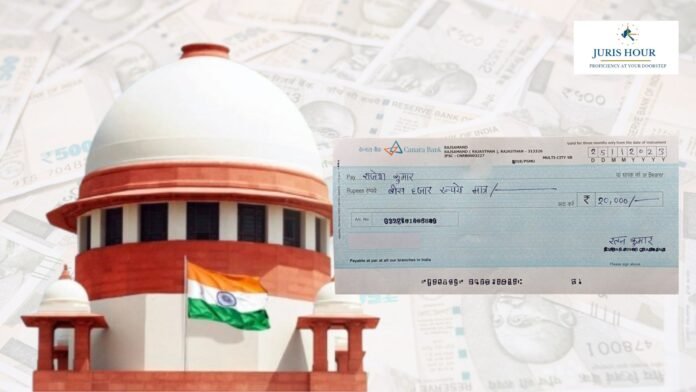
The Supreme Court has held that office bearers of a company or society can be prosecuted under Sections 138 and 141 of the Negotiable Instruments Act, 1881, if there is prima facie material showing their involvement in the underlying financial transactions leading to issuance of a dishonoured cheque.
The bench of Justice Prashant Kumar Mishra and Justice N.V. Anjaria reiterated that mere designation or status as an office bearer, without any specific role or factual connection to the transaction, is insufficient to impose vicarious criminal liability.
The ruling came in an appeal filed by Mansi Finance (Chennai) Ltd. challenging a Madras High Court order that had quashed criminal proceedings against certain office bearers of a registered educational society. The proceedings had arisen from a complaint under Sections 138 and 141 of the Negotiable Instruments Act relating to dishonour of a cheque issued towards repayment of financial liabilities.
According to the facts recorded by the Court, the dispute originated from a series of financial transactions undertaken in July 2018. The finance company alleged that the educational society, through its office bearers, had borrowed an aggregate amount of ₹4.5 crore for development of the educational institution and business requirements. The amount was advanced through different tranches and was supported by various promissory notes.
The Court noted that a Memorandum of Understanding was subsequently executed between the parties formalising the borrowing arrangements and repayment terms. The agreement provided for repayment with interest at the rate of 30% per annum and made the amount repayable on demand.
The dispute intensified when a cheque amounting to ₹5.12 crore was issued towards discharge of the alleged liability and accrued interest. The cheque, however, was dishonoured upon presentation and returned with the endorsement “Account Blocked.” Thereafter, statutory demand notices were issued to the society and its office bearers. Since no payment was made despite service of notice, criminal proceedings were initiated.
The office bearers approached the Madras High Court seeking quashing of the proceedings under Section 482 of the Code of Criminal Procedure. Their primary argument was that they were neither signatories to the cheque nor responsible for the day-to-day management of the society and that the complaint merely contained broad and omnibus allegations without satisfying the requirements of Section 141 of the NI Act.
The High Court accepted these submissions and held that prosecution against persons other than the drawer or cheque signatory could continue only where the complaint specifically established that such persons were in charge of and responsible for the conduct of the entity’s affairs. It concluded that the allegations lacked the required specificity and quashed the proceedings.
Examining the legal framework, the Supreme Court revisited earlier landmark judgments including S.M.S. Pharmaceuticals Ltd. v. Neeta Bhalla and National Small Industries Corporation Ltd. v. Harmeet Singh Paintal. The Court reiterated that Section 141 creates vicarious criminal liability and therefore must be strictly construed. It observed that criminal liability cannot automatically arise merely because an individual occupies a position in an organisation. Specific factual allegations are required to show how and in what manner such person was responsible for conduct of the entity’s affairs.
At the same time, the Supreme Court clarified that complaints should not be assessed through a hyper-technical lens. It noted that while mechanical reproduction of statutory language is inadequate, the complaint must be read as a whole and examined for substantive factual foundations rather than merely formal wording.
Applying these principles to the facts of the case, the Court found that three respondents stood on a different footing because documentary materials indicated their active participation in the financial transactions. The Court observed that certain office bearers had signed promissory notes, participated in the Memorandum of Understanding, and were connected with documents forming the basis of the debt transaction. These circumstances, according to the Court, created sufficient foundational material to continue criminal prosecution against them.
However, in relation to one respondent who was merely described as an Executive Member, the Court found no material linking him with the disputed transaction. No promissory note, cheque, memorandum, or other financial document carried his signature or otherwise showed his participation. The Court held that his position alone could not justify prosecution.
The Supreme Court accordingly partly allowed the appeal. It restored the complaint proceedings against three respondents while upholding the quashing order concerning the Executive Member. The Court further clarified that its observations were confined to determining whether sufficient foundational material existed for continuation of prosecution and should not be treated as a finding on the merits of the allegations.
Case Details
Case Title: M/S Mansi Finance (Chennai) Ltd. Versus M. Lalitha And Others
Citation: JURISHOUR-1406-SC-2026
Case No.: Criminal Appeal No. 2849 Of 2026
Date: MAY 26, 2026
Read More: JURISHOUR | TAX LAW DAILY BULLETIN : 26 May, 2026

