
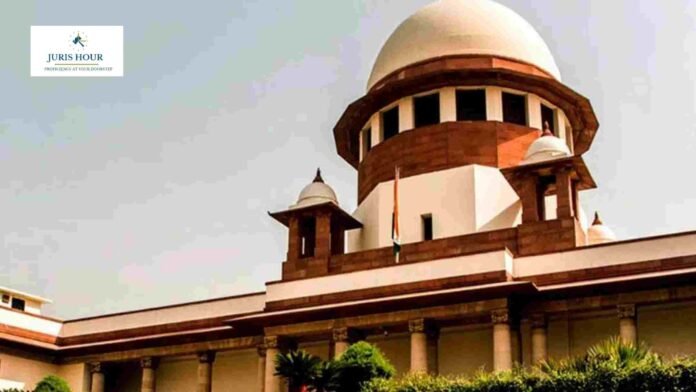
The Supreme Court has ruled that the heinous nature of an offence by itself cannot be the sole ground to deny remission or premature release to a convict, emphasizing that the criminal justice system must remain guided by reformative principles rather than perpetual punishment.
The bench of Justice B.V. Nagarathna and Justice Ujjal Bhuyan quashed a Ministry of Home Affairs (MHA) communication rejecting the premature release plea of Rohit Chaturvedi, holding that the rejection was a cryptic and non-speaking order lacking any reasoned basis.
The writ petition was filed by Rohit Chaturvedi, who had sought quashing of an MHA letter dated July 9, 2025. The letter had rejected the recommendation of the State of Uttarakhand and refused premature release despite the petitioner having spent nearly twenty-two years in prison.
The matter has had a long procedural history. The petitioner had been convicted in connection with a murder case initially registered in Uttar Pradesh in 2003 and later transferred to the CBI for investigation. The trial itself had been shifted by the Supreme Court from Uttar Pradesh to Uttarakhand. Following conviction under Sections 120B and 302 of the Indian Penal Code, the petitioner was sentenced to life imprisonment. Appeals before the High Court and the Supreme Court had earlier failed.
The controversy before the Court eventually centered not on conviction but on the petitioner’s claim for remission and premature release. During the course of proceedings, the State of Uttarakhand had recommended his release after evaluating his conduct and incarceration history. However, since the matter involved a CBI investigation, concurrence from the Central Government became necessary under the provisions of the Bharatiya Nagarik Suraksha Sanhita (BNSS). The MHA thereafter refused to concur with the State’s recommendation.
The Supreme Court found serious defects in the manner in which the MHA had exercised its authority. The bench noted that the communication merely stated that relevant materials had been considered and that the competent authority did not concur with the proposal for premature release, without indicating any reasons for such disagreement.
The Court stressed that any decision affecting a person’s liberty must be supported by reasons. According to the Court, recording reasons is not a ritualistic requirement but a safeguard against arbitrariness and a means of ensuring fairness, transparency and accountability in executive decision-making. The judges observed that absence of reasons deprives constitutional courts of the ability to conduct meaningful judicial review.
The bench further held that executive discretion in remission matters cannot be exercised in an unstructured manner and must rest on relevant, rational and non-discriminatory considerations. The Court referred to earlier decisions including Laxman Naskar v. State of West Bengal, where parameters governing remission such as future possibility of criminal conduct, rehabilitation, usefulness of continued incarceration and family circumstances had been identified.
Significantly, the Court rejected the Union Government’s reliance on the seriousness of the offence as the principal reason for refusing remission. It observed that the gravity of the crime is already taken into account during sentencing and cannot become a perpetual barrier against future consideration for release.
In an important observation on criminal jurisprudence, the Court stated that remission is not an extension of sentencing but a separate executive exercise aimed at evaluating a prisoner’s present conduct, reform and capacity for social reintegration. It observed that a criminal justice system which refuses to look beyond the offender’s worst act would abandon its reformative ideals.
The judgment also drew from philosophical principles of punishment and reform. Referring to Plato, the Court observed that punishment should not operate as an instrument of vengeance but should seek prevention, reform and restoration. Continued incarceration, where the reformative objective has already been achieved, would amount to punishment for its own sake rather than for any legitimate correctional purpose.
While evaluating the petitioner’s entitlement to remission on merits, the Court took note of several significant factors. It recorded that Uttarakhand had recommended his premature release after considering his conduct and incarceration record, that he had already spent more than twenty-two years in custody, and that his prison conduct had been certified as good.
The Court also considered the issue of parity. One of the co-accused, Amarmani Tripathi, had already been granted premature release after undergoing a shorter period of incarceration. The bench held that where a co-accused in the same case had been released, denying similar treatment would require cogent and rational distinguishing reasons. Since no such reasons were available, differential treatment would offend constitutional principles of fairness and non-arbitrariness.
Concluding that continued imprisonment would defeat the reformative purpose of remission policies, the Supreme Court quashed the MHA letter and held the petitioner entitled to premature release. Since he had already been granted interim bail during the pendency of proceedings, the Court directed that his surrender would not be required and that he should be treated as having been prematurely released in terms of the judgment.
Case Details
Case Title: Rohit Chaturvedi Versus State Of Uttarakhand & Others
Citation: JURISHOUR-1368-SC-2026
Case No.: Writ Petition (Criminal) No.446 Of 2023
Date: 15/05/2026

