
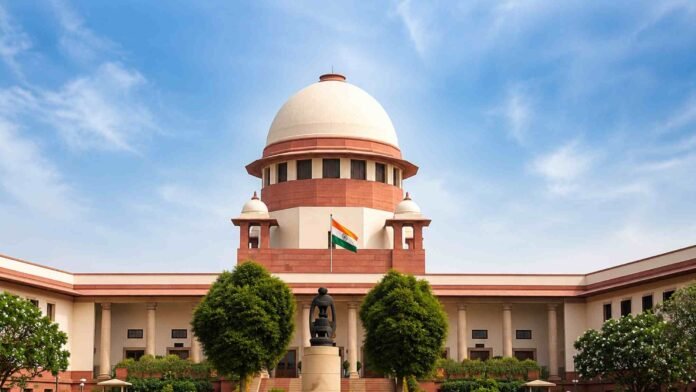
The Supreme Court has held that the Visitor of the Rajiv Gandhi National Aviation University (RGNAU), namely the President of India, was competent to exercise disciplinary authority against the First Registrar of the University and terminate his services. While disagreeing with the Allahabad High Court’s conclusion that the Visitor had no role in disciplinary proceedings, the Court ultimately refrained from disturbing the operative relief already granted due to the peculiar facts and prolonged litigation history of the case.
The bench of Justice Pamidighantam Sri Narasimha and Justice Alok Aradhe observed that transitional provisions are intended to address temporary situations during the establishment of institutions and that such provisions become exhausted after serving their purpose. However, the Court emphasized that the power of appointment also carries with it incidental authority over disciplinary matters.
The judgment arose from appeals filed by the Vice Chancellor of Rajiv Gandhi National Aviation University and the Union Government against an order of the Allahabad High Court’s Lucknow Bench. The High Court had earlier held that the Ministry of Civil Aviation (MOCA) lacked authority to initiate disciplinary action against the First Registrar and had consequently set aside the termination order.
The Rajiv Gandhi National Aviation University was established under the Rajiv Gandhi National Aviation University Act, 2013 for promoting aviation studies and related fields. The First Registrar had been appointed pursuant to the transitional provisions under the Act after the President of India, acting as Visitor of the University, approved the appointment in February 2019. The Registrar formally assumed charge in April 2019.
However, during the probation period, his services were terminated in January 2020 with one month’s salary in lieu of notice. The First Registrar challenged the action before the High Court. A Single Judge directed reinstatement with consequential benefits. Subsequently, a Division Bench held that the original termination order was stigmatic and remanded the matter to the University for fresh proceedings in accordance with law.
Following reinstatement on 31 December 2021, the First Registrar was immediately placed under suspension in contemplation of disciplinary proceedings. A charge memorandum was issued, and a three-member inquiry committee was constituted. The committee later found allegations relating to indiscipline, gross insubordination, unprofessional conduct, and obstruction of public servants in discharge of official duties to be established. Thereafter, the proposal was sent through the Ministry of Civil Aviation and approved by the Visitor, leading to a fresh termination order in April 2022.
The Allahabad High Court Division Bench had taken the view that officers of the Ministry of Civil Aviation had undertaken the entire disciplinary exercise despite not having any statutory role under the Act or Statutes governing the University. It held that the Visitor lacked disciplinary authority over employees of the University and consequently declared the proceedings without jurisdiction. The High Court also awarded back wages up to April 2022.
The Supreme Court extensively examined the statutory framework of the University Act. It noted that Section 46 of the Act created transitional arrangements for initial appointments in the University. Under Section 46(b), the first Registrar and first Finance Officer were specifically to be appointed by the Visitor on recommendation of the Vice-Chancellor.
Referring to Section 16 of the General Clauses Act, 1897, the Court reiterated the principle that where a statute confers power to appoint, it ordinarily also confers the power to suspend or dismiss the appointee unless a contrary intention appears in the legislation.
The Supreme Court observed that the case involved not a regular Registrar but the “First Registrar,” whose appointment arose from special transitional provisions under Section 46 of the Act. Therefore, since the Visitor had acted as the appointing authority, the Visitor also possessed disciplinary authority.
The Court further noted that the First Registrar’s tenure under Section 46 had itself expired on 28 February 2022 and that the termination action undertaken by the Visitor was consistent with Statute 28 governing removal of employees.
The Bench specifically held that the High Court was incorrect in concluding that the Visitor had no role in disciplinary proceedings against the First Registrar.
The Supreme Court chose not to interfere with the operative directions already granted, taking into account the expiry of the Registrar’s tenure and the repeated rounds of litigation between the parties. Consequently, the appeals were disposed of without any order as to costs.
Case Details
Case Title: Vice Chancellor Versus Jitendra Singh & Ors.
Citation: JURISHOUR-1337-SC-2026
Case No.: SLP (C) NO. 16265 OF 2024
Date: 21/05/2026
Read More: Pending NCLAT Appeals Bar Relocation Under Companies Rules: Calcutta High Court

